

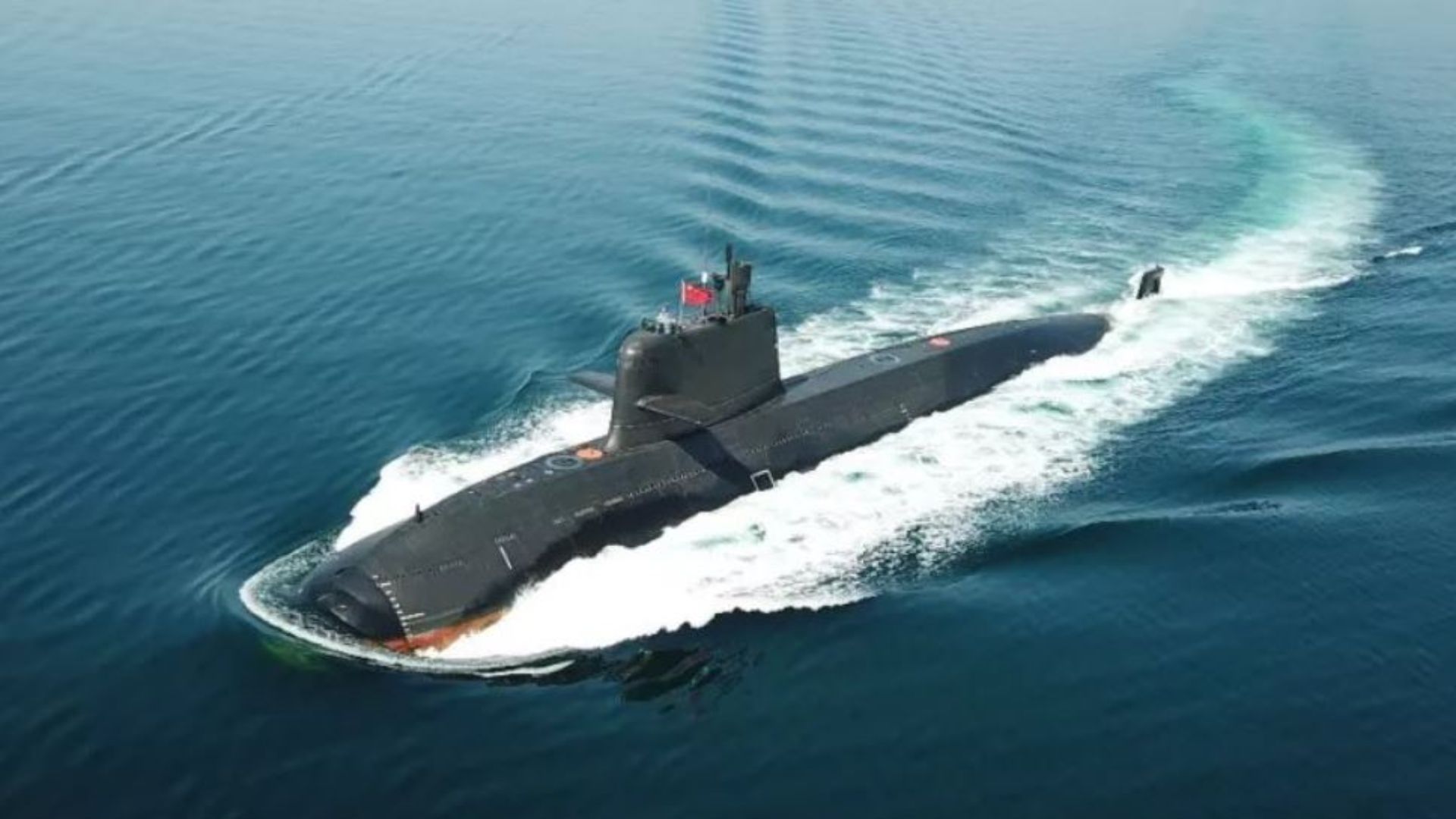
In the latest episode of Defence Uncut, Bilal Khan and Arslan Khan break down two weeks of major developments across the Pakistan Armed Forces – from the commissioning of the Pakistan Navy’s first Hangor-class AIP submarine, to the Pakistan Army’s accelerating pivot towards precision fire and precision strike capabilities, the Army Rocket Force Command’s first training launch of the Fatah-II guided missile, and the completion of Pakistan’s electro-optical satellite constellation with the PRSC-EO3 launch.
The discussion also includes a retrospective on the Pakistan Navy’s surface fleet, the recent SMASH anti-ship ballistic missile test from a Babur-class corvette, the Taimoor anti-ship cruise missile test, and a wider conversation about where Pakistan’s munitions industry is heading in a shifting global order.
Listen to the full episode on YouTube or your favourite podcast platform.
PNS/M Hangor: Pakistan Navy Commissions Its First Hangor-Class AIP Submarine
The headline development is the commissioning of PNS/M Hangor, the lead boat of the Hangor-class (S26) submarine program – a derivative of China’s Yuan-class (Type 039B) platform equipped with a Stirling-cycle air-independent propulsion (AIP) system. The program, which dates back to a contract signed around 2015 for eight submarines, was one of the Pakistan Navy’s most tightly held procurement efforts – to the point where, as Arslan notes, many observers had questioned whether it would materialize at all following the collapse of the earlier Type 214 deal with Germany’s ThyssenKrupp Marine Systems (TKMS).
That earlier program, valued at approximately 1.2 to 1.3 billion euros, fell apart between 2009 and 2010 due to a convergence of Pakistan’s fiscal crisis, the fallout of the Great Recession, and Germany’s reluctance to extend financing. Bilal traces the subsequent pivot to China – initially for six, then revised to eight S26 submarines – and the technical trade-offs involved, particularly around the AIP architecture. The Stirling-cycle system introduces more dynamic moving parts than the fuel-cell AIP that would have accompanied the Type 214, creating a potential acoustic exposure risk in the warmer waters of the Arabian Sea. However, the Hangor’s double-hull design appears to compensate for this through improved acoustic control.
Of the eight boats on order, four are being built at Wuchang Shipyard in China – all are reportedly in the final stages of handover, with sea trials underway – while the remaining four are to be constructed at Karachi Shipyard and Engineering Works (KSEW). Progress on the Pakistani-built boats has been slower, a recurring consequence of funding constraints. However, once complete, the Hangor fleet will more than triple the Pakistan Navy’s AIP-equipped submarine force from three Agosta 90B boats to eleven platforms in total.
The episode explores the strategic rationale behind the Hangor-class. Unlike the smaller coastal-defence submarines the Pakistan Navy has historically operated, the Hangor-class is designed for forward-deployed, long-endurance operations – covering sea lines of communication across the Arabian Sea, operating towards the Gulf, and extending the Pakistan Navy’s coverage net into the broader Indian Ocean region. The Pakistan Navy’s dual-submarine strategy envisions the Hangor fleet handling deep-water offensive roles while a forthcoming shallow-water attack submarine (SWATS) program – potentially based on Italy’s Fincantieri S800 platform – addresses the coastal anti-access/area-denial (A2/AD) layer.
Pakistan Navy Surface Fleet: The Armament Debate Around the Babur-Class and Jinnah-Class
The episode devotes significant time to the ongoing criticism around the armament configuration of the Pakistan Navy’s newer surface combatants – specifically the Babur-class corvettes (modified Ada-class MILGEM from Turkiye) and the forthcoming Jinnah-class frigates.
Arslan unpacks the supply-side constraints that have shaped these ships’ weapons fit. The vertical launch system (VLS) options available to the Pakistan Navy were severely limited: the Mark 41/EXLS family was not exportable to Pakistan, France’s SYLVER was unavailable, and the Turkish MIDLAS system was not ready at the time of design. The only viable option was the Chinese AJK-16 cold-launch cell – a single-missile-per-cell system that constrains the total missile load without significant hull modifications. Adding more VLS cells would require lengthening the hull, triggering design changes and cost increases the Pakistan Navy could not absorb.
On the anti-ship missile question, Arslan raises a more pointed concern: the equipping of SMASH – the navalized Fatah-II anti-ship ballistic missile – on surface combatants. The SMASH, derived from the same Fatah-II core platform used by the Army, is significantly heavier than conventional anti-ship cruise missiles like the C-802. Drawing parallels with the Type 054A/P’s four CM-302 supersonic missiles – where the weight differential limited the load to half that of the C-802 configuration – Arslan suggests the Babur-class may end up carrying very few SMASH rounds, potentially as few as four.
Bilal suggests the Pakistan Navy’s approach to ship-launched anti-ship ballistic missiles might be better suited to shore-based coastal defence batteries rather than surface combatants. He also points to the emerging Rasoob 250 program – a lightweight, stealthy cruise missile analogous to the Naval Strike Missile (NSM) – as a potentially more appropriate fit for the Jinnah-class frigate’s midlife configuration, offering 12 to 16 rounds in a form factor the ship can sustain. The broader argument is that Pakistan’s surface fleet has always been viewed primarily as a peacetime deterrence and diplomatic presence asset – not the centrepiece of wartime naval operations, which the Pakistan Navy has consistently reserved for its submarine force.
Naval Missile Tests: Taimoor Anti-Ship Variant and SMASH Certification
The Pakistan Navy conducted two notable missile tests in April 2026. The first was the Taimoor AS (anti-ship), a derivative of the Ra’ad air-launched cruise missile adapted for surface-launched anti-ship operations. Arslan notes that by stripping out the expensive navigation sensors required for strategic missions – such as digital scene-matching area correlation (DSMAC) cameras and terrain contour matching (TERCOM) systems – and relying instead on inertial navigation, satellite guidance, and a dedicated seeker, the Taimoor AS becomes a far more scalable and cost-effective conventional munition.
The second test was the SMASH anti-ship ballistic missile fired from a Babur-class corvette – the first certification launch from this class of ship. Previous similar tests had been conducted from F-22P frigates. The SMASH includes nose-mounted thrusters for terminal-phase manoeuvring – a modification not present on the standard Fatah-II – designed to defeat the close-in weapon systems and short-range air defences protecting surface targets.
The discussion also highlights what appears to be a phased retirement of the C-802 anti-ship missile from the Pakistan Navy’s inventory, with the Harbah NG, SMASH, and Taimoor family gradually replacing it across different platform classes. This reflects a broader pattern across the Pakistan Armed Forces of consolidating around domestically produced or co-produced munition families – separating strategic from conventional applications to unlock scalability and potentially open doors to international partnerships.
Pakistan Army’s Precision Fire and Precision Strike Doctrine Takes Shape
Perhaps the most detailed segment of the episode covers the Pakistan Army’s emerging integrated precision-fire and precision-strike capability – a convergence of guided munitions, digital fire control systems, battlefield management networks, and intelligence, surveillance, target acquisition, and reconnaissance (ISTAR) assets that Bilal argues constitutes a doctrinal shift.
The building blocks are now largely in place. At the munitions layer, the Nishana Precision Guided Kit (PGK) – developed by NESCOM – can retrofit INS/GNSS guidance onto legacy 105 mm to 155 mm artillery shells, mortar rounds, and Mark 80-series general-purpose bombs at an estimated cost of $10,000 to $15,000 per unit. The Tipu guided tank shell adds precision to the armoured corps. The Fatah-II and Fatah-IV provide medium-range ballistic and cruise missile strike options, while a growing portfolio of loitering munitions adds another layer of conventional attack capability.
At the fire control layer, digital fire control systems (DFCS) are now integrated into the SH-15 wheeled self-propelled howitzers, the Haider (VT-4) and Al-Khalid main battle tanks, and the Project P-251 artillery system. The recently revealed automated mortar launching system also carries a DFCS with network-connected command-and-control integration. Above these, the PAKFIRE artillery battlefield management system and the Rehobar armoured corps battlefield management system provide service-specific networking.
The missing piece – and the focus of Bilal’s analysis – is the integration layer that connects ISTAR feeds to firing platforms. The most recent Ministry of Defence Production (MoDP) report alludes to a prototype Integrated Battlefield Management System (IBFMS) developed by the Pakistan Army’s Directorate General Research and Development. This system would serve as a centralized data-ingestion and sensor-fusion engine – collecting targeting information from satellites, drones, radars, and passive emitters, and disseminating it to forward firing units in near real-time. The demand for such networking represents one of the Pakistan Army’s most significant capability gaps, and one that the MoDP report indicates is being actively addressed.
Fatah-II Training Launch: Army Rocket Force Command Signals Operational Readiness
The Army Rocket Force Command (ARFC) – formed in August 2025 following the India-Pakistan skirmish – conducted its first publicly acknowledged training launch of the Fatah-II in late April 2026. The framing as a training exercise, rather than a developmental test, signals that the Fatah-II has transitioned from testing to operational deployment within the ARFC’s inventory.
The Fatah-II is a 400 km-plus range supersonic guided missile with a 365 kg warhead and a stated circular error probable (CEP) of 50 metres or less – though, as Arslan notes, these figures reflect the GIDS export specification, and the Pakistani military variant likely differs. The common-core rocket platform that powers the Fatah-II also underpins the SMASH anti-ship ballistic missile and the Abdali strategic weapon system, with each variant carrying marginal modifications to the guidance suite, warhead, and thrust configuration for its specific application.
Bilal draws a parallel between NESCOM’s approach and Iran’s ballistic missile development strategy from the 2000s, where Tehran focused on iterating a single core platform through improvements in solid-fuel composition, aerodynamics, and casings to progressively extend range – rather than developing entirely new missile families in parallel. The implication for Pakistan is that the Fatah-II core could eventually give rise to longer-range variants as the underlying industrial capabilities mature, potentially including an air-launched derivative analogous to the CM-400AKG already in Pakistan Air Force service.
PRSC-EO3 Satellite Completes Pakistan’s Electro-Optical Constellation
The launch of SUPARCO’s PRSC-EO3 aboard a Chinese Long March rocket on 25 April 2026 completes Pakistan’s three-satellite electro-optical imaging constellation. Pakistan now operates five dedicated remote sensing satellites: three EO platforms (PRSC-EO1, EO2, EO3), one synthetic aperture radar satellite (PRSC-S1), and one hyperspectral satellite (PRSC-HS1) – forming what Quwa has previously described as a coordinated sensor triad where SAR detects changes, EO provides visual confirmation, and hyperspectral classifies material composition.
The EO3 carries three experimental systems: a multi-geometry imaging module for 3D terrain modelling – directly relevant to terrain contour matching for cruise missile guidance – advanced energy storage technology, and an onboard artificial intelligence processor for real-time data analysis and anomaly detection. This is the first PRSC satellite reported to carry an onboard AI capability, reducing the dependence on ground-based processing infrastructure.
The forthcoming $406 million PIESAT InSAR constellation deal will scale the SAR layer to up to 20 additional synthetic aperture radar satellites, potentially enabling near-hourly revisit rates. Bilal argues that the return on this investment hinges not just on the satellites themselves, but on Pakistan’s ability to develop the software infrastructure – the data-ingestion, processing, and dissemination stacks – needed to convert raw imaging intelligence into actionable targeting information for the Army’s precision-strike platforms. This is an area where SUPARCO and the National Aerospace Science and Technology Park (NASTP) could partner with the private sector and Chinese institutions to build sovereign capability.
The Bigger Picture: Industrial Consolidation, Global Market Shifts, and What Comes Next
A recurring theme across the episode is the convergence between Pakistan’s defence industry strategy and the shifting global industrial order. The consolidation of missile families around common core platforms – Fatah-II / SMASH / Abdali on the ballistic side, Harba / Babur / Taimoor on the cruise side – reflects an industrial logic driven by limited production capacity, where reusing a single common motor and standardizing subsystems is the only viable path to scaling conventional munitions stockpiles.
Bilal suggests that the erosion of US-led technology restriction regimes – accelerated by tariff disruptions, shifting alliance structures, and the growing role of Chinese industrial suppliers – may gradually create space for Pakistan to access critical inputs for supersonic and eventually hypersonic cruising missile programs. Turkey’s own ramjet development programs, including a RocketSan/TUBITAK partnership for a ramjet anti-ship missile, offer another potential avenue for cooperation given the strong relationship between the Pakistan Navy and Turkish defence vendors.
The episode closes with a forward-looking assessment: as the Pakistan Armed Forces invest heavily in satellite-based ISTAR, precision munitions, and battlefield networking, the critical next step is building the software and integration layer that connects these assets into a functioning kill chain. Whether that happens through state-owned entities alone or through a broader partnership with the private sector and international collaborators will likely determine how much of this investment translates into real operational advantage in the next five to ten years.
Listen to the Full Discussion
If you have any questions, comments, or news topic suggestions you would like to hear us discuss, then send us an email at [email protected].
