

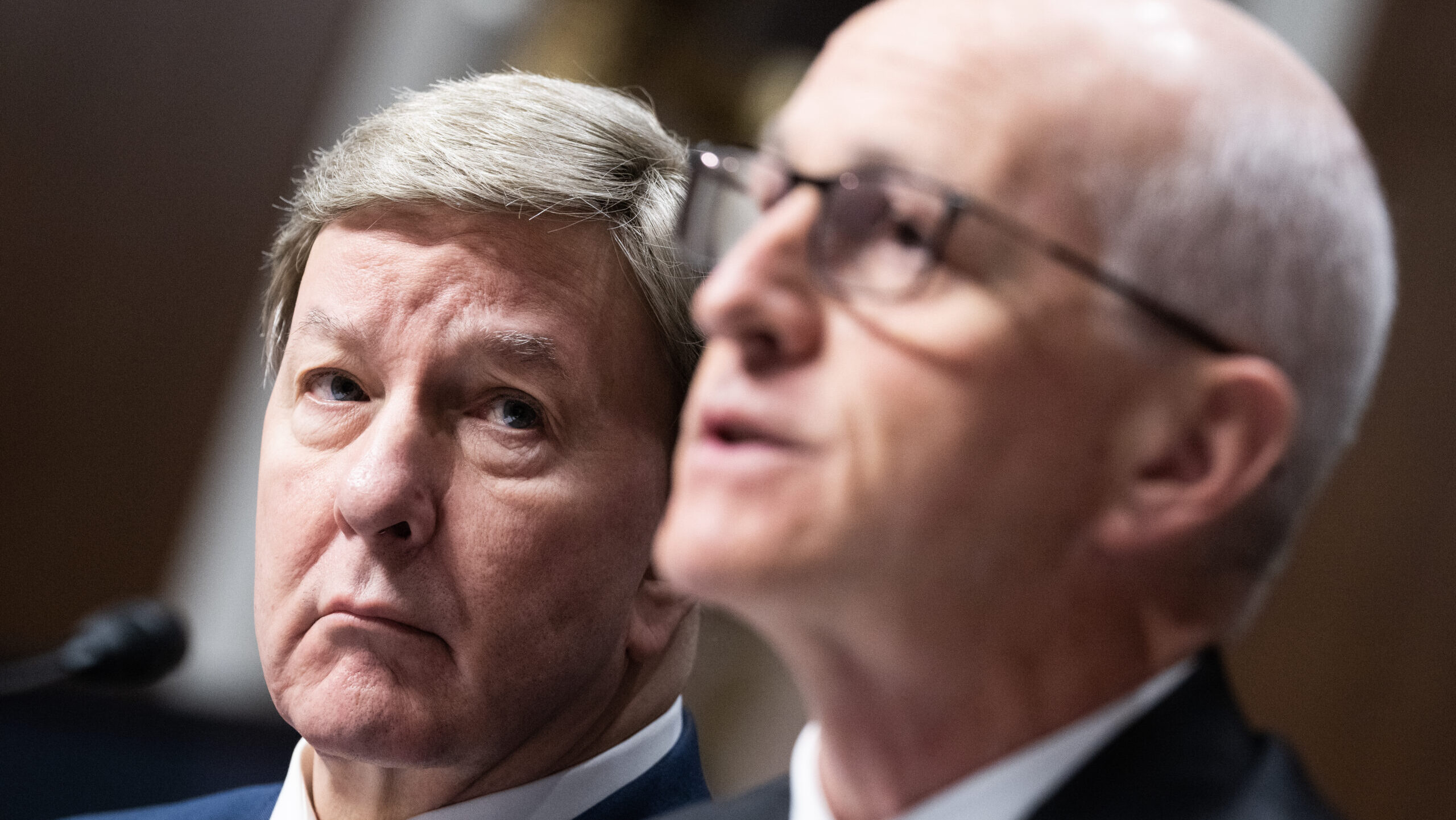
WASHINGTON — The House Armed Services Committee pushed through its version of the fiscal 2027 defense policy bill early Friday morning, adopting new “right to repair” provisions and adding $500 million for a second destroyer.
The panel adopted the FY27 National Defense Authorization Act in a 44-12 vote as the clock struck midnight, with Democrats making up all the of “no” votes.
Over the 14-hour markup, HASC members debated more than 900 amendments on topics spanning the war with Iran, the official name of the Defense Department, and Kid Rock.
While most measures either failed or succeeded on party lines, a “right to repair” amendment was one of the few points of the night where both Republicans and Democrats found common ground — while also being one of the most consequential moments for the defense industry.
The measure, offered by a bipartisan duo of Reps. Maggie Goodlander, D-N.H., and Pat Harrigan, R-N.C., would enable the Defense Department to obtain government purpose rights by default for “any technical data, computer software, or computer software” unless the contractor provides evidence that it needs to retain more restrictive intellectual property rights.
Senior Pentagon leaders such as Army Secretary Dan Driscoll have repeatedly made the case that they need additional authorities from Congress that undo the contractual restrictions that sometimes make it impossible for the military to repair its own equipment.
“What our bipartisan amendment does is to clarify and to create a clear set of rules, a default rule that will help to resolve disputes before they arise, that will streamline these processes, cut red tape, and close loopholes that have mired our military in endless challenges in trying to do some of the most basic things that we should be empowering our service members to do,” Goodlander said.
HASC Chairman Mike Rogers, R-Ala., said that the amendment would force companies to choose between protecting their IP and working with the Department of Defense, pointing to a list of industry groups such as the Aerospace Industries Association and National Defense Industrial Association who have voiced concerns with the measure.
“Many will choose to protect their IP,” he said.
Rep. Rob Wittman, R-Va., said that while he is theoretically supportive of right to repair legislation, this particular amendment would give the government “carte blanche” in accessing a contractor’s intellectual property, with no protections that would restrict the government from turning it over to a third party.
“This is going way farther than what we need to go to really pull this into where the government gets the IP that it needs,” he said.
Harrigan countered that the many of the amendment’s provisions would simply force the Defense Department to use the tools already at its disposal to obtain government purpose rights, and that it carves out exemptions for commercial items.
“This right to repair language in this amendment does not seize patents, it does not seize copyrights, it does not seize trade secrets. This private IP remains private,” Harrigan said.
Rep. Sara Jacobs, D-Calif., argued that American servicemembers’ lives could be put at stake if they are forced to wait for contractors’ permission to fix critical equipment.
“I’m not going to stand here and pretend I can out argue a contractor’s lawyer on the finer points of intellectual property, but I don’t need to, because the people who actually run this military have already told us what they need,” she said.
After about a half hour of debate, lawmakers voted to adopt the amendment in a voice vote.
More Money For Destroyers, ITEP
Like last year, many of the amendments centered on weapons programs — including some large changes in funding — received no debate at all. Instead, HASC opted to approve them en masse in large packages of amendments approved during the subcommittee portion of the mark up.
The Arleigh Burke-class destroyer was the biggest beneficiary, receiving a $500 million boost to help pay for a second ship in FY27. The amendment, from Rep. Jared Golden, D-Maine, would zap funds from submarine tenders, littoral combat ship modernization, and KC-46 tanker development in order to increase DDG-51 funds.
RELATED: Amendment to eliminate funds for Trump-class battleship falters in HASC defense bill markup
Another amendment, from Rep. Seth Moulton, D-Mass., would add $50 million to the Army’s Improved Turbine Engine Program (ITEP), bringing the total up to $100 million.
Hypersonic and counter-hypersonic testing was authorized to receive a $60 million increase over the levels initially spelled out in the HASC bill, with that funding transferred from the Navy’s account for unmanned surface vessels. Meanwhile, the Army would get an additional $62 million for autonomous resupply vessels through a reduction to KC-46 tanker development.
There were also many amendments concerning the A-10 Warthog following the Air Force’s announcement this budget cycle that it plans to retain some A-10s until 2030.
One amendment mandates that the Air Force stays true to its word to maintain the A-10 through 2030, while another provision would force the defense secretary to transfer A-10s retired by the Air Force to another service.
An additional amendment requires the Air Force to develop “a competitive experimentation plan for autonomous and non-traditional capabilities relevant to the A-10 mission set to encourage autonomous replacement and modernization of the A-10, while also prioritizing participation of non-traditional defense firms.”
Other provisions buried in the so-called “en bloc” amendment packages included:
- A requirement for the Pentagon to provide a quarterly report on munitions inventories;
- Authorization for the Missile Defense Agency “to develop and demonstrate an exoatmospheric interceptor capability to strengthen ballistic missile defense capacity and improve homeland defense architecture;”
- A prohibition from using funds authorized in the NDAA to purchase a warship from a foreign shipyard;
- A prohibition on retiring the E/A-18G Growler;
- A report on the Navy’s strategy to design and construct the BBG(X) battleship without interfering with existing nuclear-powered shipbuilding plans, specifically that of the Ford-class carrier;
- Briefings on low-cost air-to-air munitions for CCAs and transitioning F-35 sustainment to the military services by 2027;
- A brief by the Air Force on the feasibility, cost, timeline, and alternatives associated with restarting the C-17 production line; and
- A briefing on UH-60 modernization for the Army.
“No Freaking Difference”
Two of the most heated debates of the night centered around names.
In a 29-27 party line vote, Republicans adopted an amendment from Rep. Ronny Jackson, R-Texas, that would formally rename the Defense Department as the “Department of War.”
During remarks explaining his amendment, Jackson revealed a mock up of the department’s seal bearing the “Department of War” title.
“I think once I present this, and now that you can see firsthand how beautiful it actually is, you will have no choice to vote for this amendment,” Jackson said.
“Restoring the name Department of War sends an unmistakable signal to the world,” he said. “Potential adversaries like China, Russia, North Korea and Iran evaluate American resolve through both our capabilities and our messaging.”
Washington Rep. Adam Smith, the committee’s ranking Democrat, was less than enthused.
“I really think this is one of the dumbest things that has been done by this administration, and it doesn’t make any sense, but practically speaking, it makes no freaking difference whatsoever,” he said. “’The name itself strikes fear at the heart of our adversaries’ — I wish our adversaries were that stupid.”
Another amendment, offered by Rep. Marilyn Strickland, D-Wash., sought to restore the names of bases made by a congressionally charted commission that in 2022 rebranded bases named for Confederate leaders. (Defense Secretary Pete Hegseth has reverted bases to the original Confederate names.)
“My father fought in two wars, and he fought in a segregated army. So, when you talk about naming something after the Confederacy, you’re disrespecting him and every black man who wore the uniform,” she said. “So, I’m going to ask you one more time, who are we as a nation, and more importantly, who are you?”
Lawmakers voted 29-27 in favor of Strickland’s amendment, with two Republicans joining Democrats.
However, Democrat victories on amendments were scarce, with Republicans defeating measures that would have prohibited funds from being used for military operations in Iran or forced the Army to brief lawmakers on an incident where Apache helicopter pilots conducted a flyby of nu metal musician Kid Rock’s home.
Republicans also toppled several amendments offered by Democrats that would strengthen protections for media organizations who cover the Pentagon and for the military publication Stars and Stripes.
One amendment, offered by Jacobs, would have reversed press restrictions imposed by Hegseth, reinstating media credentials and allowing credentialed members of the press to have unescorted access to unclassified areas within the building.
Another, offered by Goodlander, would prohibit the department from using FY27 funds to shut down media access to the Pentagon or impose credentialling requirements that would force journalists to gain department authorization to gather and release information.
Although Rep. Don Bacon, R-Neb., joined Democrats to vote for the amendments’ adoption, both were defeated in a 27-28 vote.
