

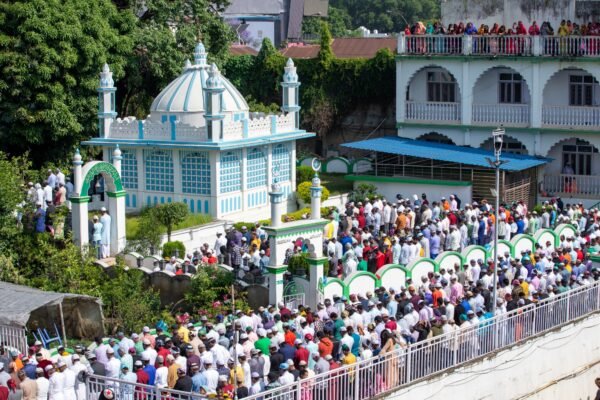
On the night of July 26, a Hindu procession was on its way back after collecting holy water from the Koshi River. The procession being taken out at Kaptanganj of Sunsari district in eastern Nepal was accompanied by loud music, to which some local Muslims objected. A scuffle broke out. Police got involved.
Hindu-Muslim tensions soon spread across Nepal’s Tarai-Madhesh belt, the east-west strip of land abutting India. In ensuing clashes between protesters and the police, four people died while curfews disrupted life across the region.
Such incidents follow a recognizable pattern. One newspaper investigation identified 17 Hindu-Muslim documented clashes over the past decade – with around two-thirds of them involving religious processions or idol immersions. The number of undocumented cases is undoubtedly higher.
The History
Over the past decade or so the influx of Hindutva ideas from India has been steadily stoking Hindu-Muslim tensions. Before that, these communities had mostly lived in harmony in a country where over 80 percent of people are Hindus. Muslims, by contrast, make up just 5 percent of the national population. But seldom did this small religious minority feel persecuted. After the recent devastating floods, the coming together of people from different faiths to help and pray for victims offered a glimpse of the inter-faith harmony Nepal has long been known for.
For most of its modern history, Nepal has been a de facto Hindu state. Prithvi Narayan Shah, the 18th-century founder of modern Nepal, famously described his kingdom as Asal Hindustan, or the “real Hindustan.” He wanted to build “a true home for Hindus” at a time when much of the Indian subcontinent was under Muslim rule.
The 1962 constitution promulgated by King Mahendra was the first to officially declare Nepal as a Hindu kingdom, with the divine monarch as its protector. After this, the 1990 charter introduced following a popular movement heralded a constitutional monarchy but kept the Hindu state characterization.
Things would drastically change in 2006 following the end of the decade-long Maoist insurgency and the second people’s movement. The interim constitution promulgated a year later held in abeyance the institution of the monarchy – which was later abolished by the first meeting of the Constituent Assembly – and formally declared Nepal a secular state.
Yet with the Maoists losing electoral ground in the second Constituent Assembly election in 2013, conservative forces began to reassert themselves. This is why the new (and currently operative) constitution promulgated in 2015 gave continuity to Nepal’s secular designation but added a rider: Nepali secularism would entail the “protection of religion and culture being practiced since ancient times.”
As the new charter was being finalized, the country’s secularism debate was also being closely watched in India. Hindu nationalist politicians and organizations there were openly lobbying for the restoration of Nepal’s Hindu status.
Narendra Modi’s election as Indian prime minister in 2014 had given the cause an added impetus. But the new Bharatiya Janata Party (BJP) establishment in New Delhi wouldn’t get its way.
It was partly because Nepal’s secular status was retained in the 2015 charter that India imposed a crippling, four-and-a-half-month-long blockade on the land-locked country.
As Nepal was struggling to finalize its constitution and consolidate its status as a secular republic, Hindu nationalist politics was becoming dominant across its southern border. Hindutva ideas, symbols, and organizations started making greater inroads into Nepal.
For and Against a Hindu State
Hindutva is a right-wing ideology that seeks to organize all Hindus as a political community. It portrays Hindu civilization as coming under threat from other religions like Islam and Christianity whose origins lie outside India.
There are compelling arguments for why a wholesale import of Hindutva is unlikely in Nepal.
Richard Bownas, a scholar who has been closely following Hindu politics in Nepal, argued that the kind of “actionable package” that makes mass Hindu mobilization for political ends so effective in India is absent in Nepal. For instance, Nepal has only around 250 active shakhas of the Hindu Swayamsevak Sangh (HSS), an offshoot of the Rastriya Swayamsevak Sangh (RSS), the Hindu nationalist volunteer paramilitary organization closely associated with the BJP.
The HSS has made rapid inroads into Nepal. Still, the country has just one shakha for every 120,000 people, in comparison to one for 17,000 people in India. Nepal’s heterogeneous religious landscape as well as the lack of religious zealotry of its political leadership, Bownas argued, also prevent Hindutva from exerting the same kind of influence.
But with ideological politics taking a backseat and populists now running Nepal, there is a distinct possibility of a greater embrace of religion as a political tool by ruling and opposition parties alike. Early signs are that the government of Balendra Shah formed after the 2025 Gen Z uprising and March 2026 elections is partial to Hinduism.
The new prime minister’s inauguration ceremony was steeped in Hindu Vedic rituals, making people of other faiths suspect the credentials of the head of government of a secular state. Even the recent ceremony to mark the first anniversary of the Gen Z protests drew controversy over the presence of certain Hindu religious leaders.
The ruling ideology-lite Rastriya Swatantra Party (RSP), it appears, will find the allure of Hinduism as a political weapon hard to resist.
The top leaders of more established political parties, which were trounced in the March 2026 general elections, also see religion as perhaps the only tool that can pave the way for their unlikely comeback.
Sher Bahadur Deuba, five-time prime minister and long-time leader of the Nepali Congress, traditionally the country’s biggest democratic force, has of late been openly flaunting his Hindu identity and emphasizing the country’s Hindu roots. Until now the committed secularist had been resisting the call of a vocal Congress faction to lobby for the restoration of the Hindu state.
K.P. Sharma Oli, the three-time prime minister and current chair of the Communist Party of Nepal-Unified Marxist-Leninist (CPN-UML), the country’s biggest communist outfit, has been courting Nepali Hindus for much longer. Among his infamous anti-India post-blockade pitches was the claim that Ram, a central deity in Hindutva mobilization, was born in Thori of Nepal rather than across the border in Ayodhya of India.
It is becoming clear that as older ideological distinctions like social democracy, communism, monarchy, and regionalism lose their mobilization power, religion is increasingly likely to fill the vacuum.
Two trends make the present moment different: the weakening of Nepal’s older political identities and the ready availability of a Hindu nationalist vocabulary from across the border.
In order to reshape Nepali politics, Hindutva does not have to look exactly the same as it does in India. Local politicians can borrow its symbols, grievances, and methods of mobilization and adapt them to their political circumstances.
That process is especially salient in the Tarai-Madhesh belt.
Saffronization of the Plains
For decades, political mobilization in Nepal’s plains – which constitutes less than 25 percent of the country’s landmass but is home to over 50 percent of its people – revolved around caste, regional exclusion, identity, and demands for representation within the Nepali state. This was especially true of Madhesh Province, the epicenter of Madheshi identity politics.
With the RSP sweeping the last general elections – winning 30 of 32 seats in the province – traditional Madheshi parties have been greatly weakened.
The erosion of ideological and regional loyalties, as has been seen in Madhesh, has prompted local politicians to try to regain their influence by presenting themselves as defenders of the “Hindu community” or “Muslim community.” This was also evident in the aftermath of the Kaptanganj clashes.
More broadly, the rise of the BJP in India, culminating symbolically in the inauguration of the Ram Mandir in Ayodhya in 2024, has coincided with more conspicuous and competitive displays of religious identity in Nepal.
Saffron pennants are increasingly visible on Hindu homes and neighborhoods in the Tarai-Madhesh – thanks in part to sustained activism of the HSS foot soldiers who encourage such displays of Hindu religiosity. Green religious flags are similarly displayed by Muslims. Religious processions are often larger, louder, and more assertive.
Before the July 26 incident, the local Hindu community in Kaptanganj was apparently unhappy because some of the green pennants planted during the Muslim festival of Muharram a month before were not uprooted at the festival’s end. Once a procession or flag is interpreted as demonstrating which community controls a road, neighborhood, or public space, minor disputes can take on existential significance.
The Tarai-Madhesh is vulnerable to the allure of Hindutva also because of geography. Nepal and India share an open border and the neighboring Indian states of Bihar and Uttar Pradesh are the heartlands of Hindu nationalist politics. Communities on the two sides have “roti-beti relations” as they are tied together by marriage, trade, pilgrimage, language, and culture.
Political ideas thus cross the border as easily as people do. This also makes it easy for organizations like the RSS – whose ideology Indian historian Ram Chandra Guha distilled as “We will show Muslims their place” – to operate in the belt.
The Corrosive Effects of Social Media
Social media has dramatically accelerated religious polarization.
Many participants in the Kaptanganj protests had hurried to the incident site after seeing provocative videos and messages on their mobile phones. Instant social media amplification then spread the clashes across the Tarai-Madhesh belt.
In the past, an argument over a flag or procession in one Tarai village would remain confined there. Local party representatives, elders, and community leaders would intervene before an argument acquired a wider communal character. Increasingly, the mediators themselves arrive as representatives of religious constituencies.
This in turn can contribute to polarization along religious lines. Once members of a religion feel politically or physically insecure, they have an incentive to mobilize on the basis of their religion.
Today, audio and video footage of a communal clash can spread across Nepal and among the diaspora communities around the world within minutes.
Videos are often stripped of context and accompanied by inflammatory claims. Hindu and Muslim influencers circulate clips portraying their respective communities as victims. Old footage can be rehashed as evidence of new attacks.
Social media changes the geographical scale of communal tensions. A local dispute between neighbors becomes an event in a much larger Hindu-Muslim struggle. That makes traditional local mediation much more difficult.
Radicalization and Demographic Fear
The emerging Hindu nationalist narrative in the Tarai-Madhesh is anti-Muslim. Yet the larger national narrative is of Hindu demographic and cultural vulnerability.
Christianity is another focus of Hindu mobilization (although this is more of an issue up in the hilly regions than down in the Tarai plains). Royalist and Hindu nationalist groups frequently claim that aggressive Christian proselytization, backed by foreign money, is eroding Nepal’s traditional culture. Opposition to conversion has consequently become intertwined with campaigns to restore Hindu statehood.
Supporters of Hindu political mobilization argue that secularism was surreptitiously introduced during Nepal’s turbulent political transition without a popular mandate. They point to Christian conversion, greater activity of foreign-funded religious organizations, and “Islamist radicalization” as the unwanted consequences. Restoring Nepal’s Hindu identity, they believe, would protect rather than divide society.
The debate over Nepal’s religious identity predates Modi and the recent communal clashes. Even the constitution reflects that unresolved tension by simultaneously declaring Nepal secular and promising protection for religions and cultures practiced since ancient times.
Hindu nationalist narratives also increasingly portray Nepal’s Hindu majority as endangered. Some YouTubers and news channels have attributed recent communal disturbances to Rohingya Muslim refugees allegedly entering Nepal from Bangladesh.
But the vast majority of Nepal’s Muslims are not a recently arrived population – nor has their presence caused any problem for much of Nepal’s modern history. They are established Nepali communities, overwhelmingly concentrated in the Tarai, often speaking the same languages and participating in the same local economies as their Hindu neighbors.
Some of these concerns deserve factual scrutiny. Religious radicalization and illicit foreign financing should not be ignored wherever credible evidence exists. Nepali laws ban forced conversation; the challenge is their judicious implementation.
State Failure and Elite Apathy
The Nepali state has responded poorly to this emerging challenge.
Even as communal tensions simmered across the Tarai-Madhesh during the latest crisis, Shah, the prime minister, remained silent for several days. He addressed the nation only after the unrest had spread and the situation was threatening to get out of control. Security institutions also appear poorly prepared to handle communal violence.
The problem is not just inadequate riot-control capacity. Resolution of communal conflict calls for local knowledge, trusted intermediaries, early intelligence, and officials capable of distinguishing between a normal religious celebration and an organized attempt at provocation. Nepal’s security forces frequently lack those advantages.
Provinces still do not have the degree of independent policing authority envisioned by the constitution, leaving crucial decisions to officials in Kathmandu. There is also an old perception in the Madhesh that Kathmandu’s political and bureaucratic establishment treats violence in the plains as somehow peripheral to the country’s central political life.
The most troubling aspect is that the violence in Kaptanganj was foreseeable.
The Armed Police Force warned the government years ago that organized actors were fanning religious and ethnic tensions in the Tarai and recommended political and administrative intervention. Yet the state continued to see such tensions principally as a law-and-order problem and failed to prepare for the worst.
Crossing a Threshold?
Is Nepal crossing a dangerous threshold whereby every major political force feels the need to employ Hinduism as a political tool? That would be unfortunate. One of the hallmarks of post-1990 Nepali politics has been the ability of Nepali political parties to come together to face moments of national crisis.
This was most clearly visible in 2015. That year, after the devastating earthquakes had brought the country to a standstill, parties from across the political spectrum set aside their ideological differences to promulgate the new constitution and put national politics back on track.
After Kaptanganj too, the parties eventually came together to call for calm. But compromise will become harder when politics is built around sacred identities. The recent clashes are warning signs of a potentially much larger transformation in Nepali politics.
Nepal is not India. Its history, social structure, and religious traditions are different. The syncretic nature of Nepali society and its long record of coexistence protect against wholesale import of India’s communal politics.
But those protections should not be taken for granted.
