

When U.S. President Donald Trump visited his Chinese counterpart Xi Jinping for a two-day summit in mid-May, perhaps no country was watching more closely than Japan. Since at least the end of the Cold War, a core tenet of Tokyo’s geostrategic posture has been the “dual hedge,” the implicit strategy of anchoring security in the Japan-U.S. alliance while simultaneously developing strong economic relations, and at times interdependence, with China.
Over the years, both parts of the hedge have faced separate competing pressures which Tokyo has continuously had to balance. With regard to the security alliance with the United States, Japan fears both abandonment, the notion that Washington will retreat from its security commitments in East Asia, and entanglement, in which Japan is pressured into joining military action in American-led operations across the globe. On the other hand, Japan has had to insulate the development of strong economic ties with China against spillover from a politically fraught relationship that is punctuated by historical grievances, a territorial dispute, and the Taiwan question.
Recent events have showcased the entirety of these dynamics simultaneously. In March, the entanglement question resurfaced when Trump implied Japan should send naval assets to the Strait of Hormuz – a suggestion Prime Minister Takaichi Sanae dismissed, citing the pacifist constitution. During the Trump-Xi summit, the worry then shifted to abandonment. Trump’s glowing appraisal of Xi harkened back to China’s tributary relations of old, and some of his comments underscored the growing doubt in his commitment to maintain the status quo in the Taiwan Strait. However, the summit fell short of any grand bargain between the superpowers. Furthermore, Trump apparently defended Takaichi during his conversations with Xi, assuaging Tokyo’s fears – at least in the short term.
Relations between Tokyo and Beijing have been even more dramatic. In November of 2025, Takaichi made her now-(in)famous remarks in which she referred to a naval blockade of Taiwan as a “survival-threatening situation” that might require the mobilization of the Japan Self Defense Forces. China, which treats Taiwan as a domestic matter and rejects outside interference, mounted a furious response that has evoked the heyday of its so-called “wolf-warrior diplomacy,” with the Chinese consul general of Osaka advocating violence against Takaichi in a social media post. Beijing has also repeatedly warned about the threat of Japanese re-militarization since, invoking Japan’s imperialist past.
Notably, the most recent political spat in the Sino-Japanese relationship has had economic effects. A call from Beijing to limit trips to Japan has led to a dramatic drop in Chinese tourism, with visits plunging 56.8 percent year-on-year in April following similar declines in previous months. China has also re-imposed an import ban on Japanese seafood and limited rare earth exports to Japan. While previous diplomatic incidents between the two countries had sometimes been accompanied by widespread boycott movements spurred by Chinese consumers, the current approach is more state-led and targeted. As a result, important sectors like high-tech manufacturing have been spared for now.
Takaichi, a noted China hawk, has refused to back down. Reading the Chinese response as an overreaction, she has played what was initially considered a political faux pas into a show of strength, a stance that helped deliver her coalition’s landslide victory in February’s elections. Most significantly, her posture translated into an effective downgrading of the two countries’ bilateral relationship as part of this year’s version of the country’s Diplomatic Bluebook.
Still, these developments leave Japan in an awkward position in maintaining the stability of its dual hedge. The security alliance with the United States increasingly hinges on Trump’s personal disposition, while Washington’s “pivot to Asia” has been displaced by “spheres of influence” rhetoric and renewed entanglement in the Middle East. At the same time, China’s recent state-led economic pressure – downstream from its forceful political rhetoric – calls into question whether economic interests and diplomacy can be reliably disentangled moving forward.
Of course, neither the Japan-U.S. alliance nor the Sino-Japanese economic relationship will completely unravel overnight. However, the overall trendlines have led Tokyo to seek further hedges. On the security front, Washington’s old “hub-and-spokes” model, referring to a set of bilateral U.S. alliances underpinning East Asian security, was already fading under the former Biden administration’s push for multilateralism. Biden enhanced the Quadrilateral Security Dialogue and launched two new trilateral frameworks including Japan: one with the Philippines, the other with South Korea. However, Trump’s political instincts do not favor multilateralism, which has prompted Japan to engage in an unprecedented push toward bilateralism.
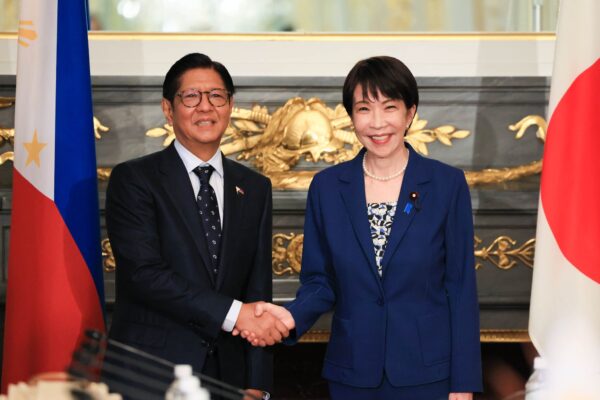
The clearest example of this is the most recent one, with Takaichi and Philippine President Ferdinand Marcos Jr. elevating their countries’ relations to a “Comprehensive Strategic Partnership” on May 28. They also agreed to move forward on a broad range of security initiatives including intelligence-sharing, defense transfers, and overall interoperability.
When Takaichi visited Australia earlier in May, Japan and Australia – which had already signed a defense pact in 2022 – also pledged further cooperation on security, including by signing a new pact on cybersecurity. While Takaichi has maintained Japan’s commitment to multilateral frameworks already established, these bilateral pushes, which also include Official Security Assistance (OSA) to South and Southeast Asian countries, underscore Tokyo’s increasing proactiveness in maintaining its security.
This has also occurred against the backdrop of a domestic defense build-up. Takaichi has pledged to fast-track Japan’s target of boosting defense spending to 2 percent of GDP. Amid concerns of slowing delivery schedules from the U.S. side, Japan has also been moving toward diversification in procurement, including by boosting its long-neglected domestic arms industry. Tokyo is now moving to become a major exporter in its own right, recently softening arms export rules and signing its largest ever defense export deal, comprising 11 stealth frigates, with Australia in April. It is also co-developing a next-generation fighter aircraft with the United Kingdom and Italy.
On the economic side, the pattern is similar. All of the bilateral summits mentioned thus far have also included an economic component. Takaichi has also increasingly linked the economic and security domains, against the backdrop of not only China’s apparent willingness to weaponize economic measures but also supply chain disruptions stemming from the conflict in Iran. She has thus begun to explicitly foreground economic security in her recent summit meetings.
One bilateral relationship where this has been increasingly evident is the one with South Korea. Takaichi and South Korean President Lee Jae-myung are unlikely partners, with both seen as ideologues and Japan-South Korea relations generally suffering under administrations led by the Democratic Party of Korea. However, the current geopolitical environment has resulted in pragmatism and a warm relationship. In their May meeting, their fourth already since Takaichi took office, the countries announced a swap line for crucial energy assets in a bid to strengthen economic security.
Japan has also taken the lead in new forms of multilateral engagement, though notably excluding the United States and China. For instance, Tokyo launched the POWERR Asia initiative in April, seeking to strengthen energy resilience at a regional level, arguably with a view to diluting Beijing’s dominance in Asian energy infrastructure. Takaichi has also sought to diversify trade further afield and is about to launch negotiations on a trade pact with the South American MERCOSUR bloc.
Taken together, all of these measures suggest a broader rebalancing of Japan’s foreign policy away from the dual hedge. While this has taken place in an incremental fashion and oftentimes merely accelerates already ongoing engagements, Tokyo is clearly aiming to diversify both its security and economic relations as it navigates its place in the world between two great powers. The deeper shift may be one of role rather than alignment: especially on security, Japan is moving from a recipient of U.S.-organized security to an organizer of its own regional networks. This could result in a mini hub-and-spokes framework with Tokyo at its center. Economically, Japan’s renewed focus on resilience and security aims to further insulate it from geopolitical shocks, with overall diversification through trade deals with new partners also underway.
Japan cannot – and will not – completely move away from its security partnership with the United States and its economic ties with China. Rather, Tokyo is moving – proactively, and on its own terms– to mitigate the potential adverse aspects stemming from the increasing instability in both relationships.
