

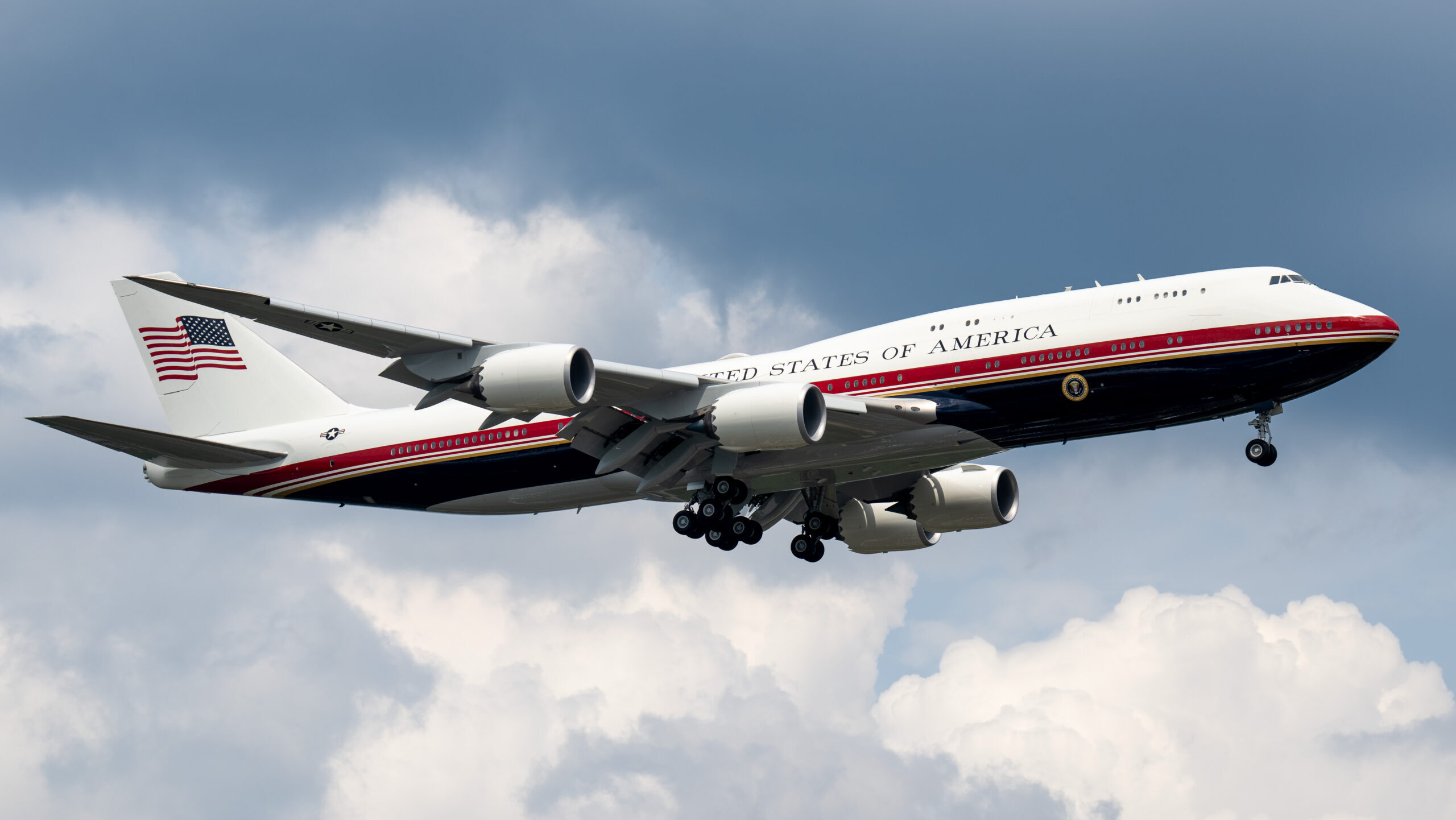
WASHINGTON — A new Air Force One plane that originated as a 747 jumbo jet gifted by Qatar will be available to transport the president beginning in July, following a 10-month sprint by L3Harris to deliver the plane last week, a company executive told Breaking Defense.
President Donald Trump accepted the controversial Qatari gift during a delivery ceremony on Friday at Joint Base Andrews, Md., following months of criticism from lawmakers that the plane could open up security vulnerabilities and ethical concerns.
Trump said the new plane will lead a flyover of military aircraft on July 4 as part of Independence Day festivities in Washington.
“The workmanship of this plane is — when you see it, you won’t believe it,” he said at the delivery ceremony. “The quality of woods, the quality of the materials, the quality of the engines — these engines are the finest and the best in the world. Nothing like it.”
L3Harris was tasked to modify the Qatari jet by the July 4 deadline, resulting in a team of about 400 employees working 24/7 to deliver the plane in 10 months, Jason Lambert, president of L3Harris’s intelligence, surveillance and reconnaissance division, said in an interview with Breaking Defense on Monday evening. Normally, the process would take several years.
“Making sure we had the personnel in place to do the work in advance of going under contract for this, and leaning in wherever we could to be able to support this mission set, and jointly deliver this in conjunction with the Air Force, is something that, frankly, in a timeline like this, I don’t think it’s ever been done,” he said.
The Air Force said the delivery will “relieve pressure” on the two legacy VC-25A aircraft that currently alternate serving as Air Force One. The aging duo are facing long maintenance cycles, and their planned successors — two new VC-25Bs — have suffered technical setbacks and workforce challenges that already pushed the replacement date from 2024 to mid-2028.
Typically, presidential transport aircraft are decked out with a suite of electronic warfare and defensive equipment, with the plane’s electronics hardened to withstand a nuclear electromagnetic pulse. The shortened modification timeline for the Qatari gift plane required L3Harris personnel to scale back the typical upgrade package.
While most of those improvements are classified, Lambert confirmed that L3Harris provided a secure communications system with connectivity to classified and unclassified networks, as well as performed modifications to the interior of the aircraft.
L3Harris worked constantly with the Air Force to ensure the modifications would “optimize the schedule” while also “mak[ing] sure that we’re delivering with the configuration and systems required to be able to service the president’s mission,” Lambert said. For example, the interiors were reworked with the US presidential seal as well as new wood and leather furnishings, but larger changes — such as moving the bulkheads or fixed structures inside the aircraft — were eschewed to have the plane ready by the president’s deadline.
Requirements were largely frozen after being signed off by the president, with an example being the aircraft’s new red, white, and blue livery — a change from the iconic baby blue color scheme used from the Kennedy administration onward.
“The president had to sign off on the paint scheme, including the flag that’s on the tail of the aircraft,” Lambert said. “Once those requirements were set, they were set and didn’t change it, so we could actually go do that work.”
Lambert declined to comment on what modifications meant to enhance the aircraft’s survivability were included or excluded to meet the delivery timeline, but said he has “the utmost confidence that the aircraft is ready to perform the mission as Air Force One.”
He added that the foreign-gifted aircraft was thoroughly inspected by security professionals to ensure no listening devices or compromising electronics were slipped inside before it arrived in the US.
“The aircraft underwent a very rigorous process, really in advance of us even working on it, performed by our electronic warfare experts in conjunction with the US government’s leaders in cybersecurity to fully inspect and ensure that everything within that aircraft was safe for the mission,” he said. “And with full assurance, we can say that that activity was performed not just in advance of our work, but throughout as well.”
Post-delivery, the aircraft will move into its initial commissioning flights, during which the White House will validate that the aircraft can hit its mission objective targets and finalize protocols associated with transporting the president, the Air Force stated.
“The safety and security of the commander in chief is our highest priority,” Air Force Secretary Troy Meink said in a news release. “From the beginning, we meticulously evaluated every requirement to accelerate delivery while maintaining the high standards expected of the presidential mission. This effort proves that the U.S. Air Force can move fast without sacrificing quality, security, or reliability.”
Training for pilots and maintainers began in October, first using a leased Atlas Air 747-8F and then using a 747-8i purchased from Lufthansa, the service said. L3Harris also delivered a 3D mockup of the interior of the plane, allowing White House personnel to familiarize themselves with the layout of the aircraft ahead of its first flight.
