

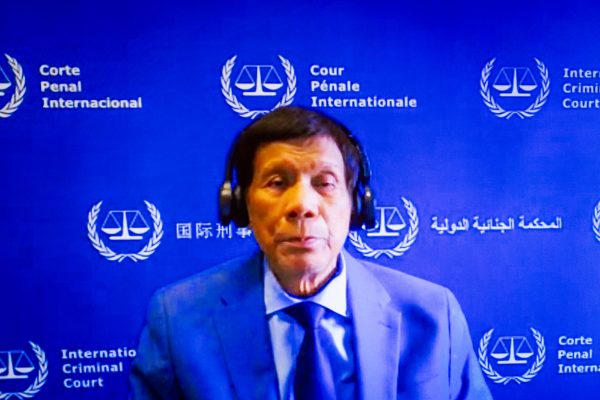
Judges at the International Criminal Court (ICC) have set November 30 as the start date for the trial of former Philippine President Rodrigo Duterte, who is charged with crimes against humanity linked to his violent anti-crime campaigns.
In a statement yesterday, The Hague-based court said that the timing of the trial of the 81-year-old had been determined by the ICC Trial Chamber after reviewing submissions by prosecutors, Duterte’s defense team, and the legal representatives of victims.
According to Rappler, victims were pushing for September 30 as the start date, but in the end, the Trial Chamber acceded to the prosecution’s preference for November 30.
“The trial will run on a daily basis until [we] reach judicial recess,” Presiding Judge Joanna Korner said during a status conference yesterday.
Duterte, 81, is facing three counts of crimes against humanity involving the murders of at least 76 people and the attempted murder of two others. Nineteen of the alleged murders were carried out between 2013 and 2016, when Duterte was mayor of Davao City. The remainder were committed during his “war on drugs” campaign, which raged throughout Duterte’s six years in office (2016-2022), and resulted in the deaths of between around 6,000 – the official estimate of the Philippine police – to as many as 30,000.
The ICC’s Pre-Trial Chamber I confirmed the charges against Duterte last month, ordering the case to go to trial. The chamber’s judges concluded that “there are substantial grounds to believe that Mr. Duterte is responsible for the crimes against humanity of murder and attempted murder.” These crimes “were committed as part of a widespread and systematic attack against a civilian population on the territory of the Republic of the Philippines” between November 1, 2011, and March 16, 2019. This period ends on the date that he withdrew the country from the ICC’s Rome Statute.
While Duterte waived his right to be present at yesterday’s hearing, as he has also been on many occasions during the pre-trial process, Duterte is mandated to appear in person at the trial. The former leader has always defended the crackdown, which was generally popular with the Philippine public during his years in power, and insisted he instructed police to kill only in self-defense.
Duterte was arrested in Manila in March 2025 and extradited to the ICC. Duterte’s successor and one-time ally, Ferdinand Marcos Jr., had initially signaled his opposition to the ICC case and declared that his administration would not cooperate with it. However, the political equation changed drastically during 2024, when the Duterte and Marcos families became locked into a bitter political feud. Duterte’s family and supporters have railed against the ICC case, arguing that the former leader’s extradition was tantamount to a “kidnapping.”
Among the most pressing questions now is whether Duterte might be joined by further defendants, in particular, Senator Ronald “Bato” Dela Rosa, who served under Duterte in Davao City and as national police chief for the first two years of his presidency.
On May 11, the ICC unsealed a warrant against Dela Rosa, announcing that it had “found reasonable grounds to believe that Mr Dela Rosa is allegedly criminally responsible as an indirect co-perpetrator… for the crime against humanity of murder.”
This case, too, is entwined with the feud between Marcos and the Duterte family. The same day as the ICC unsealed its warrant, Dela Rosa emerged from six months of hiding in order to cast the deciding vote for a Senate leadership coup that installed Alan Peter Cayetano, an ally of Duterte, as the chamber’s president. The aim of this was to forestall or frustrate the impending impeachment trial of Duterte’s daughter, Vice President Sara Duterte, who was impeached by the House of Representatives the same day for a range of transgressions. Duterte’s impeachment trial began in the Senate last week.
But Dela Rosa was confronted by officers from the National Bureau of Investigation who showed up at the Senate building to execute the ICC warrant. After locking himself in his Senate office for several days, he managed to slip out of the Senate building. The Philippine Supreme Court subsequently rejected Dela Rosa’s bid for a temporary restraining order to prevent his arrest and transfer to the ICC. He is currently the subject of a manhunt by the Philippine police.
Also yesterday, a commission was launched in the Philippines to investigate the drug war and create a “credible public record of extrajudicial killings and related abuses.”
As per Reuters, the civilian-led Philippine Truth and Reconciliation Commission will be led by former ICC judge Raul Pangalangan, and will operate independently of government control.
“This is not about replacing the courts or assigning guilt,” Pangalangan said. “It is about building a credible truth record that can guide accountability, healing, reform, and the prevention of future violence.”
