

India and the European Union have confirmed that their landmark Free Trade Agreement, described as the “Mother of All Deals,” will be formally signed by the end of 2026.
The pact, concluded in January, covers goods, services, and digital trade, and is expected to reshape global commerce by creating a free market spanning nearly two billion people and a quarter of the world’s economy.
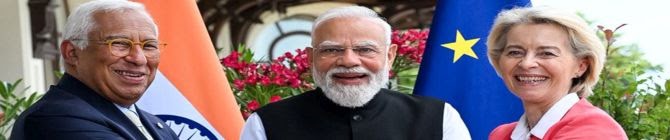
The momentum towards this historic agreement was reinforced at the G7 Summit in Evian, France, where Prime Minister Narendra Modi met European Council President Antonio Costa and European Commission President Ursula von der Leyen.
Both European leaders posted synchronised messages on social media, emphasising that the FTA would be signed by year-end, alongside accelerated work on a parallel investment agreement. They also highlighted plans to deepen cooperation in security, defence, and connectivity, particularly through the India-Middle East-Europe Corridor (IMEC).
Prime Minister Modi echoed this optimism, noting that India’s ties with the EU had reached a new high following the conclusion of the FTA. He recalled hosting both leaders during India’s Republic Day celebrations earlier in the year, and stressed that the agreement would play a vital role in strengthening peace, stability, and prosperity in the current geopolitical climate.
The Ministry of External Affairs confirmed that the trilateral meeting served as a major anchor for India’s broader European outreach. MEA Spokesperson Randhir Jaiswal stated that the leaders recalled the 16th India-EU Summit held in January and welcomed the strong progress in bilateral relations.
They also exchanged views on regional and global issues of mutual interest, underscoring the strategic depth of the partnership.
The agreement itself is unprecedented in scale. It will eliminate tariffs on 99 per cent of Indian exports to the EU and reduce duties on more than 97 per cent of European exports entering India. The EU estimates that tariff reductions could save European exporters up to €4 billion annually, while India expects significant gains in labour-intensive sectors such as textiles, leather, marine products, gems, and jewellery.
The pact also includes provisions to support small and medium enterprises, improve regulatory transparency, and expand opportunities for skilled Indian professionals in Europe.
In addition to the trilateral session, Prime Minister Modi held a bilateral meeting with German Chancellor Friedrich Merz. Both leaders expressed satisfaction at the renewed momentum in the India-Germany Strategic Partnership, which coincides with the 75th anniversary of diplomatic ties.
They discussed cooperation in trade, investments, defence, IT, and the circular economy, while also emphasising cultural linkages. Crucially, they agreed that early implementation of the India-EU FTA would further deepen bilateral ties.
Later in the day, attention turned to Prime Minister Modi’s scheduled bilateral meeting with US President Donald Trump. This engagement is being closely watched, as the two leaders are expected to focus on expediting a proposed India-US trade agreement while exploring cooperation in defence, energy, and critical minerals. Their talks follow a brief interaction the previous day, marking their first in-person meeting in 16 months.
The G7 Summit in Evian has thus become a pivotal stage for India’s diplomacy. With a packed schedule of bilateral and multilateral engagements, Prime Minister Modi has positioned India as a key player in shaping global economic and strategic discourse. His meetings with leaders from Canada, the UK, the UAE, Kenya, Egypt, Japan, and South Korea further underscore India’s expanding diplomatic footprint and its role in navigating complex global challenges.
The India-EU FTA, once signed, will stand as the most ambitious trade pact ever concluded by either side. It represents a decisive step towards diversifying supply chains, boosting investment flows, and reinforcing India’s position as a central actor in global trade and geopolitics.
ANI
