

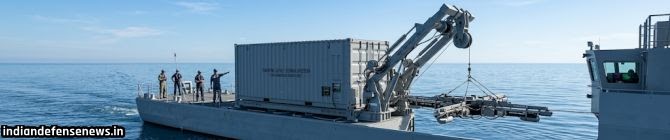
By packaging advanced Towed Array Sonars and Variable Depth Sonars (VDS) into modular, plug‑and‑play containers, the Navy can transform any vessel equipped with a certified A‑frame and winch into an ad‑hoc ASW node. This approach decouples underwater coverage from the lengthy timelines of new hull construction and represents a fundamental doctrinal change in maritime operations.
The doctrine emphasises decentralisation of ASW capability. Instead of relying exclusively on expensive, purpose‑built frigates and corvettes, the Navy can now distribute sensors across a wider variety of platforms, including Offshore Patrol Vessels (OPVs) and auxiliary ships. This broadens the reach of underwater surveillance and ensures that even non‑combatant vessels can contribute meaningfully to subsurface threat detection.
The CTLS creates a networked sensor grid capable of operating in mono, bi, and multi‑static modes. By working in tandem, these containerised systems can triangulate and track submarines across a larger geographic theatre. This networked approach enhances situational awareness, strengthens deterrence, and complicates adversary submarine operations in the Indian Ocean Region.
Rapid deployment is another cornerstone of the initiative. With production timelines for major combatants stretched, the CTLS allows the Navy to scale its underwater domain awareness quickly without waiting for new warships to be commissioned. This force multiplication effect ensures that India can maintain credible ASW coverage even as its fleet expansion program progresses gradually.
The modularity of the system is central to its design. The requirement is highly standardised, with the only mandatory ship‑fit being a certified A‑frame and winch. All other components are self‑contained within the container and plug directly into the network. This ensures interoperability, ease of installation, and flexibility across diverse classes of ships.
The official Request for Information (RFI) document outlines the technical requirements and operational parameters for the CTLS program. It reflects the Navy’s intent to build a scalable, distributed ASW architecture that leverages indigenous innovation and reduces dependence on foreign suppliers. The initiative aligns with India’s broader push for self‑reliance in defence technology under the Aatmanirbhar Bharat framework.
Strategically, the CTLS represents a paradigm shift. By decentralising ASW, creating a networked sensor grid, enabling rapid deployment, and embracing modularity, the Indian Navy is laying the foundation for a resilient, adaptive, and future‑ready underwater surveillance capability. This ensures that India’s maritime forces can counter growing submarine threats in the Indo‑Pacific while maximising the utility of existing platforms.
