

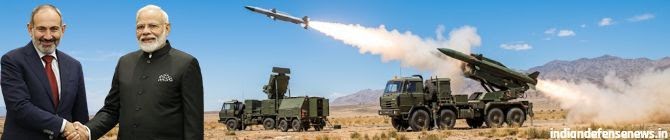
India emerged as Armenia’s top defence supplier during Prime Minister Nikol Pashinyan’s first administration, delivering missiles, rocket systems, radars and anti-drone technologies that reshaped Yerevan’s military posture.
Today, with defence ties firmly established, the emphasis is shifting towards peace-building, reconciliation and sustainable cooperation in the South Caucasus.
India became Armenia’s principal defence partner under Pashinyan 1.0, when Yerevan turned away from Moscow due to Russia’s preoccupation with the war in Ukraine. Armenia signed contracts worth nearly two billion dollars with India, acquiring Akash surface-to-air missile systems, Pinaka multi-barrel rocket launchers, Swathi weapon locating radars and advanced anti-drone technologies.
These systems were delivered progressively from 2022 onwards, significantly enhancing Armenia’s ability to counter aerial threats and artillery fire.
The partnership was not limited to procurement. Armenia’s officers trained in India, including at the School of Artillery in Nashik, where they observed live firing exercises and studied operational methodologies.
Such exchanges deepened interoperability and created a foundation for long-term cooperation. High-level visits reinforced this trajectory, with General Anil Chauhan’s delegation meeting Prime Minister Pashinyan in Yerevan and later hosting Armenian Chief of General Staff Edvard Asryan in New Delhi. Both sides explored joint ventures in defence manufacturing, signalling a move towards co-development rather than simple buyer-seller dynamics.
This defence relationship was shaped by Armenia’s urgent need to counter Azerbaijan, which was strongly supported by Pakistan and Türkiye. The 2020 and 2023 wars highlighted Armenia’s vulnerabilities, compelling Yerevan to seek reliable partners.
Pakistan’s supply of JF-17 fighter jets to Azerbaijan and Türkiye’s provision of drones and artillery systems created a formidable adversarial bloc. India’s entry as Armenia’s supplier was therefore both strategic and symbolic, counterbalancing the Ankara–Baku–Islamabad nexus.
Yet, as Armenia stabilises its defence posture, the next phase must focus on peace. India, having earned trust through defence cooperation, is well placed to support reconciliation efforts.
Investing in dialogue, humanitarian initiatives and economic cooperation can help reduce tensions in the South Caucasus. Confidence-building measures, cultural exchanges and development projects should now complement military ties, creating a holistic partnership that prioritises stability.
India’s broader strategic interest lies in projecting itself as a responsible power that not only exports arms but also fosters peace. By leveraging its role as Armenia’s top defence supplier, New Delhi can encourage diplomatic solutions, promote regional cooperation and support sustainable development.
This transition from arms to peace would benefit Armenia, strengthen India’s global image and contribute to a more secure South Caucasus.
Agencies
