

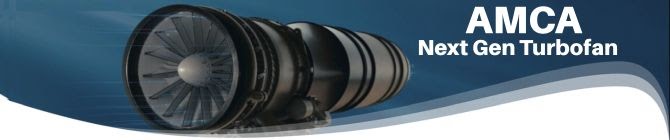
India’s AMCA fighter program is now actively weighing alternatives to the American GE F414 engine, with French firm Safran and Britain’s Rolls-Royce emerging as strong contenders. Rising costs, delivery delays, and concerns over technology transfer have prompted DRDO to explore these options to safeguard timelines and ensure strategic autonomy.
India’s Advanced Medium Combat Aircraft (AMCA) project was originally designed around the GE F414-INS6 engine. This powerplant was expected to equip the first two to four squadrons of the AMCA Mk-1, amounting to around 60–70 aircraft. It was also selected for the Tejas Mk-2 and the Twin Engine Deck-Based Fighter (TEDBF).
However, negotiations with GE Aerospace have stalled after the company demanded prices nearly three times higher than the earlier estimate of ₹70–80 crore per unit. This escalation has transformed what was once seen as a straightforward procurement into a major financial and strategic challenge.
The prototype phase of the AMCA alone requires 15 engines for five flying prototypes. Beyond this, India’s total requirement for the F414 across the AMCA, TEJAS MK-2, and TEDBF programs is projected to exceed 200 engines.
The sharp rise in cost, coupled with delays in delivery schedules, has raised alarm within the Defence Research and Development Organisation (DRDO) and the Aeronautical Development Agency (ADA). Negotiations have also been complicated by issues of technology transfer, licensed manufacturing, maintenance, repair and overhaul facilities, spares, warranties, and long-term support arrangements.
French aerospace giant Safran has pitched an enhanced derivative of its M88 engine, which currently powers the Rafale fighters in Indian service. Safran’s proposal includes adaptive airflow modulation and variable geometry nozzles, along with a pledge of full technology transfer and intellectual property rights.
The company also offers the advantage of proven reliability, existing offsets from the Rafale deal, and a major Maintenance, Repair and Overhaul facility in Hyderabad. However, analysts caution that the M88 architecture, designed for lighter airframes, may struggle to meet fifth-generation benchmarks such as sustained supercruise and low infrared signature.
British engine maker Rolls-Royce has taken a more aggressive approach, offering India a clean-sheet sixth-generation turbofan design with adaptive cycle technology. This proposal includes a Variable Cycle Engine capable of switching bypass ratios mid-flight, enhancing both combat performance and fuel efficiency.
Rolls-Royce has already bench-tested adaptive cycle components under the Global Combat Air Program with Japan and Italy, giving it a technological edge. Crucially, the company has committed to 100% technology transfer and full intellectual property ownership for India, ensuring strategic autonomy. Its roadmap outlines an engine core test by 2030, a maiden flight by 2034, and full-scale production by 2036.
The AMCA program itself is central to India’s long-term airpower modernisation. Developed by ADA, the aircraft is expected to become India’s first indigenous fifth-generation stealth fighter, reducing dependence on imported combat platforms and strengthening indigenous aerospace capabilities.
The government has already sanctioned over ₹15,000 crore for the prototype development phase, with plans to build five flying prototypes and achieve a maiden flight by 2028.
The prototypes are expected to undertake around 1,800 test sorties over seven years to validate stealth characteristics, sensors, radar, weapons integration, and propulsion performance.
India’s decision between Safran and Rolls-Royce is therefore not just about cost but about sovereignty, timelines, and future scalability. Safran offers speed and familiarity through its Rafale ecosystem, while Rolls-Royce promises a leap into sixth-generation propulsion with unmatched sovereignty.
The choice will shape India’s aerospace trajectory for decades, especially as Pakistan moves closer to inducting China’s J-35 stealth fighter, potentially introducing fifth-generation combat aircraft into the region before the AMCA enters service.
Agencies
