

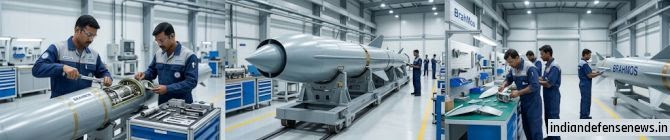
India is driving a decisive push to raise the indigenous content of the BrahMos supersonic cruise missile to 90–95%, with DRDO negotiating with Russia’s NPO Mashinostroyenia to cut costs and deepen localisation.
This effort aims to reduce reliance on imported subsystems, lower unit costs, and strengthen India’s position in the global missile export market.
India’s Defence Research and Development Organisation has already achieved around 83% indigenous content in the BrahMos missile, with a near-term target of 85% by 2026. The new ambition to reach 90–95% localisation reflects both strategic and economic imperatives.
The missile, jointly developed with Russia, has long been criticised for its high unit cost, which is significantly higher than Russia’s P-800 Oniks, the legacy system on which BrahMos is based. The Oniks benefits from decades-old production lines and high-volume domestic manufacturing, allowing Russia to market it at nearly half the cost of BrahMos.
Despite this, BrahMos remains technologically superior. The Extended Range (ER) variant incorporates indigenous seekers, advanced navigation systems such as G3OM, upgraded propulsion for ranges exceeding 450 km, and multi-platform integration.
These enhancements, while increasing capability, also raise production costs. The joint venture structure itself adds overheads absent in purely domestic models, making cost reduction through indigenisation a critical priority.
The remaining 15–20% of non-indigenous content consists of highly complex subsystems sourced from Russia. These include the liquid ramjet engine, specialised fuel systems, air intake mechanisms, and high-frequency electronic components such as travelling-wave tubes used in guidance and communication.
India has already indigenised the airframe, boosters, control systems, and much of the electronics suite. However, replacing the Russian-supplied propulsion backbone and critical electronics requires not only technological breakthroughs but also Russian concurrence under the joint venture’s contractual framework.
DRDO has made significant progress in developing an indigenous liquid-fuel ramjet engine, which is undergoing advanced testing.
This engine is expected to power future BrahMos variants with ranges up to 800 km, marking a major leap towards self-reliance.
The indigenous propulsion system, combined with lighter composite materials and optimised fuel management, will enhance efficiency while reducing costs.
Parallel developments include the BrahMos-II hypersonic cruise missile, designed to reach speeds of Mach 7–8 with an indigenously developed scramjet engine. This project underscores India’s ambition to move beyond supersonic systems and establish leadership in next-generation missile technology.
The hypersonic programme, alongside the ongoing indigenisation of BrahMos, reflects a broader strategy to build a sustainable, innovation-driven defence industrial base.
The push for 90–95% indigenous content is not merely about cost savings. It is a strategic move to ensure operational resilience, reduce vulnerability to supply chain disruptions, and expand export opportunities.
With countries such as the Philippines and Vietnam already inducting BrahMos, deeper indigenisation will make the missile more competitive globally, positioning India as a net exporter of advanced missile systems.
By negotiating with Russia to allow greater integration of Indian subsystems, DRDO is attempting to balance partnership obligations with national self-reliance goals.
Success in this endeavour would mark a major milestone in India’s defence modernisation, reinforcing the credibility of the Aatmanirbhar Bharat initiative and strengthening India’s deterrence posture in a rapidly evolving regional security environment.
Agencies
