

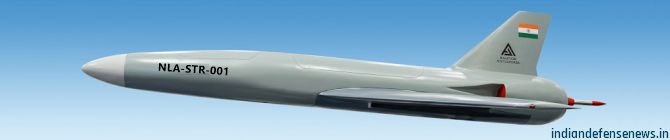
NextLeap Aeronautics has unveiled STRYKER, India’s fastest and most lethal jet-powered kamikaze UAV, marking a breakthrough in indigenous unmanned strike technology. Designed for deep penetration and precision destruction, STRYKER represents a new era in India’s drone warfare capabilities under the Atmanirbhar Bharat initiative.
The STRYKER platform is a tactical combat UAV powered by a jet engine, making it distinct from propeller-driven loitering munitions and FPV drones currently in service. Its jet propulsion allows for high-speed ingress and terminal attack manoeuvres, enabling it to overwhelm adversary air defences and strike critical infrastructure with devastating accuracy.
This speed advantage positions STRYKER as a formidable alternative to costly cruise missiles, offering a reusable and scalable solution for deep-strike missions.
NextLeap Aeronautics has emphasised that STRYKER is not a standalone system but part of a broader ecosystem of indigenous UAVs. Alongside STRYKER, the company is developing SKYHAMMER, a heavy-payload autonomous strike drone capable of ordnance delivery, and ISTAR, a hydrogen-powered platform for intelligence, surveillance, target acquisition, and reconnaissance.
Together, these systems form a layered unmanned combat architecture designed to meet India’s evolving battlefield requirements.
The STRYKER UAV is engineered with autonomous mission execution, real-time situational awareness, and precision targeting capabilities. It is expected to operate effectively in GPS-denied and electronic warfare environments, incorporating encrypted sovereign command-and-control systems to ensure resilience against jamming and spoofing. This makes it suitable for contested zones where traditional UAVs may falter.
In terms of payload, STRYKER is designed to carry high-explosive warheads optimised for both anti-personnel and anti-infrastructure roles. Its jet engine allows rapid deployment over extended ranges, collapsing the notion of safe depth zones for adversaries. The UAV’s ability to conduct saturation strikes in swarms further enhances its lethality, forcing opponents to expend expensive interceptors against relatively low-cost drones.
The unveiling of STRYKER reflects India’s response to global drone warfare trends, particularly the widespread use of Iran’s Shahed-136 drones and the U.S. Switchblade and LUCAS systems. These platforms have demonstrated how low-cost, high-speed kamikaze drones can reshape warfare economics, and STRYKER aims to provide India with a comparable, if not superior, capability.
NextLeap Aeronautics has positioned STRYKER as a flagship of India’s indigenous defence innovation. The company’s commitment to self-reliance in unmanned systems aligns with the government’s Atmanirbhar Bharat vision, ensuring that India reduces dependence on foreign suppliers while building a robust domestic defence industrial base.
The unveiling also signals India’s intent to integrate advanced UAVs into its operational doctrine, bridging the gap between tactical FPV drones and strategic missile systems.
The future trajectory of STRYKER includes full-scale flight trials and integration into India’s arsenal of unmanned combat systems. Its deployment will significantly enhance India’s deterrence posture, providing a cost-effective yet lethal option for precision strikes in both conventional and asymmetric warfare scenarios.
Agencies
