

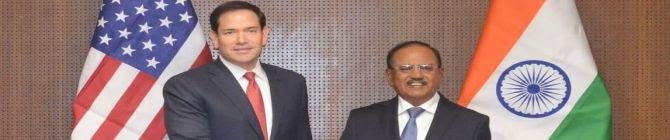
US Secretary of State Marco Rubio met National Security Adviser Ajit Doval in New Delhi on Sunday, where India conveyed strong concerns over Pakistan-based terror networks.
NSA Doval emphasised that terrorism was not merely an ideology but an entire ecosystem, pointing out that terror infrastructure operating from Pakistan remained continuously active.
He also warned that instability across Afghanistan and the wider South Asia region continued to pose serious security challenges.
During the talks, Doval underlined that India was no longer focused solely on vigilance against terror threats but was increasingly adopting an “action mode” approach in dealing with terrorism and cross-border networks.
Regional security, counter-terrorism cooperation and strategic coordination in the Indo-Pacific and South Asian region featured prominently in the discussions. Both sides also explored ways to expand India-US defence cooperation, with particular attention to technology transfer, joint development and co-production initiatives under the India-US Initiative on Critical and Emerging Technology (iCET).
Officials described this defence push as part of a broader strategic shift aimed at positioning India not just as a defence buyer but as a co-developer and manufacturing partner in advanced technologies. Rubio later held a bilateral meeting with External Affairs Minister S Jaishankar at Hyderabad House, where both sides reviewed cooperation across trade, technology, artificial intelligence, supply chains, defence and energy sectors.
After the meeting, Rubio stated that India-US ties had not lost momentum and expressed confidence that relations between the two countries would become stronger in the coming years.
He also said Washington hoped the long-pending trade agreement between the two nations would be concluded soon, adding that India and the US were strategically aligned on most major global issues.
Jaishankar noted that the discussions covered developments in West Asia, the Indian subcontinent and East Asia, while reiterating India’s support for unimpeded maritime commerce. He further highlighted that the two sides discussed civil nuclear cooperation and welcomed recent progress in the energy sector.
Rubio’s meetings came a day after he called on Prime Minister Narendra Modi during his official visit to India. Sources indicated that Rubio extended an invitation to Modi to visit the White House during Saturday’s meeting, which was also attended by senior Indian officials including Jaishankar and Doval.
The talks underscored the growing depth of India-US strategic engagement, with terrorism, defence co-production, technology transfer and energy cooperation forming the core of discussions. The emphasis on counter-terrorism and defence collaboration reflected the shared concerns of both nations in addressing regional instability and advancing a stronger Indo-Pacific partnership.
Agencies
