

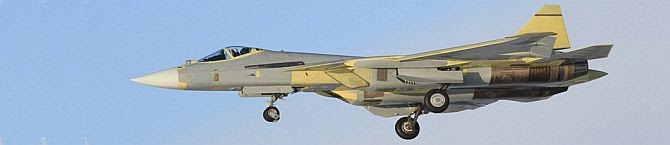
Russia has offered India unprecedented access to the Su‑57 stealth fighter’s source code, alongside licensed production rights, marking one of the most significant technology‑transfer proposals in modern defence aviation.
This move could reshape India’s fifth‑generation fighter strategy, bridging the gap until the indigenous AMCA enters service.
Russia has formally proposed that India undertake licensed production of the Su‑57 stealth fighter, with extensive technology transfer and long‑term industrial cooperation. The offer includes access to sensitive source codes and mission systems, a concession rarely granted in the global defence industry.
This would allow India to integrate indigenous weapons, sensors, and avionics into the aircraft without requiring foreign approval, thereby ensuring operational independence.
Source code access is particularly critical because modern combat aircraft are software‑driven. The code governs radar systems, electronic warfare suites, weapons integration, flight control systems, sensor fusion, and mission computers.
Western suppliers, such as the United States and France, typically restrict access to these systems. Russia’s willingness to share them represents a rare opportunity for India to exercise full control over its frontline stealth fleet.
India’s pursuit of a fifth‑generation fighter capability has been long‑standing. It previously participated in the Indo‑Russian Fifth Generation Fighter Aircraft (FGFA) programme based on the Su‑57 but withdrew in 2018 due to concerns over limited technology sharing and performance issues.
Today, with the Advanced Medium Combat Aircraft (AMCA) still a decade away from induction, policymakers are considering the Su‑57 as a bridging solution to address squadron shortfalls and counter regional threats.
The Indian Air Force currently operates around 31 fighter squadrons against an authorised strength of 42, with ageing MiG‑21s being retired. The Su‑57 proposal arrives at a critical juncture, offering a systemic solution to capability erosion.
Reports suggest India may initially procure a batch of 40 aircraft directly from Russia before commencing local manufacture, mirroring the earlier Su‑30MKI programme.
Russia has also unveiled a twin‑seat Su‑57D variant, designed specifically for export customers. This configuration aligns with the Indian Air Force’s preference for two‑crew fighters, as seen in its fleet of over 250 Su‑30MKIs.
A second crew member is considered vital for managing electronic warfare, coordinating long‑range missions, and operating in network‑centric battle environments. Global observers note that India was a driving force behind the development of this twin‑seat model.
Negotiations between New Delhi and Moscow have accelerated since mid‑2025, when Russia first offered source code access. By January 2026, India’s Ministry of Defence confirmed that talks had reached advanced technical stages.
Defence experts suggest three possible strategies are under consideration: direct imports, licensed production, and joint development of a customised Su‑57 variant with Indian avionics and radar systems. Russia has even indicated willingness to co‑develop a new version with India, granting co‑ownership of key technologies.
The Su‑57 Felon itself is Russia’s most advanced stealth fighter. It is capable of speeds approaching Mach 2, has a combat range of 3,500 kilometres, and a service ceiling of 20,000 metres.
Its radar cross‑section is estimated between 0.1 and 1 square metre, making it far less detectable than conventional fighters such as the Su‑30MKI. The aircraft features internal weapons bays, advanced sensors, and super‑cruise capability, enabling sustained supersonic flight without afterburners.
If finalised, this agreement would mark a watershed moment for India’s aerospace sector. Rather than simply purchasing a stealth fighter, India would gain genuine ownership and technological sovereignty over one of the world’s most advanced combat aircraft. It would also recalibrate Indo‑Russian defence ties, strengthening strategic autonomy at a time when regional airpower competition is intensifying.
Agencies
