

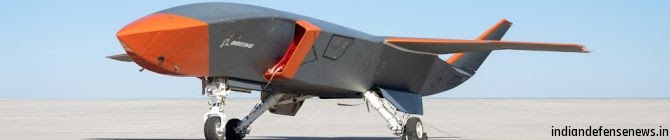
India is actively weighing the acquisition of Australia’s Boeing-developed MQ-28 Ghost Bat UCAVs as a counterbalance to Pakistan’s potential induction of Turkey’s Bayraktar Kızılelma drones.
The Ghost Bat, already tested in autonomous combat by the Royal Australian Air Force, is being positioned as a force multiplier for the Indian Air Force in future Indo-Pacific operations.
India’s interest in the MQ-28 Ghost Bat comes amid reports that Turkey may proceed with the sale of its advanced Kızılelma unmanned fighter aircraft to Pakistan. The Kızılelma is a stealth-capable, AI-driven multirole UCAV, and its induction into the Pakistan Air Force would significantly alter the regional balance.
In response, New Delhi has been exploring options to strengthen its unmanned combat capabilities, with the Ghost Bat emerging as a leading candidate due to its maturity and proven performance.
The MQ-28 Ghost Bat is an uncrewed collaborative combat aircraft designed to operate alongside crewed fighter jets and airborne early warning platforms. Boeing describes it as a “force multiplier for advanced airpower systems,” highlighting its open-system architecture that allows mission flexibility, integration of third-party payloads, and rapid reconfiguration.
This modular design is centred on its missionized nose section, enabling quick swapping of payloads to suit different operational requirements.
The aircraft boasts a range of more than 2,000 nautical miles (3,700 kilometres), a top speed of Mach 0.9, and an operational ceiling above 40,000 feet. Measuring 11.7 metres in length with a wingspan of 7.3 metres, the Ghost Bat weighs approximately 3,175 kilograms.
Developed in Australia over the past eight years, it is the first military combat aircraft designed and manufactured in the country in over half a century. More than 70 Australian companies have contributed to the programme, underscoring its collaborative industrial base.
A major milestone was achieved in December 2025, when Boeing and the Royal Australian Air Force conducted the first autonomous air-to-air combat kill engagement using an AIM-120 AMRAAM missile.
This test demonstrated the Ghost Bat’s ability to independently detect, track, and neutralise aerial threats without direct human control, marking it as one of the most advanced UCAVs globally. By March 2025, the prototype had already completed over 100 test flights, supported by more than 20,000 hours of digital simulation.
India’s interest in the Ghost Bat was visibly reinforced during the 12th Air Staff Talks between the Indian Air Force and the Royal Australian Air Force in Canberra in May 2026.

Photographs released from the meeting showed Air Vice-Marshal Sanjeev Taliyan alongside his Australian counterpart, Air Vice-Marshal Steven Pesce, with the MQ-28 Ghost Bat in the backdrop.
Discussions centred on operational synergy, interoperability, joint exercises, training, and future aerospace collaboration, signalling that the Ghost Bat is firmly on the agenda of Indo-Australian defence cooperation.
For the Indian Air Force, the Ghost Bat offers several advantages. Its autonomous capability reduces risk to pilots while enabling aggressive mission planning. Its ability to integrate seamlessly with manned aircraft such as the Su-30MKI and the upcoming AMCA makes it suitable for manned-unmanned teaming concepts.
Furthermore, its modular payload system allows India to adapt the platform for roles ranging from electronic warfare and surveillance to precision strike missions, enhancing flexibility in contested environments.
The potential induction of the Ghost Bat would also strengthen India’s strategic partnership with Australia, reinforcing Indo-Pacific security cooperation at a time when regional threats are intensifying. With Pakistan’s pursuit of Turkish UCAVs, India’s move to acquire the Ghost Bat would represent a decisive step in maintaining technological parity and operational superiority in unmanned aerial warfare.
Agencies
