

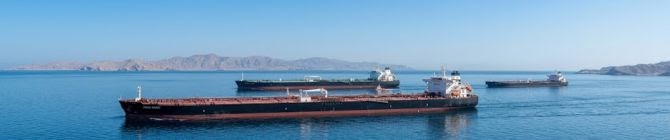
Shipowners and oil traders were left in disarray early Saturday as five Greek and Indian tankers halted their journeys, with warnings reportedly broadcast over radio channels adding to the confusion.
The incident followed Iran’s foreign minister’s statement on Friday that the strait was completely open, only for semi-official Fars news agency to later report that passage would remain closed if the US naval blockade continued. This contradiction has created doubt among operators, who are unsure whether transit is permitted without explicit Iranian clearance.
The five Greek and Indian tankers had sailed northeast toward Hormuz from waters off Dubai, laden with crude, before turning back on Saturday morning. Some are now idling near Iran’s Qeshm island, while a sixth vessel has gone dark, ceasing to transmit geolocation signals for several hours.
Together, the six ships carry about 8.3 million barrels of non-Iranian crude, and their successful passage would have represented the largest crude flows from the Gulf in a single day since the war began.
The grouping of six tankers was observed late Friday after announcements suggested Hormuz was reopening. They were part of a flotilla stranded in the Persian Gulf due to the ongoing Middle East conflict. Bloomberg News could not immediately confirm whether the U-turns were voluntary or the result of traffic control measures, as multiple vessels converged on the strait. Shortly after the crude tankers reversed course, three liquefied petroleum gas carriers and an oil product tanker were seen heading east, turning into the Gulf of Oman.
Shipowners reported hearing radio warnings late Friday that permission from the Iranian navy was still required for passage. Emails sent by Bloomberg to the owners and managers of the six crude tankers outside regular business hours received no immediate response.
Severe electronic interference in the region, combined with ships switching off tracking signals to avoid detection, has made it difficult to obtain an accurate picture of vessel movements.
The Nissos Keros, a Marshall Islands-flagged super tanker carrying around 1.8 million barrels of UAE crude, attempted transit before turning back and is now idling near Qeshm island. It is owned and managed by Greece-based Kyklades Maritime Corp.
The Minerva Evropi, a Greek-flagged Suezmax bound for Turkey with more than 1 million barrels of Iraqi Basrah crude, made a similar move and is managed by Athens-based Minerva Marine Inc.
India’s VLCC Sanmar Herald, sailing south of Iran’s Larak island, also turned around and is heading back into the Persian Gulf. The Aframax Desh Garima, which was alongside Sanmar Herald, has since gone dark, with its last geolocation signal sent at about 4:20 a.m. local time. Another Indian VLCC, Desh Vaibhav, was an hour behind Sanmar Herald and Desh Garima before stopping near Nissos Keros. Desh Vibhor, another India-linked VLCC, was close to Desh Vaibhav before also turning back near Nissos Keros.
The uncertainty over Hormuz’s reopening underscores the fragile state of global oil trade, with operators caught between Iran’s shifting declarations and the continuing US blockade. The halted journeys of these tankers highlight the risks and confusion facing maritime traffic in one of the world’s most critical energy arteries.
Agencies
