

Introduction
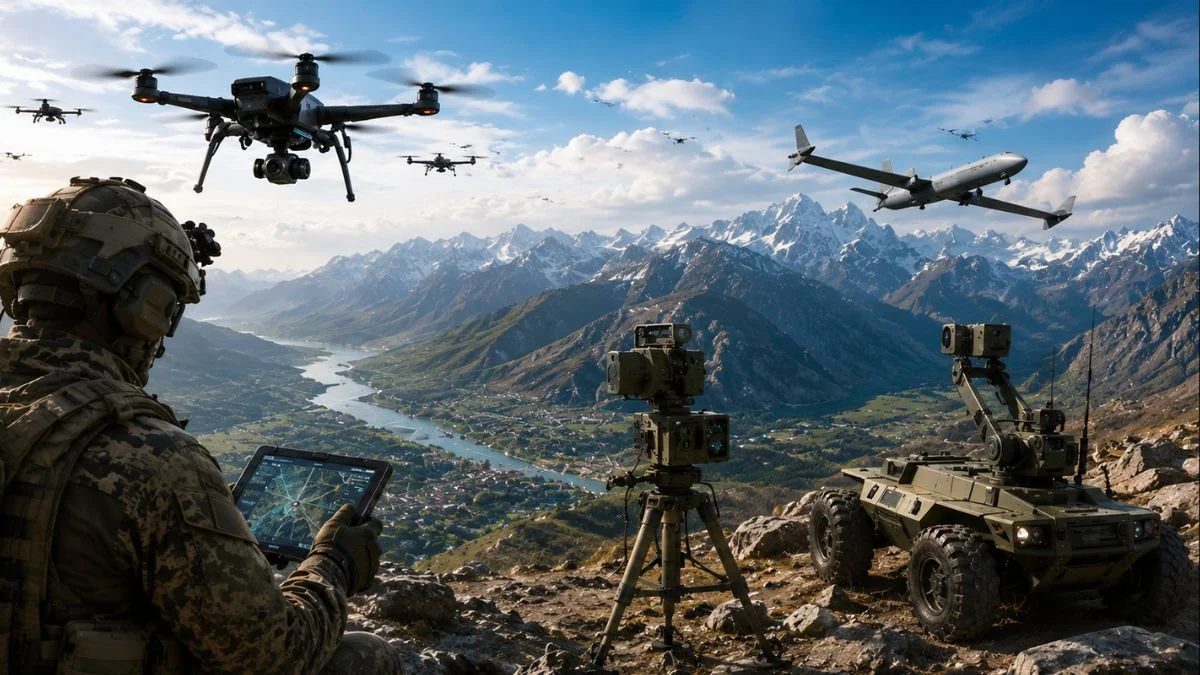
The future battlefield is no longer defined only by tanks, artillery, and infantry formations. Warfare is rapidly evolving into a contest of artificial intelligence, autonomous systems, electronic warfare, precision strike capability, and network-centric operations. Recognizing this transformation, the Indian Army has outlined a broad spectrum of advanced technology problem statements aimed at industry, startups, academia, and innovators.
These focus areas reveal not only the Army’s operational priorities, but also India’s ambition to build an indigenous, future-ready defence ecosystem aligned with Aatmanirbhar Bharat and defence indigenization.
The Rise of Autonomous Warfare
One of the most prominent themes emerging from the Indian Army’s roadmap is the growing importance of autonomous and unmanned systems. The Army is actively seeking solutions in:
- Weaponized MALE/HALE drones
- Drone swarms
- Human-in-loop autonomous systems
- UGV-based battlefield systems
- Hydrogen-powered drones
- Advanced robotics and propulsion
Recent conflicts in Eastern Europe and the Middle East have shown how low-cost drones and loitering munitions can dramatically alter battlefield dynamics.
India’s future battlefield vision focuses on:
- Organic ISR capability at unit level
- Reduced risk to soldiers
- Swarm-based tactical dominance
- Precision engagement at lower cost
- Multi-domain battlefield awareness
Modern conflicts have demonstrated that small FPV (First Person View) strike drones can provide devastating tactical effectiveness at minimal cost. The Indian Army now seeks indigenous FPV-enabled kamikaze drones capable of precision terminal guidance and real-time battlefield engagement.
Why FPV Drones Matter
Unlike conventional surveillance drones, FPV strike drones allow operators to:
- Visually track targets in real time
- Conduct terminal guidance corrections
- Navigate cluttered environments
- Strike moving targets precisely
- Minimize collateral damage
This capability becomes especially important in:
- Counter-insurgency operations
- Urban warfare
- Mountain warfare
- Cross-border tactical engagements
Lessons from Global Conflicts
Systems such as:
have shown how inexpensive autonomous strike systems can challenge expensive conventional military assets.
The Russia-Ukraine war accelerated military interest in:
- FPV attack drones
- Swarm systems
- AI-assisted targeting
- EW-resistant drones
- Low-cost precision strike platforms
Strategic Importance for India
Indigenous FPV systems could provide:
- Reduced import dependence
- Faster battlefield response
- Tactical strike capability at platoon level
- Low-cost force multiplication
The future infantry soldier will increasingly operate alongside:
- Autonomous drones
- AI-assisted targeting systems
- Loitering munitions
- Electronic warfare tools

The Indian Army has also identified a requirement for integrated unmanned aerial ecosystems combining:
- VTOL strike drones
- Solar-hybrid long-endurance UAVs
These systems are intended for:
- High-altitude Himalayan sectors
- Remote border regions
- Rugged mountain warfare environments
Why This Matters
Modern warfare increasingly rewards forces that can:
- Detect first
- Decide faster
- Strike immediately
- Sustain continuous battlefield awareness
Solar-Hybrid UAV Advantages
Solar-hybrid UAVs offer:
- 24–48+ hour endurance
- Persistent ISR capability
- Reduced fuel dependency
- Lower operational costs
- Silent or low-signature operations
VTOL Strike Drone Advantages
VTOL systems provide:
- Runway-independent operations
- Precision strike capability
- Tactical flexibility
- Deployment from confined spaces
Together, these systems can create:
- Persistent surveillance
- Autonomous target tracking
- Immediate strike capability
- Reduced sensor-to-shooter time
High-Altitude Operational Importance
India’s operational environments in:
- Ladakh
- Siachen
- Arunachal Pradesh
require systems capable of operating in:
- Thin air
- Extreme cold
- Strong winds
- Infrastructure-deficient regions
The Indian Army is also pushing for SATCOM-enabled Beyond Visual Range (BVR) Anti-Armour Loiter Munitions capable of deep tactical strike operations.
Operational Challenges
Traditional anti-tank systems suffer from:
- Line-of-sight limitations
- Short engagement ranges
- Operator exposure
- Limited battlefield persistence
Why Loiter Munitions Matter
A BVR loiter munition can:
- Detect targets at long distances
- Loiter over target zones
- Engage armour at optimal moments
- Provide persistent aerial surveillance
Key Features
The Army’s envisioned system includes:
- SATCOM connectivity
- 15 km UAV operational range
- Tandem warhead capability
- High-altitude launch capability
- Runway-independent deployment
Strategic Impact
This represents a doctrinal shift where:
- Tactical units gain strategic reach
- Infantry formations can conduct deep strikes
- Autonomous systems support anti-armour warfare
The Army is also exploring drone-based FOPEN radar systems for counter-insurgency and forest warfare.
The Challenge
Dense forests severely limit:
- Optical sensors
- Thermal imagers
- Conventional drone surveillance
Hostile elements can remain concealed beneath vegetation until troops are dangerously close.
Why FOPEN Radar Matters
FOPEN radar can:
- Penetrate dense foliage
- Detect concealed human movement
- Operate in poor visibility
- Scan large forested areas rapidly
AI-Enabled Detection
The envisioned system would integrate:
- Automated human detection
- AI-assisted threat classification
- Real-time battlefield intelligence
- Precision geo-tagging
Strategic Relevance for India
Such systems could prove highly valuable in:
- Jammu & Kashmir
- Northeast India
- Border forests
- Counter-terror operations
One of the most ambitious concepts is the development of autonomous ISR drone swarms for high-altitude surveillance and communication relay operations.
Why Swarm ISR Matters
Future drone swarms can operate as:
- Distributed sensor grids
- Autonomous airborne networks
- Communication relay ecosystems
- Persistent surveillance platforms
Operational Advantages
Swarm systems provide:
- Persistent wide-area monitoring
- Redundant operational resilience
- Autonomous task allocation
- Real-time intelligence sharing
Key Requirements
The Army seeks systems capable of:
- Operating at 18,000–20,000 feet
- 8–12 hour endurance
- 80–120 km operational range
- 200+ square km surveillance coverage
Battlefield Communication Networks
The swarms would also function as:
- Airborne mesh communication networks
- Tactical relay systems
- Inter-valley communication nodes
This is especially important in mountainous regions where terrain blocks conventional communications.
Conclusion
The Indian Army’s evolving requirements clearly indicate that India is preparing for a future battlefield dominated by:
- Autonomous drones
- AI-assisted targeting
- Persistent ISR
- Swarm intelligence
- Precision strike systems
- Networked battlefield operations
These systems are no longer experimental concepts. They are rapidly becoming central pillars of future military doctrine.
