

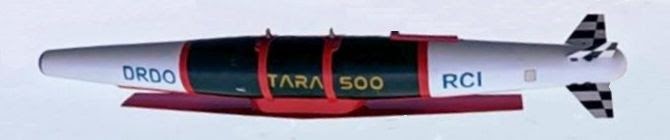
India’s successful flight trials of the Tactical Advanced Range Augmentation (TARA) glide bomb kit mark a decisive step in building affordable, indigenous precision strike capabilities.
By transforming conventional gravity bombs into long-range smart munitions, the Indian Air Force gains the ability to conduct stand-off precision strikes at a fraction of the cost of imported guided missiles, while strengthening self-reliance under the Aatmanirbhar Bharat initiative.
The Defence Research and Development Organisation’s Research Centre Imarat in Hyderabad has developed TARA as a modular range-extension system that attaches to conventional unguided warheads.
The kit has already been tested from Jaguar aircraft and is designed for integration with the Mirage-2000, Sukhoi Su-30MKI, and TEJAS platforms, ensuring wide compatibility across the Indian Air Force’s frontline fleet. This versatility allows India to leverage its existing stockpiles of 250 kg, 450 kg, and 500 kg bombs, converting them into precision-guided weapons without the need for expensive new missile acquisitions.
When released from an altitude of around five kilometres, TARA deploys wings and a tail unit that enable the weapon to glide up to 150–180 kilometres. This extended range ensures that aircraft can release munitions from well outside the reach of hostile air defence systems, greatly improving pilot survivability.
The system employs GPS, Inertial Navigation Systems, and electro-optical guidance to achieve a Circular Error Probable of under five metres, with trials demonstrating remarkable accuracy. This level of precision allows the Indian Air Force to neutralise hardened positions, bunkers, and runways with minimal collateral damage.
The strategic impact of TARA is profound. The system mirrors lessons learned from the war in Ukraine, where low-cost, mass-produced glide bombs proved devastating against fortified targets while keeping launch aircraft safe.
By adopting a similar approach, India changes the economics of modern warfare, enabling the creation of massive precision-strike stockpiles at low cost. This ensures that India can sustain long conflicts without exhausting expensive missile reserves, while reserving premium systems such as BrahMos and SCALP for high-value targets.
TARA’s development also reflects India’s determination to reduce dependence on foreign suppliers. Until now, the Indian Air Force relied on imported precision kits such as SPICE-2000 and HAMMER. TARA provides a homegrown alternative, designed and produced with the support of Indian industry partners under the Development-cum-Production Partner model.
Production activities have already commenced, ensuring scalability and rapid induction into service. Defence Minister Rajnath Singh and DRDO Chairman Samir V Kamat have hailed the successful trials as a milestone in India’s march toward self-reliance in advanced defence technologies.
Globally, the emergence of affordable glide bomb kits has become a defining trend. The United States employs JDAM-ER kits, Russia has developed UMPK glide kits, Israel fields SPICE, and China uses the LS-6 series.
India’s entry into this category with TARA underscores its commitment to keeping pace with global military innovation. By producing such weapons in large numbers, India ensures that its airpower remains competitive and resilient in the evolving landscape of modern warfare.
Ultimately, TARA represents a “workhorse smart bomb” for India’s airpower. It enhances lethality, survivability, and operational flexibility while reducing costs and foreign dependence.
By combining indigenous innovation with industrial scalability, India has positioned itself to sustain long conflicts with a robust arsenal of precision-guided glide bombs, ensuring that its air force can deliver decisive effects in future battles.
IDN (With Agency Inputs)
