

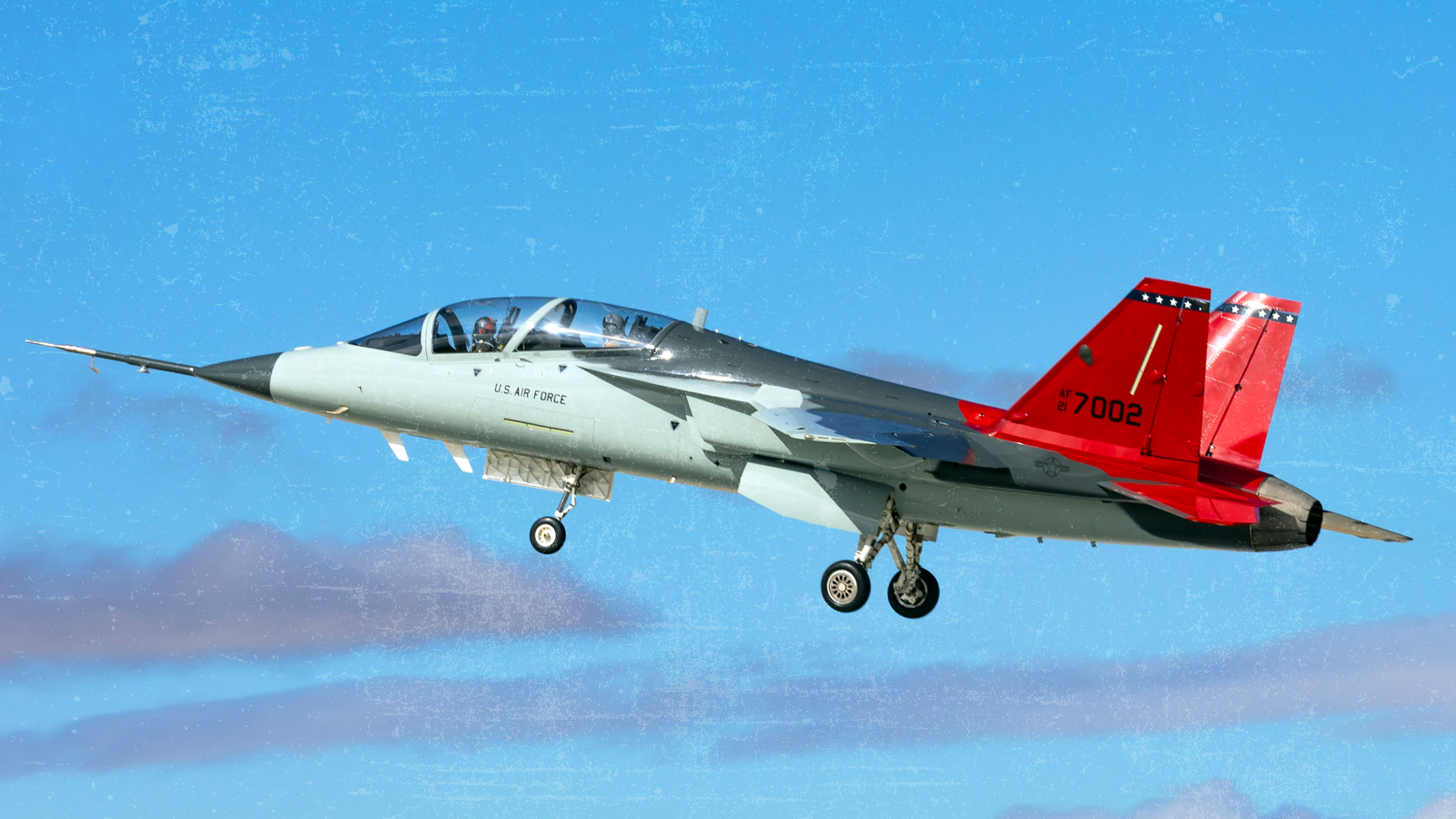
This week, Breaking Defense published a trio of new stories looking at the past, present and future of the T-7 Red Hawk, the Boeing-made trainer jet that the US Air Force intends to use to school the next generation of pilots.
Based on previously unreported documents and bolstered by interview with sources as well as former and current Air Force officials, the investigation — which came in around 7,000 words over the three pieces — provides an unprecedented look at how a key Pentagon acquisition program comes together, and where it threatens to fall apart.
Part one of the project covers the basics of how we got here, while laying out some of the major concerns shared by sources about the state of the program.
Part two focuses on the back and forth between the Air Force and prime contractor Boeing over the data rights to the project, and how that could potentially sabotage sustainment plans going forward.
Part three looks at a previously unreported agreement that could see the service and Boeing make a “horse trade” over data rights for an unrelated program, with the Air Force picking up the tab for buying the T-7’s engines.
Among the findings of the report, which was written by Michael Marrow:
- The first 82 T-7 aircraft are projected to fly with a “serious” airworthiness risk.
- Sources familiar with the program are concerned that attempts to get the T-7 to the fleet faster could increase risk for junior pilots.
- The Air Force has assessed sustainment of the aircraft as “high risk.”
- Internal Air Force documents say Boeing’s failure to provide certain data on the aircraft amounts to “non-compliance” on the part of the company.
- The plane currently cannot fly in the rain, and the program has struggled with a ground-based simulator.
- Air Force and Boeing officials are mulling a plan to change how the government buys the aircraft’s engines, at an “additional” taxpayer cost of up to $1.5 billion, which could come in exchange for technical data Boeing would provide on the company’s 747-8i jumbo jet.
For the series, the Air Force made senior program officials available for interviews, during which they generally acknowledged challenges with the program but maintained a new “active management” regime would rectify many issues. Boeing, for its part, provided a statement in which it said it’s working with the Air Force on “accelerating the path to delivering this critical capability.” Both emphasized that pilot safety was, as Boeing put it, “paramount.”
Do you know more about the T-7, or other major defense acquisition programs? We have a ProtonMail account, and you can reach us at [email protected] securely or reach reporter Michael Marrow on Signal at +1 434-602-0124.
