

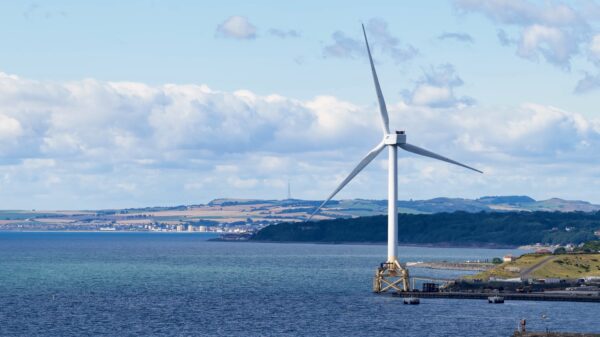
The announcement of a Japan-U.K. Offshore Wind Compact during Prime Minister Takaichi Sanae’s visit to the United Kingdom in mid-June rounds off a turbulent 12 months for the offshore wind energy sector in Japan. Successes such as the Kitakyushu Hibikinada and Goto schemes in Kyushu coming online have been offset by the withdrawal of Mitsubishi from high-profile projects off the Akita and Chiba coasts due to spiraling costs. Much of the blame for these failures has been attributed to the previous rules set by the Japanese government for companies bidding to develop projects, which left developers exposed to inflation and unexpected price hikes.
Without a strong business case, the future for offshore wind energy within Japan looks uncertain. This represents a blow to Japan’s international climate change obligations, within which offshore wind energy is expected to play a small but significant role. Perhaps more significantly, however, Japan’s stuttering offshore wind progress is a cause for concern for shrinking coastal cities such as Muroran in Hokkaido and Choshi in Chiba, which are betting on wind farms in their coastal waters to bring jobs and revenue.
Meanwhile, 10,000 kilometers away, the deal agreed by the British and Japanese prime ministers could enable up to 9 billion pounds in Japanese investment into the United Kingdom’s offshore wind sector. Even before the Japan-U.K. compact was announced, Mitsui & Co had signed a deal to acquire the Port of Nigg, a major Scottish base for North Sea offshore renewables. In just a few months’ time, a manufacturing facility backed by Sumitomo Electric Industries to the tune of 350 million pounds is scheduled to open its doors in the same region. Marubeni too has made multiple investments in Scotland’s offshore wind sector in recent years.
One might conclude Japanese companies are more enthusiastic about enabling the infrastructure for offshore wind in Scotland, and the wider United Kingdom, than in their own country. This is hardly surprising. Both Scottish and U.K. governments have courted Japanese developers for over a decade. Scotland even established an office in Nagasaki to tap into the region’s marine industry cluster. Customs and tax incentives offered by the Inverness and Cromarty Firth Green Freeport, within which the Port of Nigg is located, are an especially big draw for Japanese companies working in the offshore renewable energy supply chain.
As Japan’s government works to reboot its offshore wind policies and keep its climate obligations on track, it could learn from locations like Scotland and the wider U.K. that have persuaded Japanese developers to open their wallets and commit to projects. However, Scotland’s model is not perfect. Tax and customs incentives are favorable for companies, but reduce direct revenue to the country. While encouraging the private sector to invest in factories and fabrication yards might protect jobs in the short term, it leaves regional economies – whether in Scotland or Japan – at the mercy of boardroom decisions in Tokyo and cities like it.
Measures to renew energy systems and reduce emissions must work for coastal communities hosting offshore wind-related infrastructure. For Japan’s coastal towns, often dependent on income from fossil-fueled power stations, petrochemicals, or other industrial clusters, new jobs and economic models are urgently needed to realize a just transition that does not leave the people and places associated with high-emitting sectors behind. Recent research published in the scholarly journal Environmental Research: Energy found that local governments close to the proposed Enoshima offshore wind farm in Nagasaki are enthusiastic about the possibility of green jobs coming to a region heavily reliant on coal-fired power stations and shipbuilding.
However, the same study also found that municipal and prefectural bodies are calling out for technical support now, to ensure their ports and coastal industries are in shape to take on operations and maintenance work over the coming decades. Analysis by the Renewable Energy Institute argued that a lack of suitable port infrastructure, rather than finances or technical challenges, could in fact be the most critical barrier facing the offshore wind sector in Japan.
The update of Japan’s offshore wind policies to create a more favorable economic environment is an opportunity to ensure domestic renewable energy supports a just transition within Japan as well as overseas. For example, government grants to ports and supply chain companies could bring local facilities up to the standard required to deliver complex offshore wind projects on time and to budget. Training programs and housing support may give young people in more remote municipalities the opportunity to find skilled work close to home in an emerging sector.
The experience in Scotland and the United Kingdom shows that with the right incentives and policies, Japan’s big players have the will and technical knowhow to make offshore wind happen. But for offshore renewables to support a sustainable and net-zero Japan, regional ports, supply chain companies, and local workforces must be equipped to benefit.
