

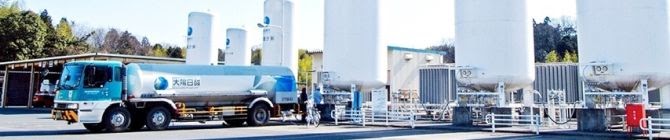
Tomoe Shokai, a long-established Japanese gas trading company, has announced plans to expand its footprint in India with a new factory in Gujarat scheduled for the 2027 fiscal year.
The company, which has been trading various gases domestically and overseas for decades, describes its role as providing the “invisible infrastructure of society.”
The company’s portfolio includes high-pressure gas, medical treatment gas, special chemical gas, and gases for electronics and vehicles. Domestically, its supply chain is robust enough to meet diverse customer requirements, while internationally it operates 14 bases across 10 countries.
Tomoe Shokai’s overseas expansion began in 1989 with Thailand, where it supplied sterilised gas to customers, later extending its services to the automotive sector. As Japanese companies required specialised gases, Tomoe Shokai ensured their needs were met. This network subsequently expanded to the Philippines, Vietnam, Singapore, Malaysia, and other Southeast Asian nations.
India first came into Tomoe Shokai’s orbit in 2008, when the company began procuring sterilised gas material from a major Indian firm. The cooperation proved successful, leading to the establishment of Tomoe India in 2012. This subsidiary became a base for gas production and supply to Southeast Asian countries.
With India’s economic progress accelerating, Tomoe Shokai now plans to launch a new factory in Gujarat. The facility will produce medical treatment gas and related infrastructure, while also serving the electronics industry, including the semiconductor sector.
It will function as a logistics centre and warehouse, ensuring reliable supply chains. The project is expected to meet the growing demand for gases in India’s medical and sanitary industries, as well as in semiconductor and electronics manufacturing.
Executive officer Masahiro Harada has highlighted the importance of this initiative, noting that 96 per cent of sterilised gas facilities in India are currently imported. As India’s GDP rises, medical care standards are expected to improve, and Tomoe Shokai aims to contribute by supplying essential gases and facilities.
Harada emphasised that every Tomoe Shokai facility is designed to support a clean environment, enabling both industrial growth and improved social living standards.
The company’s confidence in contributing to India’s clean society stems from its experience in overcoming public pollution and environmental challenges during Japan’s rapid economic growth in the 20th century. Drawing on this legacy, Tomoe Shokai intends to help India balance industrial expansion with environmental responsibility.
This expansion reflects Tomoe Shokai’s broader strategy of embedding itself within fast-growing economies, ensuring that critical sectors such as healthcare and electronics have access to reliable gas supplies. The Gujarat facility will not only strengthen India’s industrial ecosystem but also reinforce Tomoe Shokai’s role as a trusted partner in Asia’s economic development.
ANI
