

In early September, the World Nomad Games returned to Kyrgyzstan for the first time in eight years. That same week, a Shanghai Cooperation Organization summit was hosted in Bishkek. The capital went quiet.
Main roads were sealed off for motorcades. Shopping centers along the official routes closed. Residents were told, early and in public: if you can get out of town, get out. By September 1, traffic maps showed more than eighty restrictions. The streets were almost empty.
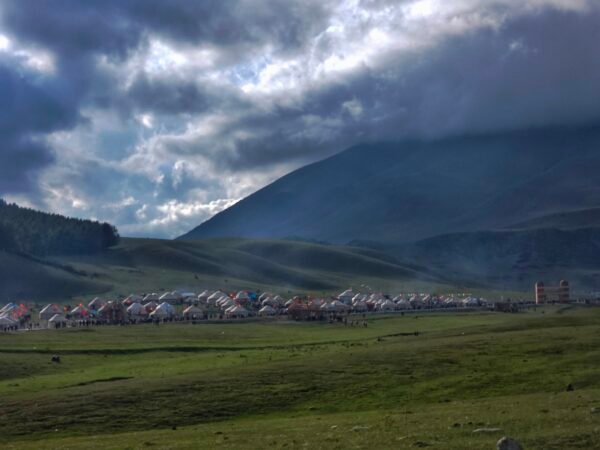
A few hours east, Kyrchyn gorge came alive. Yurts covered the meadow. Clay forts — built to recall the ancient Silk Road era — rose over the grass. Organizers said 150,000 people came through on day one. Visitors argued over bus seats. Private cars were turned away.
Bishkek was told to clear out and shut down. The summer pasture was told to put on a show.
Bishkek Arena, the 51,000-seat stadium built for the World Nomad Games opening. Aug. 31, 2026. Photo by Aigerim Turgunbaeva.
The Making of the Picture
Eight years ago, when the games were last held beside Issyk-kul, the barricades and the spectacle were centered there. This time the games opened in the new Bishkek Arena, a 51,000-seat stadium, on the same weekend as the SCO summit. In the stands: Russian President Vladimir Putin, Chinese leader Xi Jinping, Indian Prime Minister Narendra Modi, and Türkiye’s President Recep Tayyip Erdogan.
At the opening, Kyrgyz President Sadyr Japarov said: “Our foundation is independence, and our roots are in nomadic civilization. Our course is international friendship and partnership, and our future lies in building a developed, strong new Kyrgyzstan.”
He also announced that Kazan, in Russia’s Tatarstan, would host the next games in 2028. Moscow had sent a formal request, he said, and he thanked Putin.
Security around the opening ceremony was tight. Snipers stood on the arena roof. A three-kilometer radius was closed for the day. Japarov walked onstage as more than the host of a festival; he was a leader confident in the power he’s consolidated around himself.
In February 2026, Japarov dismissed his longtime ally, then-head of the State Committee for National Security Kamchybek Tashiev, breaking a tandem that had ruled Kyrgyzstan since 2020. In January 2027, he’ll run for president again.

Residents wait at a Bishkek crossing they were not allowed to use. Aug. 31, 2026. Photo by Aigerim Turgunbaeva.
The games were still about horses, yurts, and Kok Boru. The narrative frame around them is not. This was no longer a carnival by the lake, it was a state showcase.
Closer to the SCO summit, the main roads from the airport and through the center of the capital were shut down. Public transport was rerouted. Big malls and markets closed. On September 1, Bishkek really did empty out. Traffic cameras showed almost nothing moving.

A Bishkek street closed for the SCO summit, blocked with trucks. Sept. 1, 2026. Photo by Aigerim Turgunbaeva.
Anyone still on the main streets when the motorcades passed by was taken out of the shot. Pedestrians were told to duck onto side streets. If they were already in the roadway, they were sent down into the underpasses. Tourists who had come for the games stood underground alongside locals and tried to work out what was happening.
“I don’t understand why they treat their own people like this,” a tourist from Germany said. “Why are they hiding them?” She sounded more confused than angry.
Who Gets to Be in the Frame
Kyrchyn was very far from the silenced capital. Yurts covered the meadow. Fortress walls and towers rose above them — not two props at the gate, but the whole outline of a town. Each of Kyrgyzstan’s seven regions, alongside Bishkek and Osh, had its own camp: its yurts, its food, its dancers. It rained. People danced anyway.
Getting to the gorge was a daunting challenge, one many took on. You could not drive in. There were not enough free buses. People waited more than an hour and argued over seats. Those who made it arrived at a crowded, wet, very loud festival. Foreign visitors filmed what they had come to film, and they looked just as happy as the locals. A Brazilian creator with some 300,000 followers said her Issyk-kul videos were “blowing up” at home. An Australian couple looked at the yurts in the mountain meadow and said, “This is exactly how we pictured it.” Social media — and not only in Kyrgyzstan — was filled with dancing in the rain and the opening-night spectacle. The opening ceremony’s dance caught on far beyond Kyrgyzstan. Users in neighboring countries filmed themselves repeating the choreography.
Since 2016, the World Nomad Games sporting program has almost doubled, from 23 sports to 43. Women have entered several of them. In Kyrgyz-style horseback archery this year, 45 women from 32 countries competed. On paper, that looks like a tradition opening up. On the ground, the archery field became one of the most crowded spots for journalists. Women in national dress, galloping, trying to hit a mark against not-so-distant snowy peaks, photographed beautifully.
It was less beautiful up close. Kyrgyzstan’s women’s team was put together in two weeks. One coach ran both the men’s and women’s squads, but the focus stayed on the men. Equestrian sport is still treated as male territory in Kyrgyzstan. A woman, in the old traditions, is decoration — as are the girls in kyz kuumai, the bride-chase game.

Aidana Usenbekova after her last horseback archery run. Kyrchyn gorge, Sept. 3, 2026. Photo by Aigerim Turgunbaeva.
“We ride no worse. We shoot no worse. Sometimes better,” said Aidana Usenbekova, 28, one of three Kyrgyz women on the horseback archery team. “All the horse sports are still seen as men’s sports. For the few girls who even get seen and make the national team, it’s twice as hard. We’re still fighting the stereotypes here. We didn’t even have time to prepare properly. We still put in a strong performance.”
Right before the start of the competition, their mounts were handed to other riders.
“They told us those girls were guests, and we had to take whatever horses were left.”
Aidana cried, then and there, out of sheer frustration at the perceived insult.
“That’s the attitude toward women in this sport. It’s contempt. It happened right before we went out. We all walked into the competition like that.”
The games needed the female archers. They look good in the frame: a woman on a horse, a bow, the mountains behind.
On September 6, at the hippodrome in Cholpon-Ata, Kyrgyzstan beat Kazakhstan 12-0 in Kok Boru, then 7-2 in Kokpar the same day — the two games are similar but the former is Kyrgyzstan’s traditional version and the latter Kazakhstan’s. The stands roared. This was the spectacle the games were invented for. Fans had come from every region for that match.
“I came for Manas,” said Tashtan, 75, who traveled from Uzgen for Kok Boru, referring to the legendary Kyrgyz hero. “I’m a big fan of his.”
There was a mess with tickets. More were sold than there were seats — fraud, people said. Japarov stepped in and ordered the gates be opened to anyone who wanted in. People who had bought tickets and waited in the crowd for the final never made it into the stadium.

The opening ceremony of the World Nomad Games at Bishkek Arena. Aug. 31, 2026. Photo by Aigerim Turgunbaeva.
From Festival to State Showcase
Political analyst Temur Umarov doubts the leaders’ schedules were ever fully in Japarov’s hands. But the dates for the games and the SCO summit luckily lined up. Japarov used the week, Umarov says, to show Kyrgyz voters what he has long promised: order, a Kyrgyzstan visible in Central Asia on political par with Kazakhstan and Uzbekistan, something to be proud of. The show had two audiences. The main one was at home.
“The core audience this was aimed at,” Umarov said, “was Kyrgyz citizens.”
On September 9, after the games had closed, Japarov said as much in parliament. The world, he argued, had “seen Kyrgyzstan at a new level and in a new quality.”
Political scientist Asel Doolotkeldieva asks not to reduce the whole week to the coming election. Since Japarov took power, she says, the bet has been on raising the country’s regional standing and widening its foreign ties. His own popularity rises with that but it is not the only point.
“Holding the SCO summit and the Nomad Games together is tied to Independence Day,” she said. “That is a major date for Kyrgyz society. It is meant to scale both the domestic and the external message: Kyrgyzstan now has a stronger state and a sharper identity.”
The spectacle worked, she said. From migrants abroad to ethnic minorities at home, there was “an explosion of pride,” a sense of belonging, support for the current course. “The project hit a very raw nerve, and it hit it on time.”

A clay fortress built for the Games in Kyrchyn gorge. Sept. 3, 2026. Photo by Aigerim Turgunbaeva.
Japarov’s position ahead of the January 2027 election is, in her view, solid. He has never relied on force alone. For many people, a “strong state” means schools, clinics, housing. The scale of the games felt like a summing-up of those efforts. Many citizens attach that record to him.
At the opening ceremony in the Bishkek Arena, the field turned into mountains, a waterfall, a ring of people. Riders circled. For many in the stands — and far beyond them — the games were not a summit and not a campaign. They were a return of what had long been treated as the periphery: the yurt, the horse, Kok Boru, the right to call yourself a nomad at full volume. You could hear that in the arena without any political theory attached.
On the evening of September 6 in Cholpon-Ata, the games closed and the baton passed to Kazan. Kyrgyzstan left its guests the picture it wanted: horses, yurts, a Kok Boru win, a country able to bring the world to its door.
I was at the first World Nomad Games in 2014 as a reporter. Back then, there was no immense grandeur, and nothing like the hordes of journalists or tourists seen this year. There were barely any local spectators at those games. Kyrchyn — now 52 hectares of staged nomadic life, with helipads and good asphalt — was back then just a pasture reached on a dirt road that barely cut through the mountains. The yurts belonged to herders, to people who actually lived that way. Cholpon-Ata had no rebuilt venues, no giant sports grounds, no food courts imported from the capital — only local vendors wrapping up the summer season. Bishkek had not yet been built over. It still had its Soviet texture, old Manas statues on the square, the White House with its black fence.
Japarov did not invent the games, although he commanded them in 2026. The first edition was a project of then-President Almazbek Atambayev.
I was at the games in 2016 and 2018, too, both held in Kyrgyzstan because they had not quite caught on enough for other countries to clamor to host them. In those years I was asked to produce a magazine for visiting delegates, ambassadors, diplomats with bright copy on the main contests, the conferences, ethno-fashion, nomadic heritage.
Coming back in 2026, I could see how far the project had grown: the festival as a tool of national image-making, and the political frame around that image. What I missed from the first games was something that is harder to stage — the spirit of it, people who did not don nomadic culture for a festival but carried it within them always.
The picture in 2026 was not fake. In Kyrchyn, they really did dance in the rain. In the arena, they really did roar, and they were proud of the country. The games put on display the Kyrgyzstan the state wants the world to see. And it demonstrated how tightly Bishkek is prepared to hold that picture in the frame.

Spectators at the Kok Boru venue in Cholpon-Ata. Sept. 3, 2026. Photo by Aigerim Turgunbaeva.
