

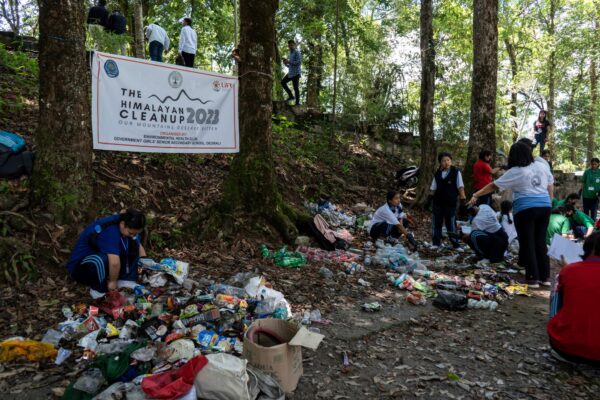
Every cleanup in Ladakh, India, tells the same story. Volunteers arrive expecting pristine mountains, crystal-clear streams, and breathtaking landscapes, only to find colorful snack wrappers buried in the soil, plastic bottles washed into rivers, and food packaging scattered across mountain slopes. Visitors move on, but leave their rubbish behind.
More than just a litter problem, this is evidence of a broken system that continues to push disposable plastic into one of the world’s most fragile mountain ecosystems while expecting local communities to manage the consequences.
The evidence gathered through The Himalayan Cleanup (THC) 2025 and 2026, coordinated by Little Green World, Navikru Eco Foundation, and local stakeholders, leaves little room for doubt. In 2025, volunteers cleaned 59 sites across Ladakh and documented 22,582 waste items, with more than 21,000 of which were plastic. Just over 74 percent of the plastic collected was non-recyclable.
One year later, THC 2026 painted an equally worrying picture. Across 19 cleanup sites, 1,050 volunteers from 23 schools and organizations collected 19,521 waste items, of which 18,709 (95.8 percent) were plastic. Even more alarming, 75.6 percent of this plastic was non-recyclable, while 71.5 percent consisted of multilayer packaging – the wrappers used for chips, biscuits, confectionery and other everyday products that have little recycling value.
Importantly, food packaging accounted for 73 percent of all plastic collected, followed by smoking-related products (18.7 percent) and personal care products (7.1 percent). These are products consumed within minutes, whose packaging can remain in the environment for decades.
In Ladakh’s cold-desert ecosystem, where decomposition is slow and waste infrastructure is limited, plastic accumulates in the landscape, contaminates water sources, threatens wildlife, and often ends up being openly burned, releasing toxic pollutants into the air.
Perhaps the most important finding from the cleanup is where most of the plastic came from. Brand audits repeatedly identified packaging from major companies, including ITC, PepsiCo, Nestlé, Coca-Cola, Perfetti Van Melle, Parle Agro, Britannia, Haldiram’s, GCMMF (Amul), Mondelez, and Dabur India.
This is not about blaming individual companies. It is about recognizing that corporations benefiting from the sale of packaged products in Ladakh must also share responsibility for recovering and managing the waste those products generate. For too long, the responsibility has fallen almost entirely on schools, volunteers, local communities, and municipal workers. Every year they organize cleanup drives, collect thousands of pieces of plastic, and restore the landscape – only to repeat the same effort the following year.
Cleanup campaigns are essential because they build awareness and generate evidence, but they cannot solve a problem rooted in unsustainable production and consumption. Ladakh does not need more cleanups alone; it needs stronger policies and shared responsibility.
The Ladakh Administration and policymakers must strengthen Extended Producer Responsibility (EPR) by ensuring that companies finance the collection and recycling of the packaging they introduce into the region, while prioritizing absolute caps on plastic production. Producers of such disposable consumer goods cannot recycle their way out of this crisis; they must actively phase out single-use packaging altogether and invest heavily in toxic-free, reusable delivery systems, instead of shifting the burden onto mountain communities.
The tourism sector – including hotels, restaurants, and tour operators – must also reduce its dependence on single-use plastics by promoting refill stations and reusable alternatives. Consumers also have a role to play by choosing reusable products, segregating waste, and demanding sustainable packaging from the brands they support.
Ladakh did not create this plastic problem, and it should not be expected to solve it alone.
