

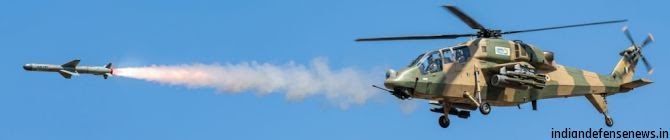
The Light Combat Helicopter (LCH) Prachand has achieved a significant milestone with the successful demonstration of its HELINA anti-tank guided missile (ATGM), underscoring India’s progress in indigenous rotary-wing strike capabilities.
This event is part of a broader roadmap that integrates advanced weapon systems and electronic warfare suites into the platform, ensuring its readiness for frontline deployment in high-intensity combat environments.
The electronic warfare suite is expected to be fielded within the next six months. Entirely indigenous, it will comprise a Radar Warning Receiver, Laser Warning Receiver, and Missile Approach Warning System.
The MAWS will be linked to Directed Infrared Countermeasures (DIRCM), enabling active countermeasures against incoming threats. While the DIRCM unit itself is slated for later integration, its inclusion will mark a major leap in survivability against modern missile systems.
This layered defensive architecture reflects India’s determination to reduce reliance on imported subsystems and build a fully indigenous combat helicopter capability.
On the weapons front, HELINA ATGM trials are progressing smoothly. The missile, designed for precision strikes against armoured targets, will first complete its validation on the Advanced Light Helicopter (ALH) platform by April 2026.
Following this, integration and trials on the LCH Prachand will commence, aligning with the broader induction timeline set for 2028.
This phased approach ensures that technical risks are mitigated while maintaining momentum towards operational readiness. The HELINA, with its fire-and-forget capability and high hit probability, will significantly enhance the Prachand’s lethality in high-altitude warfare scenarios.
The successful HELINA firing demonstration is therefore not an isolated achievement but part of a carefully sequenced program that combines indigenous avionics, electronic warfare systems, and advanced weaponry.
By 2028, the Prachand is expected to field a comprehensive suite of offensive and defensive technologies, positioning it as one of the most capable attack helicopters in its class. This progress also reinforces India’s broader defence modernisation drive under Aatmanirbhar Bharat, ensuring that critical combat platforms are sustained by domestic innovation and production.
IDN (With Agency Inputs)
