

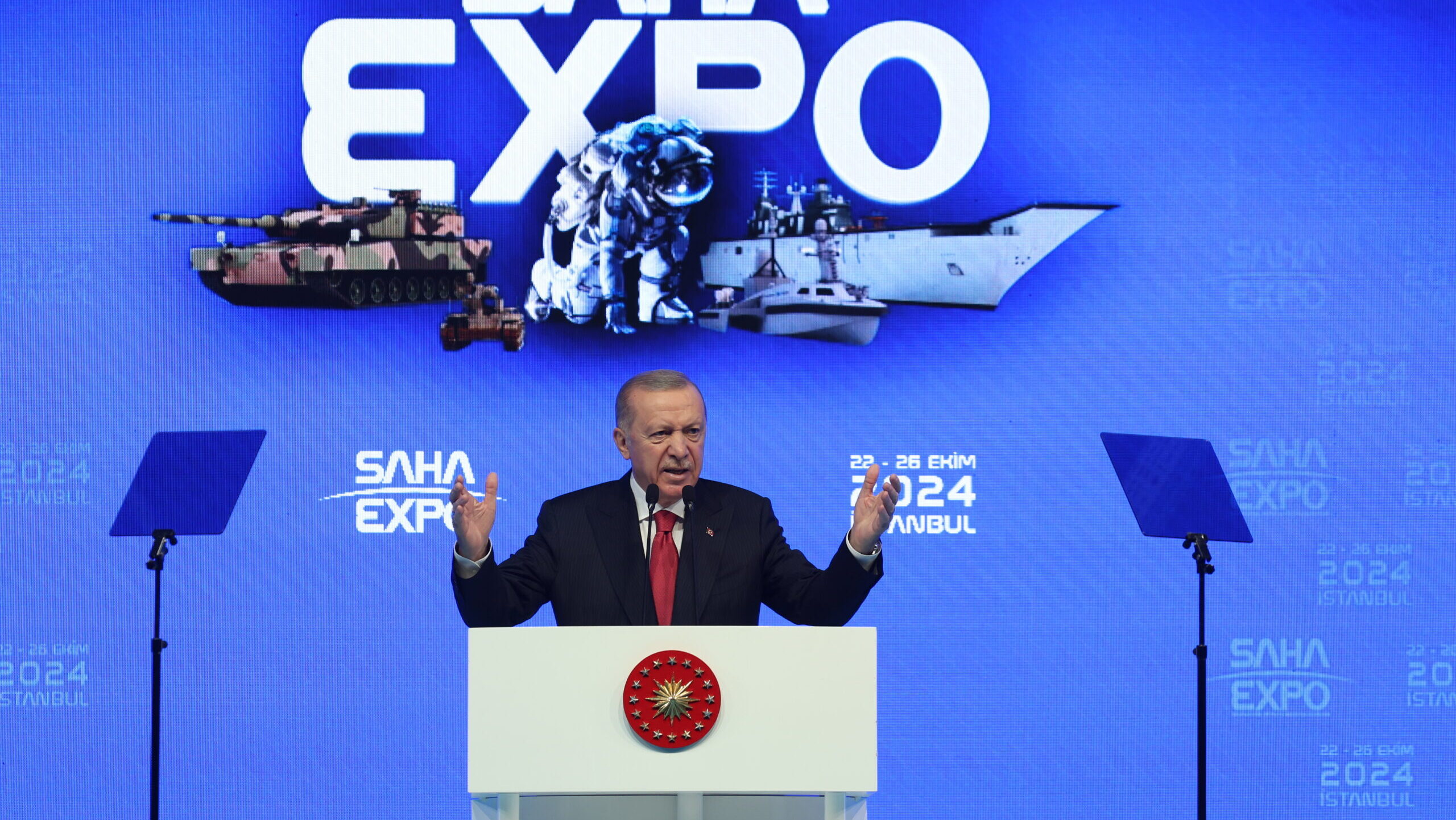
BEIRUT — Organizers of the biennial SAHA defense expo plan to take the funds from what is expected to be an all-time attendance and funnel them back into creating drone production facilities in each of Turkey’s 81 provinces, officials said ahead of the show, which opens May 5.
Haluk Bayraktar, chairman of the board of directors of SAHA and the CEO of Turkish drone manufacturer Baykar, told media on an April 25th preview call that in 2024, deals announced at SAHA totaled $6.2 billion. This year, he said, the target is $8 billion.
According to the organizers, more than 1,700 companies will participate in the edition of the show, a large leap from the initial 17 firms participating in the first edition of the show in early 2000s. Roughly 260 of the companies taking part will be from abroad.
“SAHA 2026 is poised to be the most ambitious edition yet, with expectations for record-breaking numbers of exhibitors, visitors, and floor space. Notably, there will be a significant increase in international participation from the Gulf, Asia-Pacific, North Africa, and Europe,” Ali Bakir, defense analyst and professor at Qatar University, told Breaking Defense.
He pointed that “SAHA has evolved from a national showcase into a genuine global meeting point for the defense and aerospace industry, and the 2026 edition will reflect this maturity.”
Which is why the plan, stated by Bayraktar to invest revenues from the show itself back into Turkey’s industrial base may prove so fruitful.
“We’ll use the revenues from the SAHA expo to establish these centers, which will help us instantly achieve the production capacity of millions of drones nationwide at any given moment,” he said, emphasizing that the goal is to have drone production and training centers in all 81 provinces of Turkey.
However, the announcement was light on details, with Bayraktar offering no timeline for setting them up nor explaining what revenues from SAHA would be tapped for this initiative. He did say that the largest one will be in Istanbul, and that these centers will be open to the public in an attempt to encourage youths to take part of the drone sector, from training to testing.
Serhat Süha Çubukçuoğlu, an expert at TRENDS Research & Advisory in Abu Dhabi, told Breaking Defense that this move could help decentralize drone production across the country.
“Economically, this initiative spreads the defense-industrial base beyond Istanbul, Ankara, Eskişehir, and other traditional hubs,” he said. “It aligns with Turkey’s broader strategy to decentralize industrial production by expanding it beyond its traditional concentration in Istanbul and the Marmara region to other parts of the country. It could generate local skills, create a pipeline of technicians and engineers, and connect youth to defense technology.”
Çubukçuoğlu added that opening drone production centers in all provinces shifts Turkey’s drone production “success from a company-oriented or platform-based achievement into a nationwide defense-industrial mobilization model.”
What To Look For At The Show
As usual for this kind of event, expect firms to come armed with products they want to show off, be it all new systems or modifications of existing ones.
For instance, Baykar announced that it will debut its “MIZRAK Intelligent Loitering Munition,” which it claims comes with a range above 1,000 km and AI-assisted features.
Local media outlets reported that Havelsan will unveil a new vertical take-off and landing one-way attack drone, while missiles manufacturer giant Roketsan shared on its X handle a dimmed image of a smart micro munition called MAM. The post described it as a “new player,” which has “high-precision strike capability on pinpoint targets and minimum collateral damage performance.”
Vehicles producer MKE is expected to debut air defense artillery and naval systems, including its Enfal 17 laser counter-drone system. STM will launch six new platforms at the show, including long-range loitering munition and a new version of its Alpagu fixed-wing, one-way attack drone. In the maritime domain, STM said it will unveil two autonomous platforms: a one-way Unmanned Surface Vessel (USV) and an Extra Large Unmanned Underwater Vehicle (XLUUV).
International companies will also have their share in this show. Eurofighter’s Typhoon jet is expected to be in the static display of the show. In October 2025, Turkey inked a deal to procure 20 Eurofighter Typhoons, worth $10.66 billion, in what the UK prime minister’s office described the as “the biggest fighter jet exports deal in a generation.”
“The systems being unveiled, from new-generation missiles to unmanned platforms across air, land, and sea, reflect a mature industrial base capable of delivering combat-proven solutions at competitive cost and timelines,” Bakir said.
Çubukçuoğlu noted that the offerings tell a story about where Turkey’s defense industrial base is on the global scale. Turkey, he said, “offers training, doctrine, maintenance, co-production, and political partnership. The challenges, however, are engine technologies, high-end sensors, semiconductor manufacturing, financing, and competition from larger, established suppliers.
“Overall, Turkey is likely to become not a full-spectrum defense producer, but a highly competitive middle-power defense hub specializing in drones, missiles, naval systems, armored platforms, and scalable battlefield technologies,” he added.
