

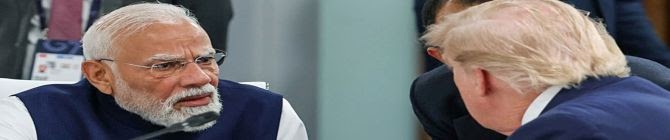
Prime Minister Narendra Modi and US President Donald Trump are set for a crucial bilateral meeting today on the sidelines of the G7 Summit in Evian, France, with the West Asia crisis, energy partnership, and the India-US trade deal dominating the agenda.
The talks come amid instability in the Strait of Hormuz, recent maritime incidents involving Indian nationals, and the final stages of trade negotiations between the two nations.
The meeting between Prime Minister Modi and President Trump is scheduled for 17 June, during the 52nd G7 Summit. Both leaders are expected to deliberate on the volatile situation in West Asia, particularly the strategic Strait of Hormuz, which remains one of the world’s most critical shipping routes for oil and gas supplies. Instability in the region has disrupted global energy markets and maritime trade, raising concerns for India’s energy security.
India and the United States are keen to build a long-term energy partnership. Discussions are expected to focus on strengthening cooperation in the energy sector, with India seeking to diversify its energy imports and reduce vulnerabilities caused by regional tensions.
The United States has emerged as a significant supplier of crude oil and LNG to India, and both sides are exploring ways to expand this cooperation further.
The proposed India-US trade deal is also high on the agenda. Negotiations have been progressing steadily, with sources indicating that the agreement is in its final stages and could be completed in the coming weeks.
This follows the interim trade agreement reached in February after a year of talks, which laid the groundwork for a comprehensive pact. The White House has confirmed that advancing the trade deal will be a central focus of the Modi-Trump meeting.
The significance of this meeting is heightened by recent maritime incidents. Earlier this month, three Indian nationals lost their lives in the Gulf of Oman when a Palau-flagged oil tanker, reportedly transporting Iranian oil, was struck by US forces over an alleged blockade violation.
This tragedy underscored the risks faced by seafarers and the broader consequences of regional instability. Prime Minister Modi has emphasised the need to ensure the safety of seafarers engaged in global maritime trade, calling it a collective responsibility of the international community.
Addressing the Outreach Session on “Forging New Partnerships and Rebuilding International Solidarity” at the G7 Summit, Prime Minister Modi welcomed progress in peace efforts in West Asia but highlighted the humanitarian and economic toll of the conflict.
He noted that disruptions in maritime trade through the Strait of Hormuz have affected the global economy and caused loss of life and property in friendly countries. Modi reiterated that lasting solutions to global conflicts can only be achieved through dialogue, diplomacy, and international cooperation.
The G7 Summit itself has been dominated by discussions on global security, economic disruptions, and public health emergencies. Leaders have focused on the wars in Ukraine and West Asia, the Ebola outbreak in Africa, and the recently announced US-Iran peace framework.
European leaders have pressed President Trump to ensure that the deal with Tehran addresses nuclear, missile, and regional security concerns comprehensively. Meanwhile, G7 leaders have pledged joint action against drug trafficking, money laundering, and organised crime, with maritime security emerging as a key theme.
India’s participation in the G7 Summit marks its 13th appearance as a partner nation and Prime Minister Modi’s seventh consecutive attendance. His interventions have consistently stressed the importance of safeguarding maritime routes, protecting seafarers, and fostering trust-based partnerships in an interconnected world.
The Modi-Trump meeting today is expected to reinforce India’s strategic alignment with the United States while addressing immediate challenges in energy security and trade.
ANI
