

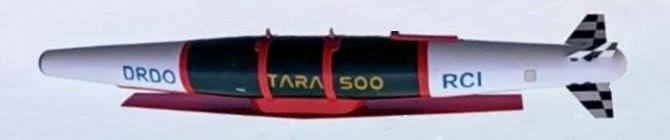
The Defence Research and Development Organisation’s Tactical Advanced Range Augmentation, or TARA, is far more significant than it first appears. For the Indian Air Force, it represents a relatively low-cost way to convert existing unguided gravity bombs into precision-guided stand-off weapons.
In modern air warfare, this is a major force multiplier, as it makes old bomb stockpiles far more lethal without the need to procure expensive new missile systems.
India already possesses large inventories of conventional gravity bombs, and TARA acts as a modular guidance and glide kit that transforms them into smart precision weapons. This approach delivers several critical advantages: lower cost per strike, faster mass production, and the ability to sustain long conflicts. Precision weapons are consumed rapidly during wars, and TARA ensures that India can maintain high-volume precision strike capability without exhausting its missile reserves.
One of the most important features of TARA is its stand-off attack capability. Modern air defence systems are increasingly dangerous, and aircraft cannot always fly directly over targets. With TARA, aircraft such as the Jaguar and Su-30MKI, and potentially TEJAS and Rafale in future integrations, can release bombs from safer distances while the weapon glides toward its target. This improves pilot survivability and enhances mission success rates.
The system deploys wings and tail units after release, using inertial navigation, GPS-assisted guidance, and electro-optical seekers to achieve accuracy levels of under five metres, with some trials recording even tighter precision.
India has so far relied on imported precision kits such as SPICE 2000 and HAMMER. TARA is essentially India’s indigenous equivalent, designed to fulfil many of the same strike missions at a fraction of the cost.
Analysts have compared its concept directly to SPICE glide bombs, but the homegrown system offers the added benefit of reducing dependence on foreign suppliers. Developed by Research Centre Imarat in Hyderabad with support from other DRDO laboratories and Indian industry partners, TARA is being produced in 250 kg, 450 kg, and 500 kg configurations, with ranges of 150–180 km when released from altitude. Production activities have already commenced under the Development-cum-Production Partner model, ensuring scalability and rapid induction.
The strategic importance of TARA is particularly evident in scenarios involving Pakistan and China. Against both adversaries, the IAF requires high-volume precision strikes for suppression of enemy air defences, runway attacks, bunker destruction, and deep strike capability.
TARA could become one of the “mass use” precision weapons for such missions, while more expensive systems like BrahMos and SCALP are reserved for high-value targets. In this sense, TARA is best understood as a “workhorse smart bomb” that complements India’s premium strike assets.
Globally, the development of affordable precision glide bombs has become a defining trend in modern warfare. The United States employs JDAM-ER kits, Russia has developed UMPK glide kits, Israel fields SPICE, and China uses the LS-6 series.
India’s entry into this category with TARA underscores its determination to keep pace with global military innovation while pursuing self-reliance under the Aatmanirbhar Bharat initiative. The ability to produce such weapons in very large numbers is one of TARA’s greatest advantages, as wartime conditions demand thousands of precision weapons rather than a few hundred premium missiles.
Ultimately, TARA represents a milestone in India’s defence modernisation. It enhances lethality, survivability, and operational flexibility for the IAF, while reducing costs and dependence on foreign systems.
By combining indigenous innovation with industrial scalability, India has positioned itself to sustain long conflicts with a robust arsenal of precision-guided glide bombs, ensuring that its airpower remains competitive in the evolving landscape of modern warfare.
IDN (With Agency Inputs)
