

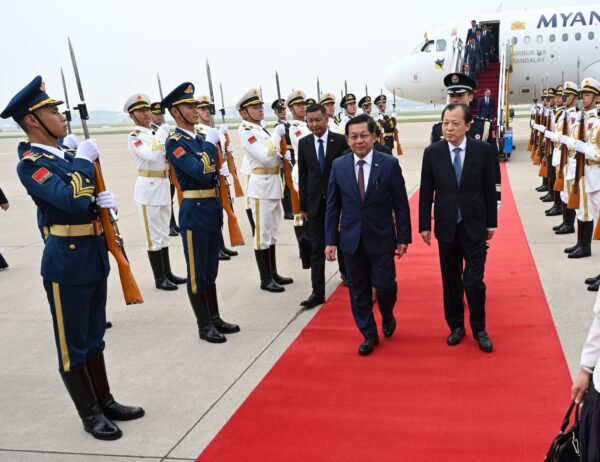
The leader of Myanmar’s new military-backed government yesterday began a five-day visit to China, his first to the country since being appointed president in April.
During the trip, Min Aung Hlaing is set to hold talks with Chinese leader Xi Jinping, Premier Li Qiang, and Zhao Leji, the chairman of the Standing Committee of the National People’s Congress of China, the two nations said in separate announcements.
Arriving in Beijing yesterday, the 69-year-old was received with the full red-carpet treatment. According to a report in the state-run Global New Light of Myanmar, “a Chinese child and a Myanmar child presented bouquets to welcome the delegation led by the President.” He was then driven to the Diaoyutai State Guesthouse, and received “warm and enthusiastic welcomes” en route.
Chinese Foreign Ministry spokesperson Lin Jian told a regular news conference on Friday that China hopes to use this visit to renew its friendship with Myanmar and deepen “comprehensive strategic cooperation,” the AFP news agency reported.
The Myanmar state media was slightly more forthcoming, stating that Min Aung Hlaing “will engage in cordial and open exchanges of views on matters aimed at further strengthening the existing Pauk-Phaw relations between Myanmar and China, as well as enhancing cooperation between the two governments and peoples in various sectors, including economic and security affairs.” (“Pauk-Phaw” is a special term that the two nations have used to describe their “fraternal” ties since the early 1950s.)
In addition to meetings with China’s top leaders, Min Aung Hlaing will meet with provincial leaders and business representatives. He is also scheduled to “attend an economic conference, and visit advanced high-tech industrial enterprises.”
The trip is Min Aung Hlaing’s second since he was sworn in as president in April, following a multi-phase election that was widely criticized as a ruse to perpetuate the military’s hold on power. The election was boycotted by many opposition parties, and dominated by the military’s political proxy, the Union Solidarity and Development Party. It was also canceled in many parts of the country that were affected by conflict or under the control of armed resistance groups.
Since taking office, Min Aung Hlaing has launched a campaign to normalize Myanmar’s relations with the key regional partners. Late last month, he embarked on a five-day state visit to Myanmar’s other major neighbor, India, where he met with Prime Minister Narendra Modi and a host of other officials and business leaders. He and Modi reportedly “underscored the importance of strengthening bilateral cooperation” and pledged to strengthen cooperation in technology, energy, critical minerals, and crossborder infrastructure.
Min Aung Hlaing’s trip to China comes after Wang Yi hosted his Myanmar counterpart Tin Maung Swe in Beijing in early June. During their meeting, Wang said that China “stands ready to work with Myanmar’s new government to strengthen high-level exchanges, enhance political mutual trust, and deepen strategic cooperation,” according to a Xinhua report.
Tin Maung Swe said Naypyidaw was “willing to enhance high-level exchanges with China,” promote Chinese investment in Myanmar, and to advance the construction of the China-Myanmar Economic Corridor, a group of infrastructure projects linking China’s Yunnan province to Myanmar’s coast on the Andaman Sea. He also promised “to resolutely combat online gambling and telecom fraud and make every effort to safeguard the safety of Chinese personnel, institutions and projects in Myanmar.”
Attention has been focused on Min Aung Hlaing’s trip by the arrest in China earlier this month of a Myanmar-born U.S. citizen who headed a prominent think-tank focusing on Myanmar. Min Zin, the co-founder of the Institute for Strategy and Policy-Myanmar (ISP-Myanmar), was arrested in early June in the city of Kunming. He has since “been placed under criminal detention by the relevant authorities in accordance with the law on suspicion of engaging in espionage and endangering China’s national security,” China’s Foreign Ministry spokesperson said last week.
ISP-Myanmar has previously published detailed research about Chinese relations with Myanmar, including its extensive infrastructure investments in the country.
All told, China’s hosting of Min Aung Hlaing is a strong gesture of support for his government. Despite its initial dissatisfaction with the 2021 coup, Beijing quickly came to see the Myanmar military as the best option for preventing the disintegration of the Myanmar state and safeguarding Beijing’s strategic interests in the country.
As one Chinese analyst told the state-run Global Times, Min Aung Hlaing’s visit “provides an opportunity for China and Myanmar to advance practical cooperation in multiple areas,” stating that there was “substantial room for cooperation” in energy and mineral resource projects.”
For Myanmar, the visit underlines China’s important status as a key partner of the new-look military government. Despite disruptions due to the ongoing conflicts in Shan State and elsewhere along the China-Myanmar border, China remains Myanmar’s largest trade partner, with a bilateral trade volume totaling around $19.4 billion in 2025.
Whatever the military’s private misgivings about its overdependence on China, it is clear that good relations with Beijing are vital if the military-backed government is to consolidate its position and begin the slow journey back to international acceptance.
