

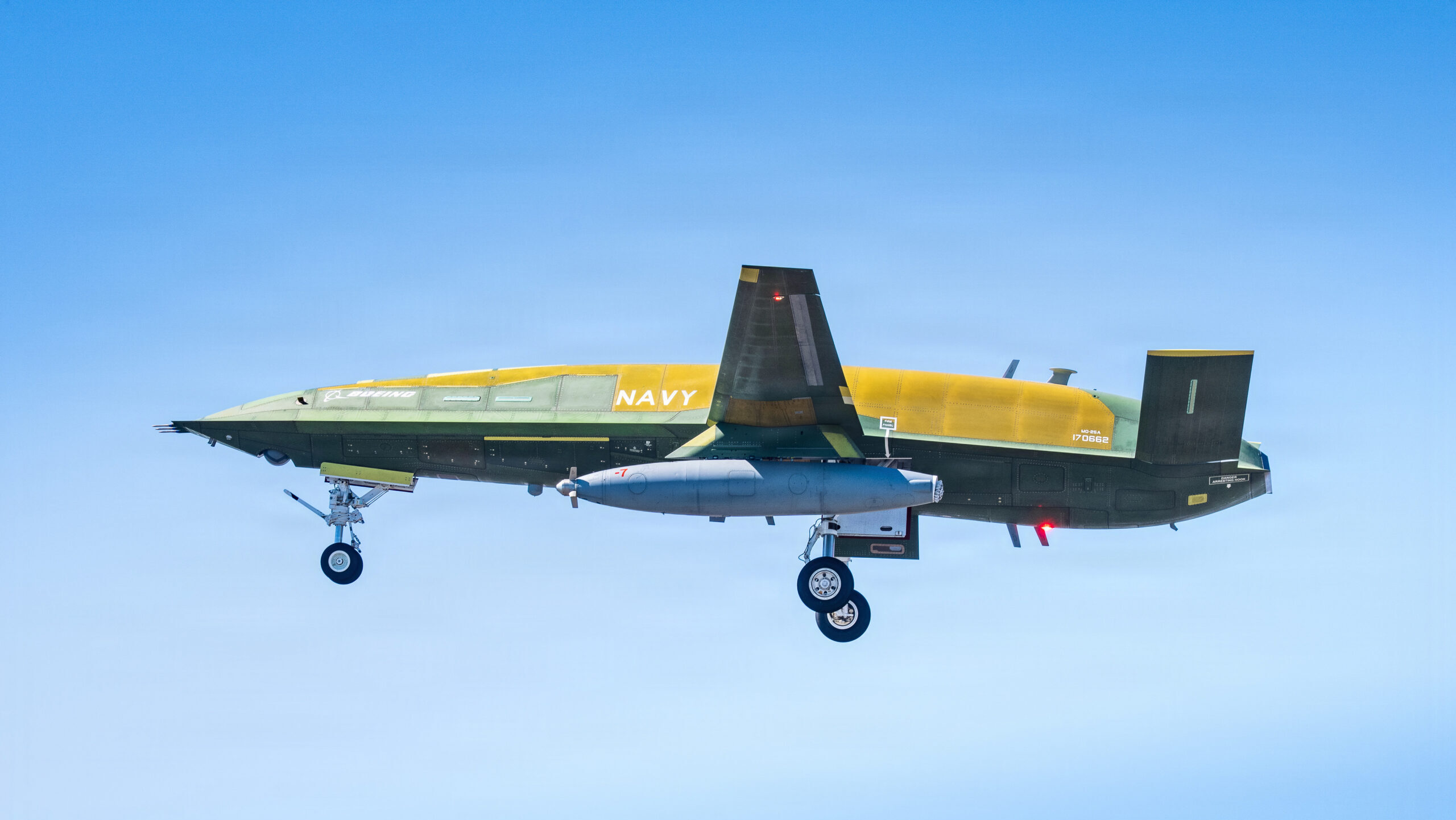
WASHINGTON — A production representative MQ-25 Stingray unmanned aerial system completed its first test flight on Saturday — paving the way for the aircraft to move toward conducting aircraft carrier operations.
The aircraft took off from Boeing’s facility at MidAmerica Airport in Mascoutah, Ill., on Saturday for an approximately two-hour flight, where it demonstrated its ability to autonomously taxi, take off, fly, land, and respond to ground control station commands, according to Boeing.
“The MQ-25A is not just an aircraft: it’s the first step in integrating unmanned aerial refueling onto the carrier deck, directly enabling our manned fighters to fly further and faster,” Rear Adm. Tony Rossi, who oversees the Program Executive Office for Unmanned Aviation and Strike Weapons, said in a Navy news release. “This capability is vital to the future of naval aviation.”
Boeing says a previous test version of the MQ-25 was able to refuel an F/A-18 Super Hornet, E-2D Hawkeye and F-35C Lightning II.
The recent “successful flight builds on years of learning from our MQ-25A T1 prototype and represents a major maturation of the program,” Dan Gillian, vice president and general manager of Boeing Air Dominance, said in a statement today. “The MQ-25A is the most complex autonomous system ever developed for the carrier environment, and this historic achievement advances us closer to safely integrating the Stingray into the carrier air wing.”
The aircraft is outfitted with the AE 3007N engine made by Rolls-Royce. Meagan Rater, Rolls-Royce director of US Mature Programs, Defense, said that the company will continue to work with the Navy and Boeing to make the aircraft “a reality for our service members, giving them a key strategic advantage in contested environments.”
The first test flight involving an operational aircraft comes after a series of production delays, and a demonstrator version of the MQ-25 conducted its first flight in 2019.
The Navy’s fiscal 2027 budget request includes three MQ-25s. Although the aircraft originally was scheduled for initial operating capability (IOC) in 2024, that milestone has been postponed several times, and the service now anticipates it will reach IOC by FY29, according to new budget documents released this month.
The Navy and Boeing plan to complete subsequent test flights out of the MidAmerica Airport, and then the aircraft will head to Naval Air Station Patuxent River, Md., later this year to lay the groundwork for carrier qualifications.
