

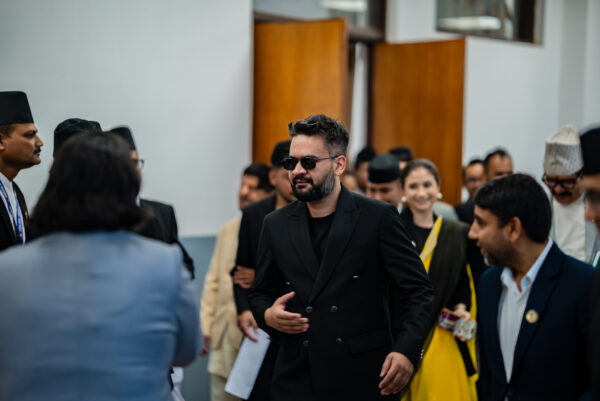
It was the exception that proved the rule. On May 29, Prime Minister Balendra Shah addressed the federal parliament, two full months after assuming office on March 27. Shah insists that he is a man of “action, not words.” With him repeatedly refusing to speak in parliament — even when it was mandatory to do so under parliamentary rules — pressure had steadily been building on the government and the ruling Rastriya Swatantra Party (RSP) to correct the anomaly.
Yet when Shah did finally break his silence, instead of appeasing the opposition parties, his maiden parliamentary speech sparked a firestorm.
While answering parliamentarians’ questions, Shah spoke on the boundary dispute between Nepal and India. He said negotiations were on with India to resolve the dispute over the Kalapani area, which Nepal claims but where Indian troops have been stationed since the 1962 Sino-Indian war. Similar discussions, he added, were underway to resolve the issue of the resumption of Indian pilgrimage to the Kailash Mansarovar in China’s Tibet through the Lipulekh pass in the Kalapani area. (India and China had resumed the pilgrimage without informing Nepal.)
So far so good.
But while talking about Kalapani, Shah then added that not only had India encroached upon Nepali territories, but Nepal had also encroached on Indian territories. It was news to Nepalis that India, the dominant South Asian economic and military powerhouse next door, would allow its lands to be encroached by its comparably puny neighbor. If Shah meant localized cross-border occupation caused by shifting river courses, he should have said so clearly. On a matter as sensitive as Kalapani, there is no room for imprecision.
Moreover, his May 29 address sat uneasily with parliamentary norms. He was not scheduled to speak on that day and ended up speaking on such a sensitive topic off the cuff.
This episode fits a pattern already visible in his use of ordinances, centralization of authority, diplomatic refusals and disregard for parliamentary procedure.
Despite having an overwhelming mandate, Shah has tried to bring about laws through ordinances. The decision-making in the constitutional council, which recommends officials in state institutions, was tweaked in a way so as to give the prime minister the final authority to pick a new chief justice, raising the specter of the judiciary being controlled by the executive.
Likewise, on the basis of another ordinance, the government removed 1,500 senior civil servants without any plans for their replacement. This affected vital functions like the regulation of civil aviation and the conduct of school-level examinations.
Previously, the 36-year-old Nepali prime minister had refused to meet Indian Foreign Secretary Vikram Misri, who was travelling to Nepal to extend Narendra Modi’s formal invitation to Shah to visit India. When Shah refused to see him, Misri had to cancel his Nepal trip. Interestingly, Shah had first accepted Modi’s invitation. Yet he later let it be known that he would not be travelling abroad for the first year of his tenure. This did not sit well with the Indians. He also refused to meet top officials from China and the U.S., irritating two other important partners for Nepal. Shah declined to see them despite being counseled by his Cabinet members that such a blanket policy on not meeting foreign officials was unwise.
Back in March, the new government had kicked off its term by arresting a host of political leaders on questionable legal grounds. It then razed the settlements of riverside squatters without plans for their resettlement.
The government increasingly appears to be a one-man show. Ministers complain that they can do little more than blindly follow orders from the Prime Minister’s Office, where more and more decision-making seems to have been centralized.
With his dark glasses, black topi (cap) and black clothes, and as someone who barely speaks publicly, Shah has cultivated an aura of mystery that feeds into his personality-driven politics. A large section of the public still seems to back him. Even as his government’s new budget has been widely criticized by experts for going beyond the state’s capacity and for ignoring the plight of the poor and marginalized, many of his supporters have enthusiastically lapped it up. They have even tried to justify Shah’s latest remarks on Indian encroachment — such a statement, it won’t be an exaggeration to say, would have been political suicide for any other Nepali head of government.
Shah and his government can seemingly do no wrong. After witnessing decades of misrule and corruption under the old parties, people are in a mood to give him the benefit of the doubt. Perhaps rightly so.
But for how long? He is alienating constituencies that any government eventually needs: the media, the intelligentsia, the opposition parties and key foreign partners.
Shah has so far governed as if his ability to get out of difficult situations is limitless. Yet recent ructions in parliament, which has now spilled onto the street, suggest that is far from the case.
