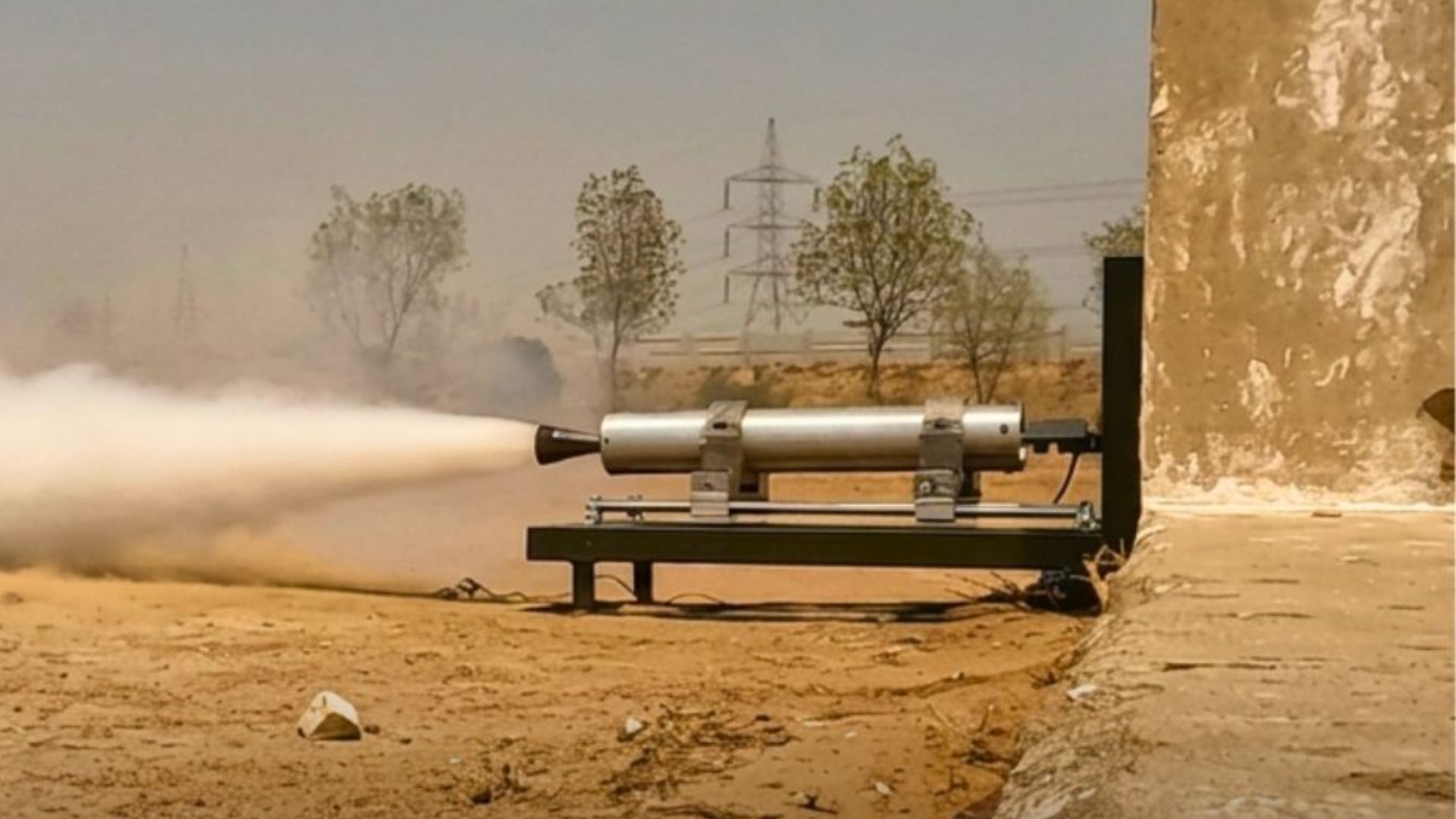
On 06 June, Woot-Tech, a privately owned Pakistani defence contractor, revealed that it had tested a rocket-assisted take-off (RATO) booster for unmanned aerial vehicles (UAV).
Designated RATO-150, Woot-Tech describes it as a 2,500 Ns-class system built for reliable assisted launch. In a company announcement, Woot-Tech pitched the booster as both cost-effective and mass-producible, enabling the end-user to dispense with large pneumatic catapults and long runways, while supporting rapid deployment/launch from austere sites. Woot-Tech is marketing the RATO for tactical, reconnaissance, and defence missions, and tagged for zero-length launch and loitering munition use.
Overall, Woot-Tech is positioning the RATO-150 to support loitering or one-way attack (OWA) munitions, which currently comprise the majority of Woot-Tech’s solution offerings. In other words, the RATO-150 is primarily a launch enabler for the systems Woot-Tech is already producing and marketing.
A 2,500 Ns Booster and Its Class
Woot-Tech specifies 2,500 Ns – i.e., Newton-seconds – a measure of total impulse rather than thrust. The total impulse is the quantity that determines how much momentum a booster can transfer to an air vehicle, so it sets the ceiling on what the RATO-150 can launch.
A RATO booster is a short-burn solid- or hybrid-rocket motor. It accelerates an air vehicle to flying speed from a rail, canister, or zero-length launcher, then separates once the air vehicle’s own engine takes over.
This is the standard launch method across the loitering-munition and OWA class. IAI’s Harpy and Harop fire from sealed canisters with rocket assist before unfolding their wings, while the Shahed-136 launches via RATO from truck-mounted rails.
Internally, RATO solutions range from 2.5 kN · s to 200 kN · s of total impulse, covering everything from small tactical drones and OWAs to heavy-payload, retrievable systems. Providing 2,500 Ns, Woot-Tech’s RATO-150 sits at the floor of that range, indicating that it is designed for lighter-weight UAS.
A Launch Backbone for Woot-Tech’s Effector Stack
Woot-Tech Aerospace, founded in 2021, began with commercial vertical take-off and landing (VTOL) drones for agriculture and survey work before moving into defence.
Its portfolio now runs across target drones, an armed multirotor, loitering munitions, a turbojet OWA, a cruise missile, and a drone-swarm system.
The jet-powered effectors anchor the line. The HiMark-25 TJ is a turbojet OWA, and the Nimbus 2K is a cruise missile, both built for long-range expendable strike.
Its Juggernaut armed multirotor has already entered service with the Pakistan Navy (PN) and special operations forces (SOF). The company is not new to supplying a service arm directly.
Woot-Tech had already offered RATO as an option on the HiMark-25 TJ to extend its range from mobile launch sites. The RATO-150 turns that option into a dedicated product.