

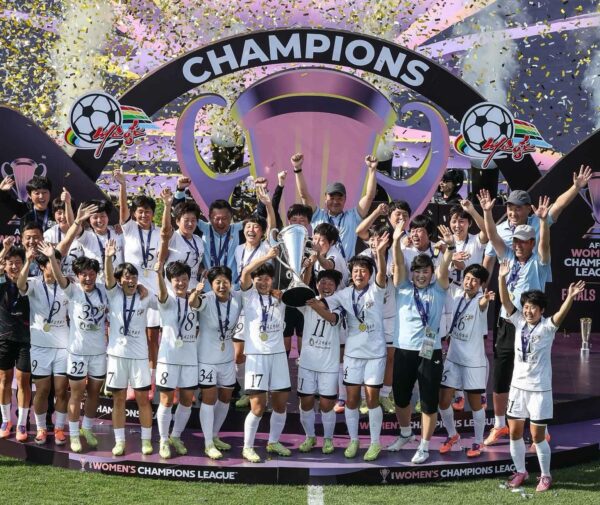
Last week, North Korea sent a sports team to South Korea for the first time since 2018. What should have been a routine women’s football tournament was instead a glimpse into the state of play for inter-Korean relations.
Observers closely watched the encounter for signs about the trajectory of engagement between the two Koreas. As Pyongyang deepens its two-state policy toward a South Korean government still searching for a new framework for inter-Korean relations, the tournament offered a rare test of how both governments would manage direct contact. The match was an important departure from the post-COVID baseline and offered insight into how North Korea now approaches the South: not as a partner in reconciliation, but as a separate state. Just as importantly, it exposed how slowly Seoul has adapted its legal and political frameworks to that shift.
Background
Since emerging from its self-imposed pandemic isolation in late 2023, North Korea has cautiously resumed participation in international sporting events. The Kim Jong Un regime has dispatched athletes to the Asian Games, international taekwondo competitions, and other events abroad. But Pyongyang has remained highly selective about where its athletes travel and whom it hosts.
That caution was evident in the case of Japan. North Korea permitted its men’s football team to travel to Tokyo for World Cup qualifiers, but when the time came for Japan’s team to travel to Pyongyang for the return fixture, North Korea abruptly canceled the event.
Meanwhile, with South Korea, Pyongyang had avoided virtually all forms of sporting contests for years except in third countries.
The Asian Football Confederation’s women’s club championship therefore represented a notable exception. North Korea’s Naegohyang Football Club advanced through the tournament and earned an opportunity to play in the semifinal hosted in the South Korean city of Suwon, about 30 kilometers south of Seoul. With support from the AFC and South Korea’s Korean Football Association, Pyongyang approved travel for the North Korean team to South Korea via Beijing.
By winning their match against Suwon FC on May 20, Naegohyang FC extended their stay in South Korea to vie for the championship against Japan’s Tokyo Verdy Beleza on May 23. They won 1-0 in the final, allowing the North Korean athletes to depart the next day with both the title and a $1 million prize.
South Korea’s Restrained Elation
For the Lee administration, Naegohyang FC’s trip to South Korea provided a rare opportunity for contact with a North Korean organization, however minimal. The biggest challenge during the visit was balancing enthusiasm for renewed contact with the need to avoid politicizing the event.
Based on existing laws related to inter-Korean contact, Naegohyang FC’s visit required extraordinary administrative measures. Unlike standard visa procedures, travel by North Korean nationals to South Korea falls under the authority of the Ministry of Unification through the Inter-Korean Exchange and Cooperation Act. The Korean Football Association submitted its request on behalf of the AFC only days before the match, and the ministry moved quickly to approve the visit.
Officially, the South Korean government insisted that it would not inflate the significance of the event beyond that of an ordinary football match. In practice, however, the Ministry of Unification took steps to create a favorable atmosphere. The ministry authorized use of the Inter-Korean Cooperation Fund to support civic groups participating in welcoming activities, including banners, and stadium tickets. The funding amounted to roughly 300 million won (around $200,000). Established under South Korean law, the hefty Inter-Korean Cooperation Fund operates independently of standard annual budget cycles and is specifically designed to finance initiatives related to inter-Korean engagement.
With monetary support, inter-Korean support groups rallied behind Naegohyang FC. There were well-wishers at the airport, as well as cheering squads present during both the semifinal and final matches, despite pouring rain and cold weather for the first contest that emptied out hundreds of other seats.
While the South Korean government actively encouraged this support from civic groups, the administration attempted to exercise restraint at the political level. Rather than publicly elevating the event into a symbol of reconciliation – something that could have triggered backlash from Pyongyang – South Korean officials accepted the AFC’s request that the sporting event be treated separately from politics and avoided dispatching government officials to attend the event.
When questioned about it in the National Assembly, the normally outspoken Minister of Unification Chung Dong-young simply stated that he hoped the match would set a good precedent. However, Chung did express support for the North Korean team in the final, stating, “They beat Suwon and advanced to the final, so I hope they win the championship if possible… They happen to be facing Japan, so please give them strong support.”
After Naegohyang FC’s victory, South Korean President Lee Jae-myung offered words of congratulations to the North Korean team and expressed gratitude for the inter-Korean cheering squads. Posting on X, Lee extended his “sincere congratulations” to Naegohyang FC and paid his “deepest respects to our cheering squad for making the tournament shine with a mature cheering culture.”
North Korea’s Straightforward Approach
The North Korean government maintained a disciplined, no-nonsense approach to the football tournament. It was clear that the government and Naegohyang FC understood the publicity that would surround the team, evidenced by the standardized attire and rigid posture of the athletes and staff as they arrived in Incheon airport ahead of the contests.
Still, North Korean state media remained silent on the team’s arrival in South Korea until after the first match had concluded. The morning after Naegohyang FC’s victory over Suwon FC, North Korean outlets published straightforward reporting on the outcomes with minimal commentary. The reports avoided both bombast and the derogatory rhetoric; rather, there was neutral characterization of the South Korean opponents.
For example, in reporting on an October 2023 football match, state media referred to the contest as happening “between teams from the DPRK and the region of south Korean puppets,” whereas this most recent report characterized the match as “between the Naegohyang Team of the DPRK and the Suwon Team of the ROK” (short for the “Democratic People’s Republic of Korea” and “Republic of Korea,” respectively).
Other details were important during this trip, starting from the outset with the team’s entry into South Korea. The North Korean travelers presented their passports at Incheon airport as they would for any other international travel. This created a mismatch with South Korean customs and immigration officials, who did not stamp the passports but used them only for identity verification as per the Inter-Korean Exchange and Cooperation Act.
Another important detail was the North Korean government’s willingness to allow the Naegohyang manager and team captain to participate in multiple press conferences. While the content of these press conferences were not re-published in North Korean state media, it is notable that the government allowed them to proceed. During the first few press conferences, the interviewees maintained neutral responses and deflected any questions that could be considered as outside the realm of football, proceeding about as one might expect from any foreign team participating in a sporting event abroad.
However, the final press conference after the championship match ended abruptly and in protest. A South Korean reporter opened a question by stating, “North Korean women’s football has maintained a high level historically,” which prompted the Naegohyang manager, Ri Yu Il, to respond, “What did you just say?” He then demanded that the reporter “call our national title correctly,” meaning the Democratic People’s Republic of Korea. Ri ended the press conference soon after, underscoring Pyongyang’s insistence that interactions with Seoul be conducted explicitly on state-to-state terms.
Naegohyang FC departed South Korea the day after the championship, receiving fanfare and acclaim upon their return to Pyongyang. North Korean state media maintained its neutral commentary toward the South while boasting its own team’s achievement in becoming the “best women’s football team (club team) in Asia.”
What This Signals for the State of Inter-Korean Relations
The tournament demonstrated that Pyongyang is moving faster than Seoul in redefining the terms of inter-Korean engagement. Issues like passport entry and naming conventions for the two Koreas illustrated North Korea’s push to institutionalize interstate relations, while Seoul continues to struggle over how to adapt its approaches based on constitutional and legal frameworks that still treat relations on the Korean Peninsula as inter-Korean.
These events will likely compel some political actors in the South to accelerate debates over how to update inter-Korean policy designs. For example, the question about what to call North Korea already came to the fore last month but resulted in no substantive decision. The Lee administration may use the events from last week as evidence for the needed change. The ruling party – which also holds a majority in the National Assembly – could feasibly pursue updates to laws related to inter-Korean cooperation.
Meanwhile, North Korea does not have to change its trajectory at all. The football tournament demonstrated that consistent, incremental steps towards normalizing interstate relations will be more effective than attempts at sweeping political change. The Kim regime will likely continue observing the Lee administration’s actions, publishing high-level statements when necessary to shape South Korean government policy.
In Lee’s congratulatory message to Naegohyang FC, he stated, “The ball is round, and we will meet again.” The larger question for Seoul is whether it is prepared to formally adapt to Pyongyang’s two-state framework for that next encounter, or whether it will continue operating under assumptions North Korea has already abandoned.
