

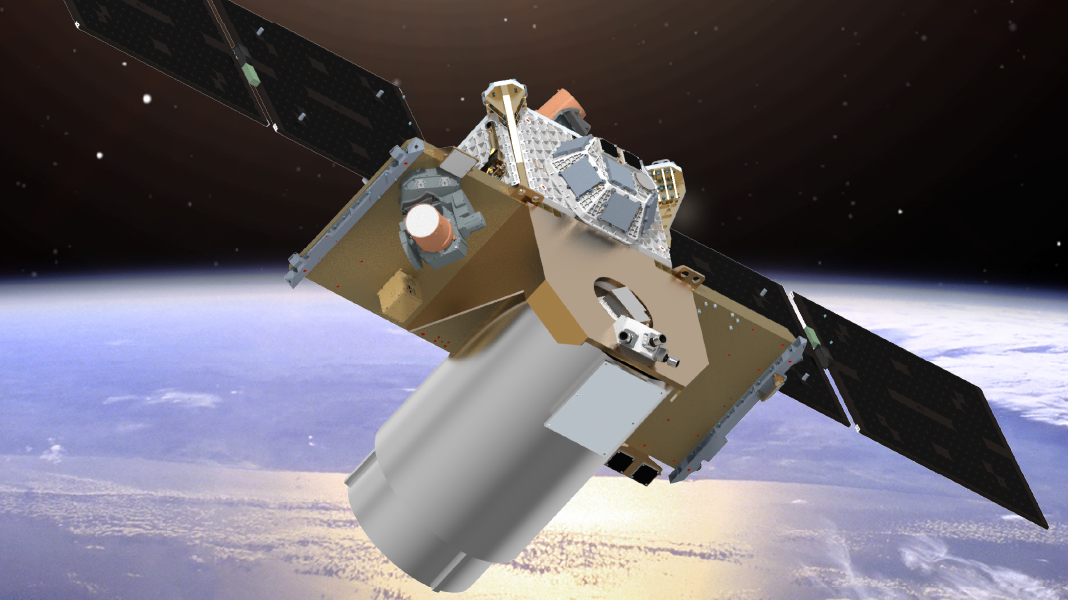
WASHINGTON ― The National Reconnaissance Office (NRO) has topped up its existing contract with BlackSky Technologies to help speed the development of new wide-area imagery satellites designed to support AI-driven target detection and analytics, according to agency and company officials.
In an announcement today, BlackSky said that the funding injection will “accelerate the development of the company’s AROS broad area collection satellites” to enable the provision of “a flight-ready multi-spectral, large-area mapping spacecraft and foundation data collection system in 2028.”
While NRO rarely releases contract values since its budget is classified, an agency spokesperson told Breaking Defense that the modification to BlackSky’s 2022 contract is for “an 8-figure amount to bring the total contract value to over $150 [million].”
Blacksky initiated self-funded development of AROS in 2023, and originally had hoped to launch AROS by 2027. Asked about the delay, a company spokesperson responded:
“The contract modification covers the initial development phase and the launch timeline provided was what BlackSky could commit to, given the customer’s needs.”
According to the company’s announcement, the new AROS satellites are being optimized to gather and process data to underpin “AI-enabled analytics that detect and characterize aircraft, vessels and vehicles [providing] decision makers with real-time strategic and tactical insights over broad geographic areas.”
The wide-area surveillance AROS birds will be integrated with BlackSky’s current Gen-3 constellation to create a “tip and cue” capability that will support “dynamic country-scale digital mapping, navigation, maritime situational awareness and 3D digital twin applications.”
The BlackSky spokesperson told Breaking Defense that it is the synergy between the Gen-3 and AROS constellations that is at the heart of the promised leap in capabilities
“AROS’s product attributes complement our existing Gen-3 capabilities very well, particularly with regard to the powerful tip and queue ability between broad area and Gen-3 point location monitoring. It’s important to note that AI-driven detection and identification tools can be used interchangeably between Gen-3 and AROS and are oriented toward helping human end-users optimize workflows across the mapping and ISR mission sets,” the spokesperson said.
In addition, BlackSky’s announcement said, the new architecture will “showcase a new proprietary data pipeline designed to feed real-time and retrospective AI analytics, model training and decision support tools and will be ready for deployment and integration into customer workflows within a relatively short timeframe.”
While the NRO does not undertake imagery analysis — that is the job of the National Geospatial-Intelligence Agency — the NRO spokesperson explained that the spysat agency is moving quickly to apply artificial intelligence to enhance collection of intelligence, surveillance and reconnaissance (ISR) data.
“The NRO is at the forefront of integrating AI into space-based ISR, enhancing our ability to monitor global activities to expand America’s intelligence advantage. Through strategic partnerships with commercial enterprises, academia, and government entities, the NRO leverages the best AI capabilities available while developing specialized solutions for unique national security requirements,” the spokesperson said.
