

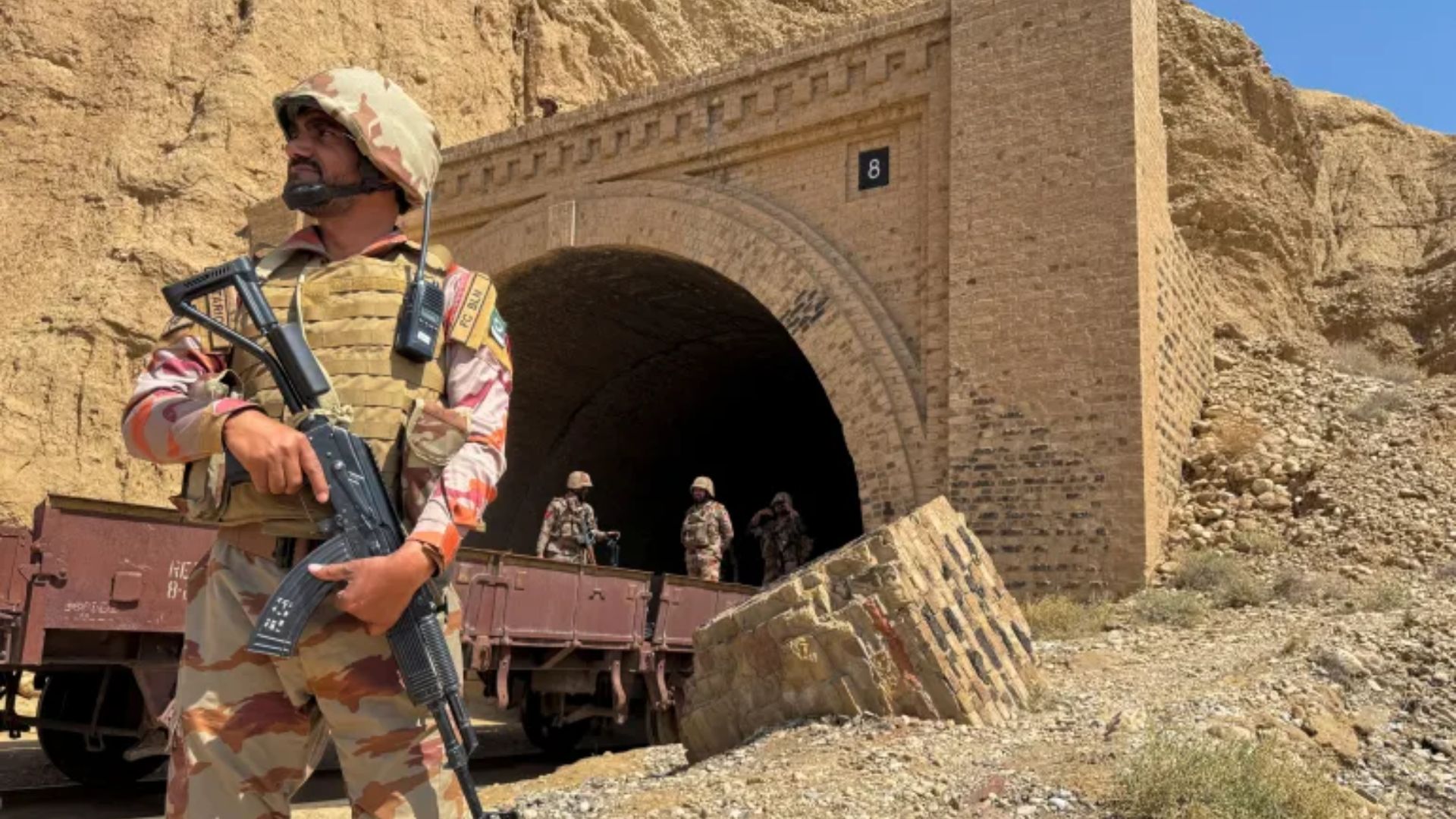
Pakistan’s military says 42 people, including security personnel and civilians, were killed across Balochistan over four days in what the Inter-Services Public Relations (ISPR) described as three major attacks between 4 and 8 July. Addressing a press conference in Rawalpindi on 8 July, ISPR director-general Lieutenant-General Ahmed Sharif Chaudhry said the dead comprised four civilians, 27 policemen and 11 army personnel, while security forces had killed 54 militants in the attacks and the operations that followed.
By the ISPR’s account, the first incident occurred on the night of 4-5 July in the Hanna Urak area on the outskirts of Quetta, where militants the military attributes to the Tehreek-e-Taliban Pakistan (TTP) attacked residents. Chaudhry said four civilians were killed and six wounded before local people resisted and forced the attackers to withdraw.
The costliest engagement began on 6 July at a police post guarding a pumping station of the Mangi Dam in Ziarat district, where the ISPR says nine policemen were killed in the initial assault and the attackers took surviving personnel hostage. Chaudhry said the military held off from using aerial assets to avoid harming the captives, and that a further 18 policemen were killed as the standoff in the Ziarat highlands continued, raising police fatalities to 27, while 26 militants were killed in an operation he said remained under way.
The third incident, on 8 July, was an ambush on an army convoy on the N-25 highway near Bela in Lasbela district, which the ISPR attributed to the Baloch Liberation Army (BLA), reporting one junior commissioned officer and 10 soldiers killed alongside 14 BLA fighters. Chaudhry added that separate operations in Kharan and Dalbandin accounted for a further 14 militants, and that engagements were continuing at several locations.
Chaudhry framed the wave as an externally directed campaign, naming India as its orchestrator and asserting that the militants operate from territory under the Afghan Taliban. He said most of those killed had been found to be Afghan nationals, and that three of the four attackers in a 27 June assault on a Rangers camp in Karachi were Afghan.
Both the BLA and the TTP routinely claim such operations through their own spokesmen, and their tallies have diverged sharply from official ones (e.g., after a May 2026 attack on a train near Quetta, the BLA claimed to have killed 82 military personnel against a far lower official count). Independent verification remains difficult given restricted access to the province, while Kabul has consistently rejected Pakistani allegations that it harbours anti-Pakistan militants and New Delhi has denied backing separatist or jihadist groups.
The surge lands as Pakistan’s western frontier absorbs pressure on several fronts at once. Since fighting with Afghanistan flared in late February, figures compiled by the Armed Conflict Location and Event Data Project (ACLED) record close to 200 Pakistani air strikes and shelling actions into Afghan territory, with the Afghan Taliban responding through explosive-laden commercial drones flown into Khyber Pakhtunkhwa and Balochistan. That sits atop an unresolved Baloch insurgency and a broader strain on Islamabad’s regional position, from the fallout of this year’s Iran conflict to the diplomatic costs of repeated cross-border strikes.
For Quwa, the operational pattern on display (e.g., checkpoint overruns, hostage-taking, convoy ambushes and drawn-out clearance operations in mountainous terrain) reinforces a force-structure argument advanced across its Market Intelligence coverage: a sustained counter-insurgency and counter-terrorism (COIN/CT) tempo will, over time, pull Pakistan Army procurement toward the capabilities suited to it.
Army Aviation is the most direct of these, spanning attack helicopters for on-call fire support and a transport fleet sized for air assault and the rapid mobilization of troops into contested valleys where road movement invites ambush. The second is infantry trained and equipped specifically for COIN/CT, whether by returning to the emphasis of earlier campaigns or by expanding the Light Commando Battalions (LCBs). The third, and the hardest to resource, is a renewed investment in preventative intelligence, and human intelligence (HUMINT) in particular, given that the Ziarat and Bela engagements began only once the attacks were already under way.
Chaudhry said operations would continue against militants and their facilitators “wherever they are located,” a formulation that leaves open further action along and across the Afghan border.
