

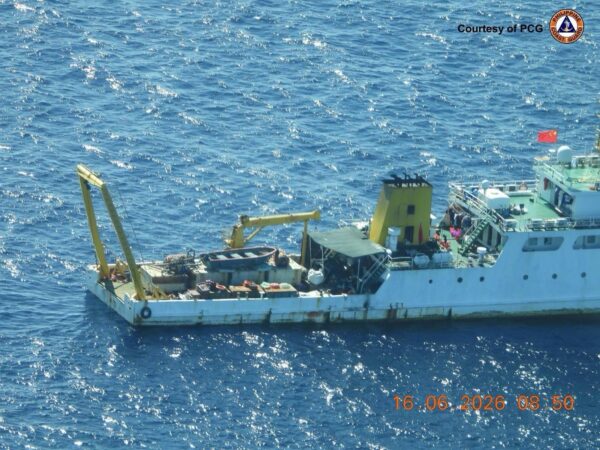
The Philippine government yesterday confirmed that a “movable platform” that was placed by Chinese maritime forces at a contested shoal in the South China Sea has been removed.
The platform, which measured about six meters by six meters and appeared to be equipped with an antenna, was first spotted in satellite images taken on May 25, the National Task Force for the West Philippine Sea (NTF-WPS) said last week. The Philippine Department of Foreign Affairs subsequently protested the “illegal presence” of the platform, claiming that the protection of Manila’s sovereignty and jurisdiction “remains a paramount consideration.”
In a statement yesterday, the NTF-WPS confirmed that aerial and maritime patrols conducted yesterday by the Bureau of Fisheries and Aquatic Resources and the Philippine Coast Guard (PCG) had confirmed the removal of the platform.
“While we take note of the removal, we reiterate our principled and unyielding position: Bajo de Masinloc is and will always be an integral part of Philippine territory,” it said in a statement, using Manila’s official name for the shoal, over which it said the Philippines has “indivisible, incontrovertible, and longstanding sovereignty.”
The PCG later stated that it had observed the Chinese research vessel Yue Zhan Yu Ke 6 “dismantling the floating platform and loading it onto her stern” on Tuesday. It said that the vessel was “no longer in the vicinity” of the shoal, but that as of yesterday, a smaller Chinese research vessel was still present.
The NTF-WPS said that it was assessing the nature, purpose, and potential implications of the platform’s deployment, adding that Scarborough Shoal “is part of the Philippines and within its maritime zones as recognized by international law.”
The triangular atoll, which sits around 200 kilometers to the west of the Philippines’ Luzon island, and 874 kilometers from China’s Hainan Island, has been a persistent flashpoint in the maritime disputes between the Philippines and China. The shoal has been under Chinese control since 2012, when the two nations engaged in a tense 10-week stand-off that concluded with China occupying the feature, despite an agreement for mutual withdrawal from the shoal.
Since then, China Coast Guard vessels have surrounded the shoal and made repeated attempts to restrict Filipino fishermen from accessing the rich fishing grounds inside the atoll’s central lagoon.
The deployment of the floating platform appeared to mark an intensification of China’s campaign of pressure against Philippine-claimed features in the South China Sea.
That China has opted to remove the platform is perhaps a sign that Manila’s robust response has forced China to retreat. More likely, Beijing was merely testing the waters (so to speak) and has no intention of backing down in its attempt to force the Philippines into acquiescence to its maximalist maritime and territorial claims.
In a press briefing yesterday, Reuters reported, China’s Foreign Ministry spokesperson Lin Jian stated that China has “indisputable sovereignty” over Scarborough Shoal and that the floating platform was part of a program of “comprehensive research” in the South China Sea, possibly linked to the nature reserve that it declared at Scarborough Shoal last year.
He added that such activities fall within China’s sovereign rights and that other countries “have no rights to interfere in them.”
