

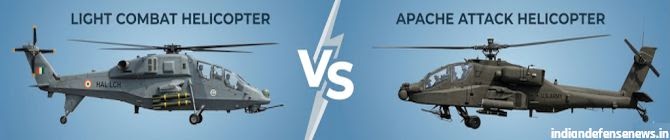
India’s indigenous Light Combat Helicopter, Prachand, and America’s AH‑64E
Apache represent two very different philosophies in attack helicopter design,
each tailored to distinct operational environments and requirements.
The recent approval by the US State Department of a deal worth more than USD
198.2 million for support services and related equipment for Apache
helicopters underlines the continuing importance of the platform to India’s
defence capability.
The State Department emphasised that the sale would strengthen India’s
homeland defence, deter regional threats, and enhance its ability to meet
current and future challenges.
In April, General Upendra Dwivedi, the Chief of Army Staff, undertook a sortie
in the Prachand, assessing its agility, mission readiness, and performance.
This raised a pertinent question: if India has developed its own indigenous
attack helicopter, why does it continue to rely on foreign platforms such as
the Apache? The answer lies in the complementary roles these helicopters play.
Details / Specifications of the world’s best Attack Gunships
| Features | HAL Light Combat Helicopter “Prachand” | Boeing AH-64E Apache |
|---|---|---|
| Primary Operational Terrain | High-altitude operations in hilly Himalayan terrain. | Flat plains, deserts, and semi-desert areas along western and north-western borders (e.g., Rajasthan and Punjab). |
| Operational Conditions | Optimized for the high-altitude environment of the Kargil/Himalayan region. | Built for all-weather, day-and-night combat operations. |
| Altitude Capability | Highest ceiling being among all attack helicopters. | 20,000 To 21,000 Feet |
| Targeting & Avionics | Integrates state-of-the-art avionics suite | Detects up to 256 targets, displays 128, and prioritises the 16 biggest threats within seconds. |
| Manned-Unmanned Teaming | Under Development | Integrates with drones/UAVs through MUM-T, allowing pilots to control UAVs during combat missions. |
| Stealth & Survivability | Incorporates Reduced Radar Cross-Section (RCS), Infrared Suppression, Aural & Visual Signature Reduction, Rugged Crash Worthiness, Ballistic Protection and Defensive Aids Suite | Low Radar Cross Section (RCS) and a heat signature reducing Infrared Suppressor |
| Gun / Cannon | 20mm turret gun. | 30mm automatic cannon. |
| Rockets & Missiles | 70mm rockets, Air-to-Air missiles, and Anti-Tank Guided Missiles (ATGMs). | 70mm rockets and Hellfire missiles. |
| Performance | Approximate maximum speed of 268 kmph and a combat range of 550 km. | Approximate maximum speed of 300 kmph and a combat range of 480 km. |
According to Hindustan Aeronautics Limited, the Prachand is a two‑pilot
aircraft with a maximum take‑off weight of 5,800 kilograms. It can reach a
maximum speed of 280 kilometres per hour, cruise comfortably at 260 kilometres
per hour, and has an operational range between 550 and 700 kilometres
depending on payload. Its climb rate is 12 metres per second, and it boasts
the world’s highest operational ceiling at 6,500 metres.
By contrast, Boeing’s AH‑64E Apache, also a twin‑seater, has a maximum
take‑off weight of 10,432 kilograms, a top speed of 300 kilometres per hour, a
cruise speed of 265 kilometres per hour, a combat range of 480 to 500
kilometres, a service ceiling of 6,400 metres, and a climb rate of
approximately 14.2 metres per second. While Prachand offers a higher
operational ceiling and longer range, the Apache excels in payload capacity,
climb rate, and speed.
The differences are rooted in operational requirements. Prachand was conceived
after the Kargil War, when India realised the need for a light combat
helicopter capable of operating in the extreme altitudes and harsh conditions
of the Himalayas.
It became the first attack helicopter to land in Siachen, the world’s highest
battlefield, and was designed specifically for operations in Ladakh, Arunachal
Pradesh, and other mountainous regions. Its lighter weight of 5.8 tons makes
it ideally suited for such terrain.
The Apache, on the other hand, was designed for operations in flat plains,
deserts, and semi‑desert areas such as Rajasthan and Punjab. Its heavier build
and greater payload capacity reflect its role in these environments. India’s
requirement for both helicopters stems from the diversity of its operational
theatres.
The modernisation of India’s air fleet is ongoing, with ageing platforms being
phased out. During the induction ceremony of Apache helicopters in 2019, then
Air Chief Marshal BS Dhanoa noted that the Apaches were being purchased to
replace the Mi‑35 fleet.
He highlighted that Apaches had played integral roles in numerous historic
campaigns worldwide and had been customised to meet the exacting standards of
the Indian Air Force. The US State Department further emphasised that India
would have no difficulty absorbing these systems into its armed forces,
underscoring the strategic depth of the US‑India defence partnership.
In April, the Indian Army showcased the combat strength of the Apache during a
live‑firing exercise named ‘Brahmastra’ at the Pokhran Firing Range. The
demonstration highlighted the Army’s increasing focus on high‑precision,
network‑centric warfare.
The Apache remains one of the most advanced multi‑role combat helicopters
globally, equipped with a 30mm chain gun, Hellfire anti‑tank missiles, Hydra
rockets, and advanced targeting systems including the Longbow radar and
night‑vision sensors. Its ability to operate in all‑weather conditions,
including at night, mirrors the capabilities of Prachand, though each platform
brings unique strengths to the battlefield.
Together, Prachand and Apache form a complementary duo in India’s arsenal.
Prachand ensures dominance in the high‑altitude Himalayan battlefields, while
Apache provides unmatched firepower and resilience in plains and desert
warfare.
India’s reliance on both platforms reflects a pragmatic approach to its
diverse operational needs, combining indigenous innovation with proven
international technology to secure its strategic frontiers.
Agencies
