

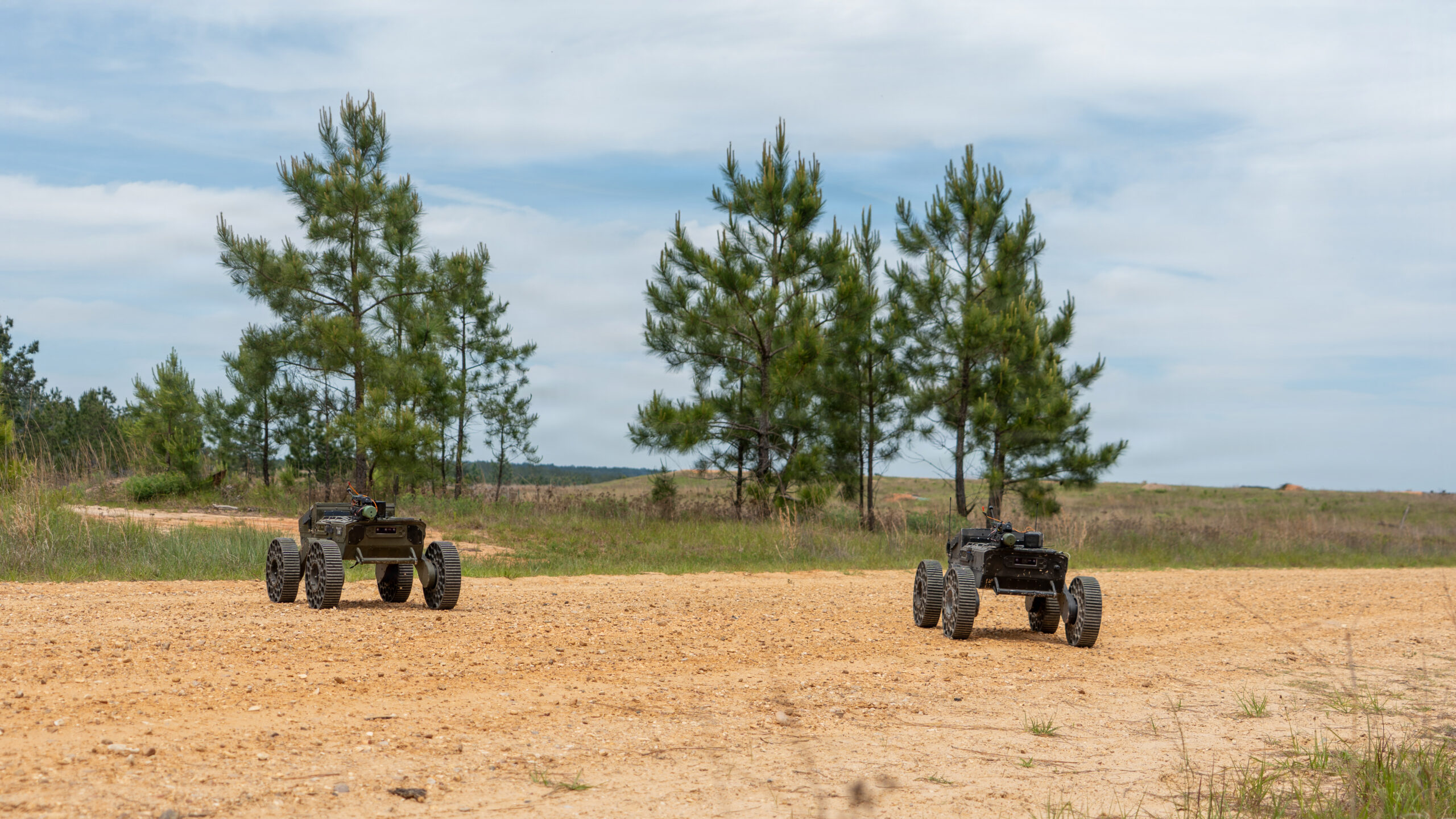
WASHINGTON — This spring, soldiers from the 3rd Mobile Brigade Combat Team, 101st Airborne Division stood idle while drones buzzed overhead and unmanned ground vehicles (UGVs) trudged forward in their places. For the first time the soldiers would see for themselves if robots could take out the adversarial defenses, albeit pretend, before they would have to hypothetically risk their own lives to defeat the enemy.
Such an exercise is referred to as a robotic combined arms breach — where uncrewed ground and aerial vehicles are used to defeat enemy defenses — Col. Ryan Bell, commander of the 3rd MBCT, 101st Division, told Breaking Defense in a recent interview. The exercise was part of the larger Joint Readiness Training Center (JRTC) rotation in Fort Polk, Louisiana in April.
“The most dangerous point in a fight for an infantry battalion is the breach point where I’m trying to breach an obstacle — usually around like a trench or a defense,” Bell said. In this scenario, breach points refer to heavily defended territory with mined wired obstacles. These areas are typically where brigades “take the most casualties.”
“The task was, can we, with robots, make this uncontested for the rifleman? So when the rifleman gets to the breach, everybody’s dead, there’s nobody left defending, because we were able to defeat them with robots,” Bell added.
For the breaching exercise, the soldiers sent in dozens of purpose-built attritable system (PBAS) drones and two UGVs to defeat the “enemy’s” defenses. The PBAS drones, called Abe-101s, were built by the soldiers themselves. The breach began with soldiers attaching two of the Abes to a modified AERO Sky “carrier drone” to simulate a hardened one way attack munition aimed at taking down jammers.
Later, more Abes were flown in five waves of five, with some waves equipped with attack munitions to take out bunkers, vehicles, and any simulated soldier fighting positions. The other waves flew in to drop smoke to disorient the opposition. Then, two UGVs with 28-lbs. breaching charges — explosive payloads that are remotely detonated — were brought in to take out the mined wired obstacles to create the openings for infantry to finally enter, Bell said.
Overall, the arms breach exercise was successful, Bell said. It determined he made the right call to “protect” his soldiers and keep them in reserve until he “needed them,” explaining that the drones and UGVs “absolutely did what we asked” them to do.
The 3rd Brigade’s success in breaching comes as the world has witnessed Ukraine using both drones and UGVs to deter Russian attacks, and in more unusual cases, taking Russian positions without any infantry in the proximity. (The unmanned systems are reportedly controlled by soldiers miles away)
UGVs have most often been used for casualty evacuation and resupply missions in the ongoing conflict in Ukraine, however, in the past several months more and more reports have surfaced of the systems being used for combat assault missions. Further, the US Army has seemingly been taking notes, not just during JRTC rotations, but also with recent solicitations aimed at CASEVAC and other logistics missions.
Back To The Breach
Though the 3rd Brigade’s breach went well, Bell said he could have used some more mature capabilities to defeat the hypothetical opposition more effectively.
For instance, he said sending the PBAS drones in swarms would have saved him man power. Ideally, he would have one soldier operating five to 30 drones instead of having one operator per drone. The brigade practiced operating three drones with one soldier at a separate exercise during the JRTC rotation, though Bell said it “didn’t work that well.” His multi-functional reconnaissance company is currently in Montana testing swarm technology, he noted, and they’ve been able to fly three to five drones with one operator without as many hiccups.
“Since April, the technology has continued to mature. It’s impressive to see how fast it’s improving. What I would tell you is, in the future, we absolutely need one to many. I need to have one operator to control 15 to 20 to 30 drones at a time,” Bell said recently.
Though the UGVs did their job during the breach, his brigade would ideally have more “robust” vehicles, Bell said.
“The ground robots were great for breaching, but there’s things they need to do to become more robust as they go over different types of terrain, so they don’t get stuck there,” he said. “We just have to practice how we drive them and how we maneuver.”
Though not only relevant to the breach exercise, Bell said he could also use some help from industry on scaling PBAS drones. He said his brigade is able to build “a decent number” of their Abe-101s “in a week,” but they don’t have the manpower nor the ability to produce as many as they need in their own facilities.
“If I’m saying I need 1,000 a week and the division is three mobile brigades, we’re looking at 15,000 a month. So go across 11 divisions, you’re looking at 150,000 to 200,000 a month 2 million a year. There’s no way we can produce those in-house,” he said when referencing not only the facility for his brigade, but across the larger service.
In addition to scaling, the service also needs help keeping the drones at a lower price point, Bell said, adding that right now the Abe-101s can be built for about $750 a piece without any add-ons like terminal guidance or night vision capabilities.
“I have to think of them more like artillery shells. I have to keep the price point down as I scale this for the Army to where they’re competitive with artillery for cost for effect,” he said.
