

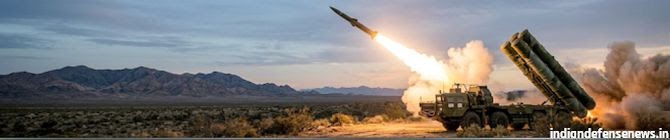
Russia has confirmed its readiness to supply India with additional S-400 air defence systems without restrictions, reinforcing New Delhi’s decision to expand its fleet beyond the original five units.
This comes after the fourth system was delivered in May 2026, with the fifth expected later this year, and India’s approval to procure another five squadrons following the system’s combat success in Operation Sindoor.
Russia’s President Vladimir Putin, speaking at the St Petersburg International Economic Forum, emphasised that Moscow views India as a trusted partner and is prepared to deepen cooperation in defence without limitations.
He highlighted that attempts by the United States to pressure Prime Minister Narendra Modi over India’s ties with Russia would be counterproductive and ineffective, noting that India consistently acts in pursuit of its own national interests.
President Putin stressed that Russia does not see India’s growing cooperation with other countries, including the United States, as a threat to bilateral relations, and reaffirmed confidence in the future of India-Russia ties.
India’s acquisition of the S-400 Triumf, locally designated as the Sudarshan Chakra, has already transformed its air defence posture. The original $5.43 billion contract signed in October 2018 covered five systems, of which four have now been delivered.
The phased induction has allowed the Indian Air Force to gradually integrate the system into its layered defence network, enhancing coverage against hostile aircraft, cruise missiles, and ballistic missile threats. The fifth system is scheduled to arrive by November 2026, completing the initial contract.
The decision to procure an additional five squadrons, valued at nearly $25 billion, reflects India’s confidence in the system’s performance during Operation Sindoor in May 2025.
During that campaign, the S-400 successfully intercepted multiple Pakistani aerial threats, including drones and missiles, and forced adversary aircraft to retreat deep into their own territory. Its ability to engage targets at ranges up to 400 kilometres proved decisive in neutralising high-value threats and protecting critical infrastructure.
The system’s versatility, employing multiple interceptor missiles for different categories of threats, has made it indispensable in India’s two-front defence planning against both China and Pakistan.
Russia’s Federal Service for Military-Technical Cooperation has confirmed that negotiations for the new batch are already underway, with Moscow prepared to meet India’s requirements.
The expanded fleet will provide India with up to ten squadrons, creating a formidable shield across sensitive sectors including the northern and western borders.
The procurement also includes provisions for domestic maintenance, repair, and overhaul facilities, reducing reliance on Russia and supporting India’s defence industrial base.
Putin’s remarks also touched upon the broader strategic context, noting that Western attempts to limit India-Russia cooperation would harm global stability. He expressed confidence that bilateral trade could reach $100 billion in the coming years, underlining the economic dimension of the partnership.
For India, the S-400 deal is not only about immediate defence needs but also about reinforcing strategic autonomy, ensuring credible deterrence, and maintaining operational readiness in an increasingly complex security environment.
The S-400’s integration into India’s Integrated Air Command and Control System ensures efficient allocation of interceptors during saturation attacks, while future linkage with indigenous projects such as Project Kusha will further strengthen the layered defence architecture.
With Russia’s willingness to offer unrestricted cooperation, India’s air defence modernisation is set to accelerate, positioning the S-400 as the backbone of its long-range protection strategy.
Agencies
