

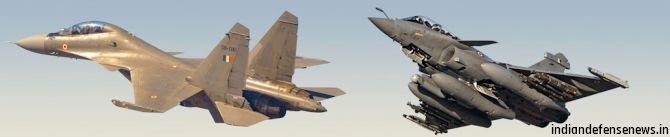
In modern air combat, the decisive factor is often who detects the opponent first, and this dynamic plays out in the contrast between the heavy Su-30MKI and the smaller, sensor-rich Rafale. The Su-30MKI, with its imposing size and supermanoeuvrability, was designed for long-range air superiority missions, acting as a powerful guardian capable of controlling vast airspaces.
In contrast, the Rafale is a medium-sized omnirole fighter, renowned for its ability to perform multiple tasks in a single mission, including air-to-air combat, precision strikes, reconnaissance, and naval operations.
The Su-30MKI excels in close air combat thanks to its thrust-vectoring engines, which allow it to perform sharp turns and complex manoeuvres even at low speeds. This supermanoeuvrability enables it to dominate dogfights by staying behind enemy aircraft and pointing its nose in almost any direction.
The Rafale, however, holds a distinct advantage in detection and electronic warfare. Its advanced AESA radar, the Thales RBE-2AA, introduced in 2012, provides rapid multi-target tracking, resilience against jamming, and a smaller radar cross-section, making the aircraft harder to detect. This gives the Rafale the critical “see first, shoot first” edge, allowing it to lock onto and engage threats before being spotted.
For ground attack missions, the Rafale’s sophisticated electronics and targeting systems ensure precision and efficiency, while its ability to share data seamlessly with other platforms enhances team effectiveness.
The Su-30MKI, with its larger frame, can carry heavier payloads of bombs and missiles, though it often needs to operate closer to targets. India’s acquisition of the Rafale was driven in part by its advanced missile systems, notably the Meteor beyond-visual-range air-to-air missile and the MICA system, which extend its reach and survivability in contested environments.
Cost considerations also play a role in the pairing. The Su-30MKI is significantly cheaper to procure and maintain, making it ideal for long missions with heavy ordnance. The Rafale, while more expensive, brings unmatched sensor fusion, precision strike capability, and survivability.
Together, they form a balanced force: the Su-30MKI provides raw power and endurance, while the Rafale delivers technological sophistication and flexibility. This synergy ensures that India’s air combat doctrine is not reliant on a single platform but instead leverages the strengths of both to create a formidable aerial force.
The combination of these two fighters underscores India’s approach to modern warfare, where diverse capabilities are integrated to achieve dominance across multiple mission profiles. Rather than competing, the Rafale and Su-30MKI complement each other, embodying a strategy that blends brute strength with advanced technology to safeguard national security.
Their partnership represents a quiet revolution in the Indian Air Force’s doctrine, preparing it for future conflicts where teamwork, detection, and precision will matter more than sheer size alone.
Agencies
