

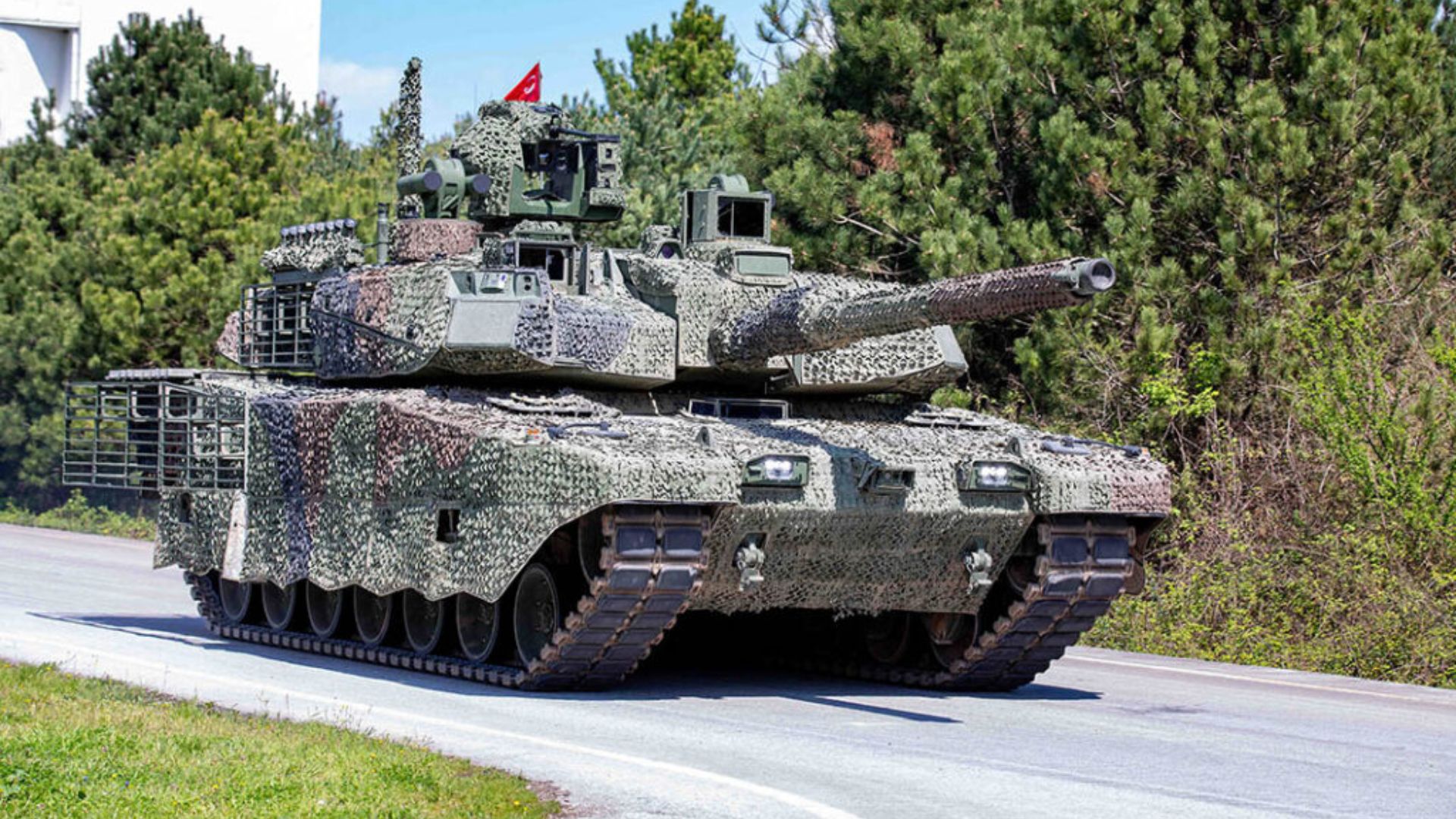
On the latest episode of Pulse Check, editor-in-chief Bilal Khan and aerospace engineer Aseem unpack whether Turkey’s defence industry is real or hype — and why the answer matters more for Pakistan than for Turkey itself.
Has the question been floating around defence forums for the better part of a decade: is Turkey’s defence industry the real thing, or is it Western technology repackaged under a Turkish flag?
On this episode of Pulse Check – a subscriber-exclusive podcast produced by Quwa Pakistan Defence Journal – editor-in-chief Bilal Khan and defence engineer Aseem took this head on. The products are real. The R&D is genuine. The industrial base is growing.
But the economics of sustaining that base – across fighter jets, attack helicopters, ballistic missiles, surface-to-air systems, and armed drones simultaneously – do not add up, and Turkey cannot solve them on its own.
The implication for Pakistan is direct.
If Turkey’s programs are going to survive their own cost structures, they will need export partners who can absorb production volume and share development overhead.
Pakistan, with its own defence modernization needs and limited access to Western supply chains, is one of the most obvious partners – but only if Islamabad is willing to rethink how it has structured defence procurement for the past three decades.
Finish the story. Get the full picture.
Unlock independent journalism and deeper analysis on Pakistan’s key defence and policy developments
The Products Are Real — The Unit Costs Are the Problem
Turkey is a newly industrialized country, a member of the OECD and the G20. The products coming out of Turkish Aerospace Industries (TAI), Roketsan, and Aselsan every year at exhibitions like IDEF and SAHA are not vaporware.
“The advancements are real, they’re genuine, they’re anchored in actual R&D investment and a growing industrial base,” Bilal Khan said. “But the long-term sustainability of these programs is contingent on Turkey’s ability to scale – to distribute the overhead that they’re accumulating across all of this R&D.”
The scale problem is not abstract. Consider the T129 ATAK attack helicopter deal that Pakistan signed before the United States blocked it. The contract was reportedly worth around $1.5 billion for roughly 30 helicopters – inclusive of offsets and maintenance, repair, and overhaul (MRO) provisions.
“The unit price was not too far off from the AH-1Z Viper,” Bilal Khan noted. “Which was also around $50 million, but the Viper is a bigger helicopter, arguably higher quality in some respects, more durable, battle-proven. The unit prices were almost the same between the heavy and the light.”
So, the Turkish stuff is not as expensive as the French or British equivalents – but it is nowhere near as cost-competitive as the Chinese alternatives. And that gap is not a quality issue. It is a volume issue.
Only two countries in the world sustain end-to-end defence industries at genuine scale: the United States, which maintains a global military architecture with dozens of export customers, and China, which has a domestic order base large enough to amortize R&D costs even without major exports. France and Russia are what Bilal Khan termed “half examples” – countries that once covered their own needs comprehensively but now depend on European consortium arrangements or, in Russia’s case, increasingly on Chinese inputs.
What Turkey Did Right — and What Pakistan Did Not
“Turkey is kind of like Pakistan if Pakistan had 30 to 40 years to develop the way we want it to develop,” Aseem said. “If Pakistan became a developed or developing country – much more developed than it is – it would have turned into Turkey.”
To be clear, Turkey’s path to the TFX fifth-generation fighter program was not a leap. It was a ladder. Turkish Aerospace began with F-16 overhauls and component manufacturing in the 1980s and 1990s. From there, it moved to the Hurjet advanced trainer. In parallel, it pursued helicopter and unmanned aerial vehicle (UAV) programs. Thousands of engineers from the Hurjet program are now working directly on the TFX.
“There are thousands of people from Hurjet that are now working in the TFX program,” Aseem said. “They’re directly drawing on that workforce. That should tell you the value of having these precursor programs.”
But the institutional architecture mattered just as much as the engineering. Turkish Aerospace and TAI Engine Industries (TEI) were set up as separate state-owned enterprises under the Turkish Armed Forces Foundation – a pension fund, not a government ministry. The managers who ran these entities were industry professionals, not rotating military officers. They stayed for 10, 15, or 20 years, building institutional memory and long-term relationships with the likes of Airbus and Boeing.
“These entities are not money pits,” Bilal Khan said. “They’re funded by a pension fund. The Turkish Armed Forces Pension Fund wants to make sure the pensions are healthy, so they need a positive return on investment. Even though these are state-owned enterprises, there is some level of business here that has to be maintained.”
The contrast with Pakistan is stark. Pakistan’s JF-17 Thunder program – while a valid decision given the Pakistan Air Force’s (PAF) urgent need for a multirole fighter – offloaded virtually all design and development work to China’s Chengdu Aerospace Corporation (CAC).
“Pakistan says it’s going to make the Azm,” Aseem said, referring to Pakistan’s aspirational fifth-generation fighter program. “But you have to look at what Pakistan has done for this. Not much. The JF-17 was primarily developed by China. You don’t have any qualification or design infrastructure inside Pakistan. It’s all in Chengdu.”
“We basically paid Chengdu to go improve its R&D, which it could then reapply into things like the J-10 and J-20,” Bilal Khan added. “That investment money did not flow back to Pakistan. And now we’re seeing the cost of it.”
Access to the Western Supply Chain
There is a factor that rarely comes up in these discussions but matters enormously: access to basic industrial inputs from Western markets.
If a Turkish aerospace company needs a specific grade of carbon fibre sheeting, it can order it from Germany and have it show up in a few days. The material may not even appear on any export control list.
“If you want to do the same thing in Pakistan, that material is not even on an export control list somewhere,” Aseem said. “But as soon as someone sees the word Pakistan, they’re like, no, we’re not going to do business with you.”
It goes well beyond carbon fibre. The advanced instrumentation you need for aerospace development – computer numerically controlled (CNC) machining centres, supersonic and hypersonic wind tunnel testing systems, specialized sensors – is made by a small number of Western, primarily American or American-co-invested companies. If you are outside that supply chain, or you carry sanctions baggage, you can be delayed by years even when the engineering talent is there.
“Even when you do have the people, you’re always going to be delayed by a number of years compared to your rivals or your allies,” Bilal Khan said. “You just don’t have access to the things you need in order to do it.”
That said, neither Bilal Khan nor Aseem dismissed Pakistan’s capabilities outright. Bilal Khan pointed to Pakistan’s nuclear weapons program – where Islamabad executed with what he called “super competent” precision. The nuclear effort succeeded because it was civilian-led, R&D-driven, and built on top of a pre-existing organic foundation in nuclear science and industrial capacity going back to the 1960s.
“The nuclear side – everything was done correctly,” he said. “There was a foundation. Before they went into nuclear weapons, they had the prior organic R&D foundation within nuclear that allowed them to pursue it.”
“They understood their capabilities and their realities,” Aseem said. “They weren’t delusional. That’s entirely it. They were realistic. And that’s kind of what Turkey has done as well.”
The Consortium Thesis
Turkey’s defence industry will not survive as an independent, self-contained exporter competing on unit cost with both Western and Chinese players. The economics just do not allow it.
So, what is the alternative? Bilal Khan laid out the logic: if Turkey, Pakistan, Saudi Arabia, Indonesia, Malaysia, Bangladesh, and Egypt were to pool their market demands, they could collectively generate the production volume needed to bring Turkish programs into the black. Through consortium building, the group could start taking collective ownership of critical technologies and supply chains – what Bilal Khan described as “a modulator in the centre between the East and the West.”
“You have on both ends – in Turkey, you have pre-existing relationships with the West, a lot of that R&D culture has moved in,” he said. “In Pakistan, more on the Eastern side with some Western influence. On the Indonesian and Malaysian side, maybe nowadays more Western. The point is that you have so much already there in terms of experience, people, expertise, markets, demand, fiscal capacity – but it has to be done as a group.”
This is not without precedent. The European Union’s defence-industrial consolidation and the deepening Asia-Pacific partnerships between South Korea, Japan, and Australia follow the same logic.
TFX Versus J-35: Where Pakistan Fits
The question of whether the TFX or the Chinese Shenyang J-35 will ultimately serve the PAF loomed over the discussion. But interestingly, the panellists framed it less as a competition between two aircraft and more as a question of industrial participation.
Turkish Aerospace’s strategy is not simply to sell 60 TFX airframes to the PAF. The Turks want the Pakistan Aeronautical Complex (PAC) in Kamra to produce parts for the aircraft and have skin in the program – a model that de-risks the TFX’s economics while building Pakistani industrial capacity.
“They don’t just want to sell 60 TFXs to PAF,” Aseem said. “They want PAC to actually produce parts for the aircraft and be involved in that program. This de-risks the program for them and improves scale.”
In fact, Turkish Aerospace has already opened offices in Pakistan, Malaysia, Indonesia, and Saudi Arabia – all potential TFX export customers. The presence is partly about tapping into foreign engineering talent, but it is primarily about setting up the relationships and local industrial roots that come before major procurement contracts.
The J-35, by contrast, would continue the same pattern – Pakistan as a buyer of finished Chinese systems, with limited industrial return. The TFX path, if pursued, would be a structural departure: Pakistan as a co-production partner with real ownership in the program.
But it carries its own risks. The TFX is still in development, and whether its cost structure can compete with a Chinese alternative backed by a much larger domestic order base is an open question.
What Pakistan Would Need to Change
The final part of the discussion turned to what Pakistan would actually need to do in order to become a real consortium partner, not just another export customer.
The core issue is institutional. Pakistan’s defence production entities – from the Pakistan Aeronautical Complex to the National Engineering and Scientific Commission (NESCOM) – are not structured as commercially accountable enterprises. They do not operate under the same profit-and-loss disciplines that Turkey’s Armed Forces Foundation imposes on Turkish Aerospace.
In Turkey, the state-owned defence firms are run by career industry professionals who build institutional memory over decades. In Pakistan, defence production organizations rotate military officers through leadership positions every three to five years. That prevents the kind of deep commercial relationships and long-term program management expertise that underpin Turkey’s industrial maturity.
“Instead of an officer – an air marshal, air vice marshal – rotating in every three or four years, you have people who were there for 10, 15, 20 years running the show,” Bilal Khan said, describing the Turkish model. “Building institutional maturity and memory, building those connections and networks and maintaining them for very long periods of time.”
The fundamental economic argument – that defence industrialization requires either massive domestic demand or deep export partnerships – applies to both Turkey and Pakistan. And one can see why a consortium model is not simply a nice-to-have but a structural necessity for both countries.
Turkey has the products, the industrial base, and the Western supply chain access. Pakistan has the strategic demand, the population base, and the geographic position between Eastern and Western technology spheres. Neither can solve its defence-industrial challenges alone.
Whether Islamabad and Ankara can turn a decade of warm rhetoric into the kind of binding, long-term industrial partnership that the economics require – with shared production, shared IP, and shared risk – is the real test. It is not an engineering problem. It is a political economy problem. And as both Bilal Khan and Aseem made clear, it is one that neither country can afford to keep deferring.
Pulse Check is a subscriber-exclusive podcast available to Quwa Plus members. The episode is available as a free preview. Subscribe for full access to every episode, plus Quwa’s ongoing coverage of Pakistan defence procurement, strategic analysis, and Turkish defence developments.
Quwa Plus
Make Sense of Pakistan’s Defence and Policy Shifts
Independent Pakistan-led analysis, Pulse Check audio briefings, and a decade of reporting to help you understand what changed, why it matters, and how the story fits together.
Featured & Trusted By
