

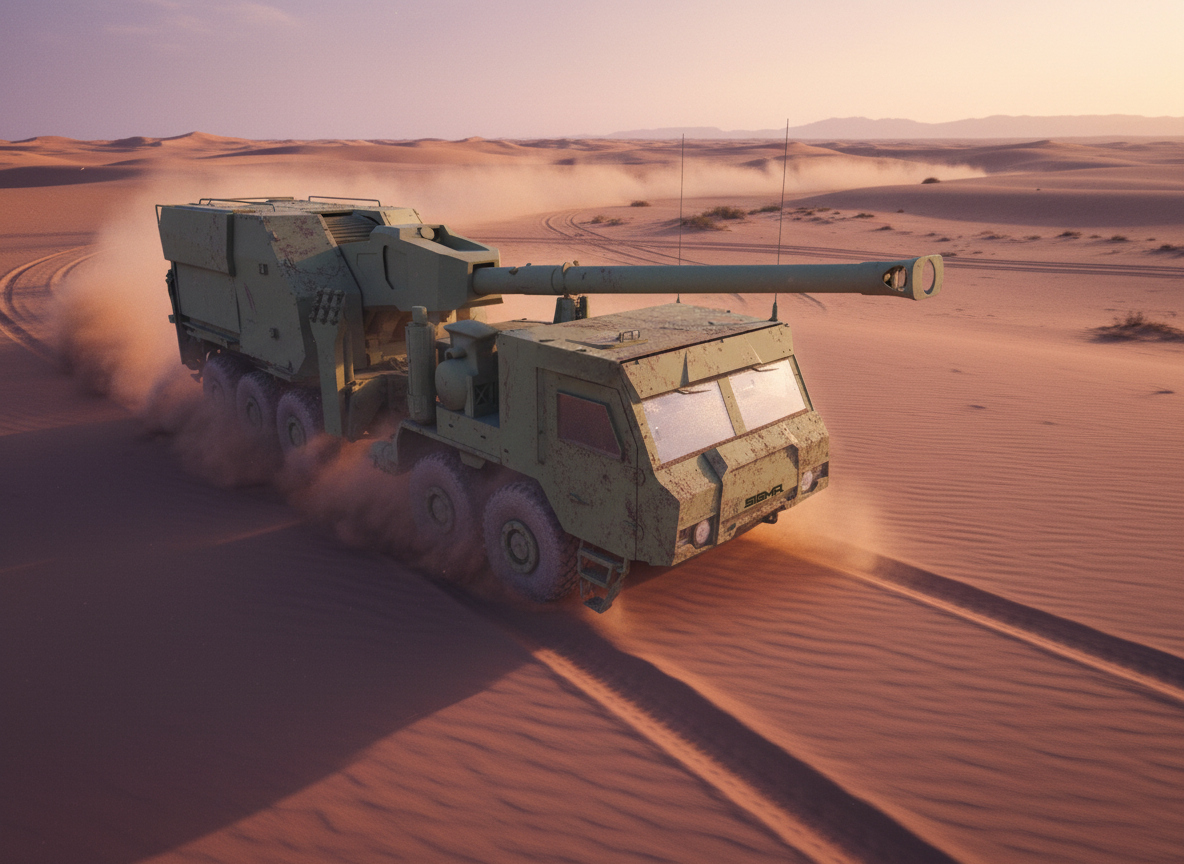
Elbit America asserts that the value of its SIGMA Mobile Tactical Cannon extends beyond lessons drawn from Ukraine’s trench-driven fight. Instead, the company points to a broader shift toward dispersed, fast-moving operations where survival depends on generating 360-degree effects downrange while avoiding static, predictable positions.
SIGMA was intentionally designed to be “American” in more than name. SIGMA’s American identity is also forged from its domestic supply chain, its full-rate production in Charleston, South Carolina, and its compatibility with the US Army’s ammunition inventory. Elbit America President and CEO Luke Savoie explains why all that matters.
Breaking Defense: Before we get into the platform itself, what are the threat scenarios necessitating the need for a mobile howitzer?
Savoie: Modern fires doctrine makes one thing clear: artillery must control the clock and not simply react to it. In an environment dominated by long-range drones, counter-battery radars, and pervasive ISR (Intelligence, Surveillance and Reconnaissance), firepower without survivability is a liability. What we’ve seen recently – especially with Operation Epic Fury – reinforces our core value proposition for SIGMA, which is speed, survivability, and sustained fires. In modern warfare, you can’t have predictable emplacement locations or be a static target. Long-range drones like Shaheds strike preplanned, stationary targets. But if your artillery is moving, unpredictable, and constantly shifting positions, they’re far harder to hit. Artillery is still important to project power at great distances in a survivable, dynamic way. Artillery still matters, but it can’t be slow and static. SIGMA offers 360-degree firing, speed, and survivability.
Let’s talk about the US defense industrial base and what makes SIGMA different from other systems that might be described as American-made.
There’s a difference between American‑made and American. SIGMA is American. Too often, “American‑made” means final assembly happens here but critical kits and components come from abroad, creating vulnerability at the worst possible time. SIGMA was designed with a US supply chain from day one: built on an Oshkosh 10×10 with US-made tires, lights, electrical components, hydraulics, and even the small items – turn signals, headlights, filters – sourced domestically. Our barrels, forgings, and steel are anchored in the US, too. We have a whole network of suppliers across the country supplying components, but it all comes together in Charleston, South Carolina SIGMA.
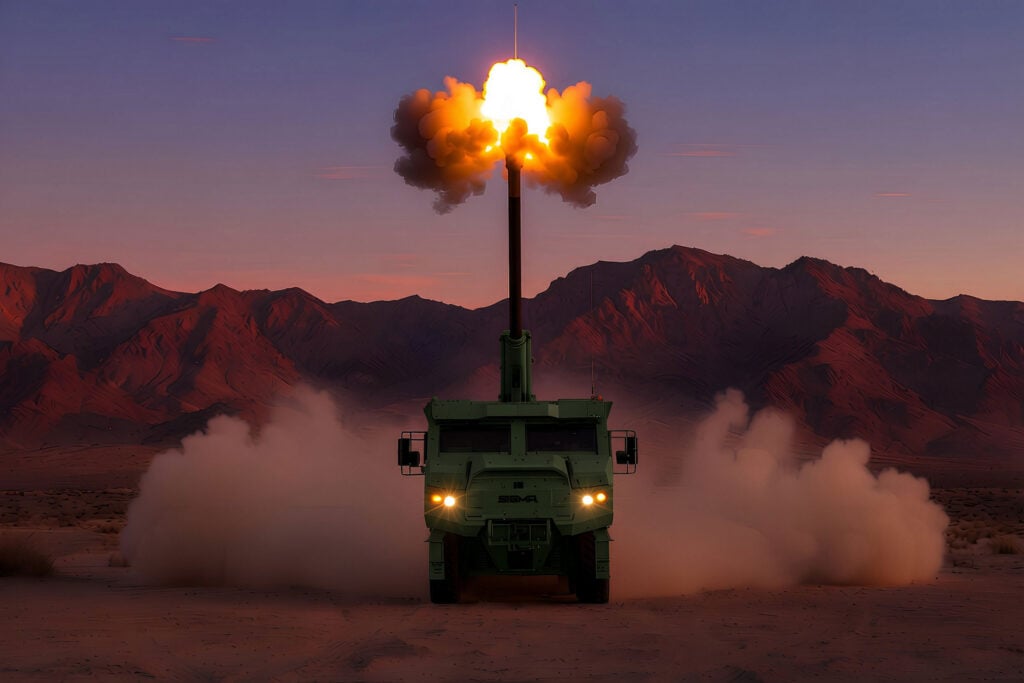
Where does that industrial base stand today when it comes to scaling SIGMA?
We’re ready to scale now. We designed SIGMA and our entire US setup for full‑rate production, and we are operating at full rate in Charleston. On a recent visit, we had a dozen Oshkosh 10×10s in WIP (Work‑In‑Progress), staged for integration.
Our Charleston facility has two built-in levers for capacity expansion within the current footprint. And our partner, Oshkosh, delivers chassis at rate and often early because their production line is mature and they’re already producing the Mobile Artillery Platform (MAP).
Most competitors would need to start from scratch in the US. Nothing comparable exists today in the wheeled howitzer space. Our competitors can’t scale like we can because they’d have to recreate something in the US or build something from the ground up.
Discuss some of SIGMA’s features, especially survivability.
Survivability starts with true 360‑degree firing. SIGMA can fire max charge in any direction without repositioning. That means the crew can align with the terrain – tree lines, ridges, cover – without worrying about where the gun can or cannot point. Restrictions create predictability, and predictability kills. SIGMA eliminates that.
Mobility is the other half of survivability. With five independently locking differentials, SIGMA navigates primary, secondary, tertiary roads, and complex off‑road terrain. With its ten wheels, SIGMA can navigate challenging terrain and go where other systems can’t. That agility enables sub‑60‑second displacement, shrinking the targeting window and enhancing counter‑battery survivability.
SIGMA also brings the firepower, which helps with survivability. The system can sustain firing at 8‑rounds‑per‑minute from a 40‑round onboard magazine all at max charge.
Finally, where do the savings come from over the life of the platform, from sustainment to training?
Because SIGMA is already in full-rate production for an international customer, its unit price is relatively low. But the real savings come later.
First, sustainment: Break a taillight or a turn signal? It’s a standard US component – not a propriety import. The engine, transmission, oils, tires, and braking system are all common within the US Army logistics system, thanks to our partnership with Oshkosh. That commonality significantly lowers lifecycle costs.
Second, ammunition: We fire all JBMoU* compliant ammunition and charges. This includes all ammo currently in the US artillery ecosystem. Changes to ammo. and charges will mean increased costs for barrels and sustainment. We designed SIGMA around the US ecosystem from the start.
Third, training: SIGMA includes embedded training in the system. Crews can execute full fire missions using the cab’s digital interfaces. No separate simulator required. Every vehicle becomes its own training device, dramatically reducing training infrastructure and increasing readiness.
*Joint Ballistics Memorandum of Understanding – a NATO agreement to ensure 155mm artillery weapon and ammunition systems are interchangeable.
