

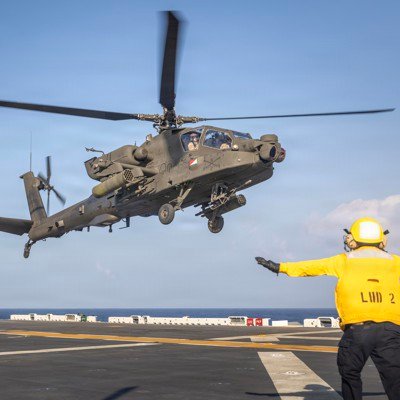
HONOLULU—Heavy seas didn’t stop Firestorm Labs from printing “thousands” of unique parts aboard the USS Essex amphibious assault ship on the way to the Rim of the Pacific naval exercise here, the expeditionary manufacturing company announced this week.
“We were told it was the roughest water off the California coast in the last five years,” Firestorm CEO Dan Magy told Defense One. The company has an exclusive arrangement with HP, which uses a type of 3D printing called multi-jet fusion, “and what we’ve found is that the systems and the machines are quite resilient.”
“We think we’re building a contested logistics solution that is going to be scalable across all branches of the Department of War,” Magy said. “If we’ve seen anything from Ukraine and now from Iran… we need to rethink warfare from the ground up. We are increasingly dealing with contested environments where—you know, look at what just a blockade in one part of the world has caused to the ability to get products out, oil prices. Heaven forbid something like that happened in the South China Sea, where 70 percent of the things we all buy in the world are produced.”
Magy believes their xCell additive manufacturing unit—composed of two 20-foot containers that can go anywhere—”really represents a leap forward in how we’re thinking about solving, maintaining legacy systems, but also building attritable systems like drones closer to the need.”
During a tour of the xCell unit used aboard the Essex, Duane Blank, field operations manager for Firestorm, showed off some of the parts printed at sea, including stops made to protect Apache helicopter rotors from scraping against the ship’s non-skid coating.
The nylon composite the company uses for printing works for “everything within the entire spectrum of warfare,” Blank said, from prosthetics to drones to humanitarian assistance and disaster relief items.
Among the items printed while pitching through Sea State 5 were a dozen Squall first-person-view drones, Blank said, which were later used as adversary aircraft during a counter-drone exercise as part of RIMPAC.
The “beauty of 3D printing,” he said, is the “ability to iterate” and get troops what they need “at the point of need.”
Magy said it’s a top concern.
“The No. 1 thing we’re hearing from folks across the service is, ‘It’s great if you make it in a factory in Alabama or California or Texas. What happens if the thing breaks on the battlefield? I have to put it in a box now for four months.’”
Sustainment wasn’t what the company initially set out to address, he said, “but it has become increasingly important for all of our customers, because there are a number of legacy systems that like, the supply chain just isn’t there anymore. Let alone the supply chain for something in Okinawa or in Bahrain.”
