

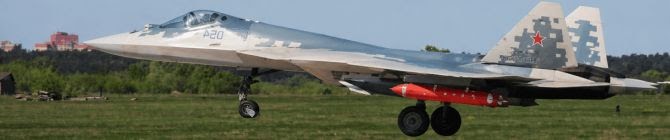
The revelation of the S-71K Kover cruise missile tailored for the Su-57 and
its S-70 Okhotnik unmanned wingman does indeed shift the calculus for India’s
evaluation of the Su-57E.
platform to remain outside most hostile air defence envelopes,
reported
Malaysia based defence portal Defence Security Asia.
This is particularly relevant for the Indian Air Force, which has long sought
reliable deep strike options without exposing its manned assets to high-risk
environments.
The 250 kg warhead, derived from the OFAB-250 family, provides substantial
destructive capability against fixed installations, making it suitable for
pre-planned missions where precision and survivability matter more than
adaptability.
The inertial navigation system, while optimised for fixed targets, underscores
the missile’s role as a cost-efficient solution for strategic strikes rather
than dynamic battlefield engagements. Its design philosophy—leveraging
commercial components for rapid fielding—suggests Russia’s intent to make the
system affordable and scalable, which could appeal to India as it balances
budgetary constraints with operational needs.
Comparative Analysis of Stand‑Off Strike Missiles
| Missile | Origin | Range | Warhead | Guidance | Key Strengths | Limitations |
|---|---|---|---|---|---|---|
| S‑71K Kover | Russia | ~300 km | 250 kg HE fragmentation (OFAB‑250 family) | Inertial navigation (INS) |
Cost‑efficient, rapid fielding Designed for UCAV integration (Okhotnik) Enables Su‑57 to act as command node |
Optimised for fixed targets Lacks multi‑mode seekers Limited against mobile/highly defended assets |
| JASSM/JASSM‑ER | USA | 370 km (baseline), >926 km (ER) | 450 kg penetrator (WDU‑42/B) | GPS + INS + Imaging Infrared (IIR) |
Stealthy design Precision strike with CEP ~3 m Effective against fixed & relocatable targets Integrated on multiple platforms (F‑15, F‑16, B‑1, B‑2, F‑35) |
Higher cost (~$1M+ per missile) Production bottlenecks in high‑intensity conflicts |
| Storm Shadow/SCALP EG | UK/France | ~560 km | 450 kg BROACH tandem penetrator | GPS + INS + Terrain reference + IIR terminal seeker | Designed for hardened/buried targets Proven combat record (Iraq, Libya, Ukraine) Low‑observable, terrain‑hugging flight |
Very high unit cost (~£2M) Fire‑and‑forget, cannot retarget mid‑flight |
The integration with the S-70 Okhotnik UCAV is perhaps the most transformative
aspect. By enabling distributed strike missions, the Su-57 can act as a
command node, directing unmanned assets into contested airspace while itself
remaining at a safer distance. This manned-unmanned teaming concept aligns
with India’s growing interest in networked warfare and autonomous systems.
For India, the addition of the S-71K capability enhances the Su-57E’s
attractiveness as more than just a stealth fighter—it becomes part of a
broader strike ecosystem. The ability to conduct deep strikes without risking
frontline fighters could fill a gap left by delays in indigenous programmes
such as the Advanced Medium Combat Aircraft.
However, the caveat remains significant: the missile is optimised for fixed
targets and lacks sophisticated multi-mode seekers. Against mobile, heavily
defended, or high-value dynamic targets, its utility would be limited compared
to advanced Western stand-off weapons. This means India would need to view the
S-71K as a complementary capability rather than a comprehensive solution.
In essence, the S-71K Kover adds a genuine stand-off strike dimension to the
Su-57 package, reinforcing its appeal for India’s evaluation.
Yet, the limitations in seeker technology highlight the need for India to
consider whether this capability aligns with its operational doctrine, which
often demands flexibility against both fixed and mobile adversary assets.
The Su-57E with the S-71K could serve as a potent tool for strategic
deterrence and pre-planned missions, but India would still require other
systems to address dynamic battlefield challenges.
DSA
