

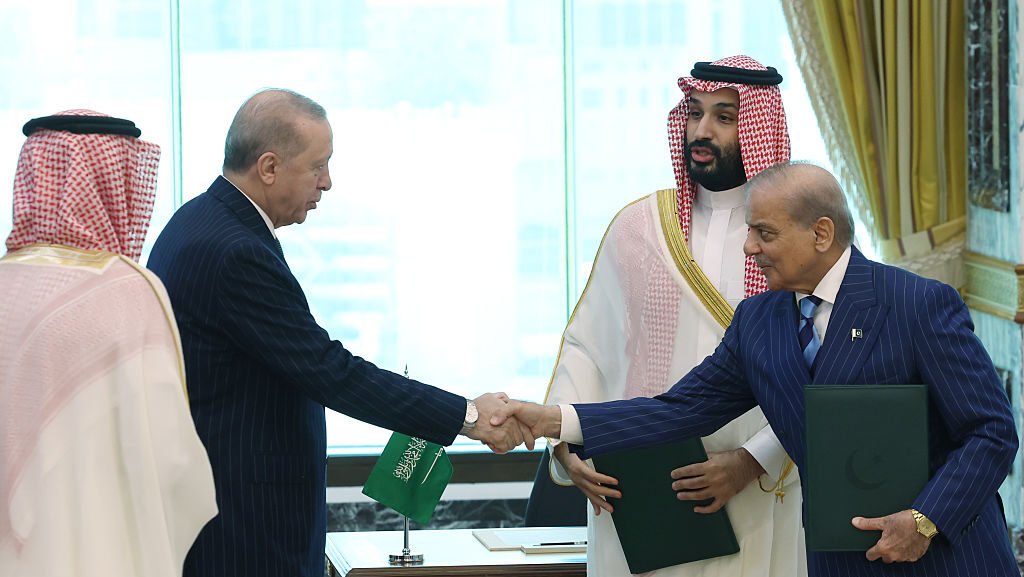
WASHINGTON — The leaders of Saudi Arabia, Turkey and Pakistan today signed a new joint defense agreement, creating a NATO-style collective defense alliance that could soon be tested amid complex regional conflicts.
“The Agreement is intended to strengthen collective deterrence against any act of aggression, and stipulates that any armed attack against any one of the three States shall be regarded as an attack against them all,” a joint statement reads. “It further provides for the enhancement of all aspects of defence cooperation among the three States.”
The agreement was signed by Saudi Crown Prince Mohammed bin Salman, Turkish President Recep Tayyip Erdoğan and Pakistani Prime Minister Muhammad Sharif at the Makkah Al-Mukarramah Summit for Joint Defence in the holy city of Mecca in Saudi Arabia.
The countries said the idea was “[g]uided by the longstanding historical ties among the three states, based on the enduring bonds of brotherhood and Islamic solidarity that unite them, and building upon their shared strategic interests and longstanding defense cooperation.” The agreement, the countries added, “reflect[s] the three states’ shared commitment to further strengthening their collective security and to promoting peace, security, and stability in the region and beyond, in pursuit of a secure and prosperous future.”
The agreement comes nearly a year after Saudi Arabia and Pakistan signed their own defense accord on Sept. 17, bringing Riyadh under Pakistan’s nuclear umbrella. A Turkish official said today’s deal does not replace any existing bilateral agreements, according to The Associated Press.
The budding alliance could be put to the test shortly. Saudi Arabia has come under attack repeatedly this year from Iran-backed forces as Tehran lashes out in the wake of the US-Israeli military campaign against it. Just hours before the pact was signed, a senior Saudi official told Reuters the Islamic kingdom was bracing for attacks from Iran’s proxies in Yemen and Iraq based on intelligence collected domestically and from regional allies and the US.
Pakistan, meanwhile, has for months played a diplomatic role in the Iran conflict, one of several venues for complex peace talks. The inclusion of Turkey, a NATO member, in the defense alliance could further heighten tensions with Israel, but also provide an opening for Riyadh and Islamabad to more easily tap into Ankara’s booming defense export market.
Michael Kugelman, a senior fellow at the Atlantic Council, said the trilateral alliance was a “logical outgrowth of the deepening security ties” of the three nations.
He added on X that with its “focus on collective regional deterrence [with] an eye to Iran, it’ll be received well in Washington, which wants to see more burden-sharing from top allies.”
