

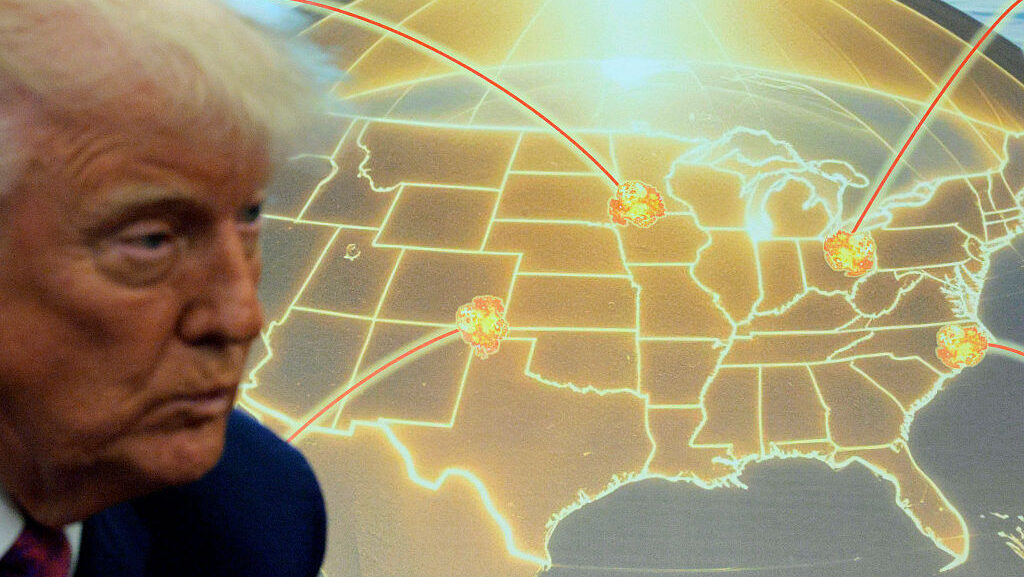
WASHINGTON — The Space Force has quietly tapped a dozen companies to bring to fruition a key element of President Donald Trump’s Golden Dome missile defense shield: space-based interceptors (SBIs), which the service expects should be ready for demonstration in as little as two years.
In a press release today, the Space Force revealed that 20 contracts — collectively totaling a potential $3.2 billion — have been awarded to the 12 firms over the last several months under a dedicated SBI program. According to the Space Force, the companies will help construct a proliferated low earth orbit “constellation of interceptors capable of boost, midcourse and glide phase engagements.” Essentially, those systems would be capable of knocking down missiles, including hypersonic glide vehicles capable of maneuvering, throughout earlier phases of flight.
The Space Force late last year disclosed multiple awards for SBI prototypes, but didn’t name the winners. That list, made public today, shows a mix of legacy defense stalwarts and relative newcomers. Those companies are:
- Anduril Industries Inc.
- Booz Allen Hamilton Inc.
- General Dynamics Mission Systems Inc.
- GITAI USA Inc.
- Lockheed Martin
- Northrop Grumman
- Quindar Inc.
- Raytheon (also known by its parent company RTX)
- Sci-Tec Inc
- SpaceX
- True Anomaly Inc.
- Turion Space Corp.
The individual value of each company’s contract, nor their specific roles fielding SBI systems, were disclosed. The Space Force said it would not release additional information at this time, citing operational security.
The SBI deals were issued as Other Transaction Awards, which Space Force Col. Bryon McClain said “attracted both traditional and non-traditional vendors, while harnessing American innovation, and ensuring continuous competition.”
The Space Force intends to show “an initial capability in 2028,” McClain, the service’s program executive officer for space combat power, said in the release.
“The global strategic landscape has changed, a new generation of threats hold the homeland at risk. Proven and formidable U.S. missile defense systems, combined with next-generation space-based tracking and advanced interceptors must be integrated with Artificial Intelligence to counter the speed, maneuverability, and lethality of the threats,” the Space Force said in the release.
The announcement comes just one day after the Golden Dome’s czar, Space Force Gen. Michael Guetlein, emphasized that the Pentagon needs to show progress to the American public for the project estimated to cost $185 billion. Guetlein also recently testified before lawmakers that the SBI concept may not make it into the final Golden Dome architecture if it is shown to be prohibitively costly.
“We are so focused on affordability. If we cannot do it affordab[ly], we will not go into production,” Guetlein said.
