

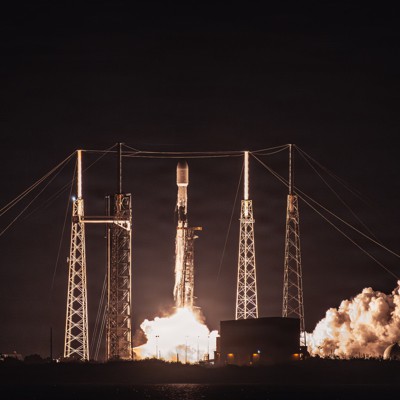
CAPE CANAVERAL, Fla. — After decades of development, a rocket switch in March, and a last-minute weather delay, the U.S. Space Force finally launched the last satellite of the world’s most modern GPS system into orbit.
The final GPS III space vehicle, known as SV-10, broke through the Florida skies and into the heavens aboard a SpaceX Falcon 9 rocket last month. The new satellite offers position data three times more accurate and eight times more jamproof than previous ones, according to the Space Force. For civilians, it means more precise road directions and better food delivery. For troops, it means more sophisticated targeting and higher-security communications in austere environments.
It’s a no-fail mission that people—from parents getting their kids to soccer games to Air Force pilots in enemy airspace—are counting on, said Space Force Col. Stephen Hobbs, Combat Forces Command’s Mission Delta 31 commander.
“We can talk about the captain of industry who owns a banking conglomerate and they want to make sure they have precise timing for their ATMs,” Hobbs said. “On the military side, we talk about an Army captain on the ground wanting to make sure that he or she can get from point A to point B in order to achieve their objective. We talk about a Navy captain in charge of a ship who’s trying to find their way into port … All of those captains care about this signal.”
As commerce and combat grow more reliant on space systems, the tempo and stakes of Space Force’s GPS launches are also rising. Defense One spoke to guardians at Cape Canaveral Space Force Station last month ahead of the GPS III launch and what it takes to keep up the demand the military and companies have for the upgraded satellite capabilities.
The guardians said it’s a notable milestone to celebrate, but it’s a brief, and short-lived recognition. The way they see it, there’s more work to be done.
The GPS III system, which was approved by Congress in 2000, already has a replacement on its heels. The first launch of the next system, known as GPSIIIF, or Follow-On, is slated for May 2027. It’s pitched as an even more resilient signal that should allow for “over 60 times more anti-jam capabilities than legacy space vehicles,” the service said.
While preparing for those next launches, guardians are also maintaining today’s constellation, including some satellites that are decades past their planned retirement.
“Maintaining a cadence of keeping GPS satellites on orbit, that’s the best approach,” said Capt. Brahn Kush, the government mission integration manager. “The same way they do routine oil changes is the best approach. You never realize that impact, because you kept a consistent cadence.”
Moving faster and accepting risk
The final launch of the a GPS III satellite had some bumps. In late February, service officials paused planned national-security launches aboard United Launch Alliance’s Vulcan rocket because an anomaly had been discovered on one of the solid rocket motors.
Service leaders told reporters at Space Symposium in Colorado Springs last month that the anomaly is still under investigation and they’re evaluating the manifest for Vulcan’s scheduled launches as they look for the cause of the problem.
The SV-10, nicknamed the “Hedy Lamarr” for the Hollywood star and inventor, was among the affected missions. In just weeks, guardians had to switch the mission to SpaceX’s Falcon 9 instead. After those preparations were made, bad weather pushed the April 20 launch back another day.
Guardians involved with the mission said those obstacles, while unexpected, have become easier to navigate. In 2024, the service debuted a protocol called “Rapid Response Trailblazer,” which aims to reduce the time between mission start and launch.
Capt. Austin Guerrero, the chief of GPS III/IIIF launch operations, told Defense One that exercise was vital to getting the most recent satellites on orbit.
“The asked us, ‘Hey, if we were to switch to a different launch provider, how fast can we get moving?’ So our team moved out, and we did that in about four months. The typical timeline for our launch processing is six. So we got that down on our first shot down to four months,” Guerrero said. “So, that kind of set the standard.”
That framework boosted flexibility for the remaining GPS III space vehicles launches. He said each iteration of the last three satellites was quicker and more streamlined.
“Each launch, we take lessons learned and apply them to the next,” Guerrero said. “That’s allowed us to kind of establish a rhythm and be ready to execute very quickly.”
GPS IIIF satellites are to be launched in May 2027, top Space Force leaders have told Congress. The same day as the SV-10 launch, Pentagon officials unveiled the 2027 budget request, which called for 31 space launches, two new GPS satellites and their supporting infrastructure, and nearly $6 billion for satellite communications systems.
If Congress approves that funding, guardians at Cape Canaveral are ready to get the latest technology into the skies.
“There’s always a want or need for a new capability, and our job is to deliver on those capabilities,” Guerrero said. “And so providing capabilities again, and again, only strengthens our ability to deliver that to the world.”
From the ground up
Even as the final GPS III soared into orbit, the Space Force wrestled with challenges on the ground.
A day before the SV-10 launch, the service announced it was canceling a key program meant to modernize the ground stations to keep the GPS constellation competitive and protected.
The Global Positioning System Next Generation Operational Control System, known as OCX, was canceled after the 15-plus-year effort faced multiple delays and consumed a staggering $6.3 billion. The Space Force formally accepted OCX from Raytheon in July, but the service discovered persistent problems within the system, the service said in a news release.
“Despite repeated collaborative approaches by the entire government and contractor team, the challenges of onboarding the system in an operationally relevant timeline proved insurmountable,” Hobbs said in the news release. “We discovered problems across a broad range of capability areas that would put current GPS military and civilian capabilities at risk.”
Meanwhile, the Space Force continues to improve the existing ground system. Called AEP, it can use the GPS III constellation’s upgraded capabilities such as M-Code, a highly encrypted signal for military use, the service said.
“AEP has been repeatedly upgraded over the years to deliver new mission capabilities,” a Space Force spokesperson said. “For example, AEP provides M-Code signal broadcast to warfighters for operational use today. In addition, AEP upgrades have made it far more cyber resilient than in the past. Our plan is to make additional AEP upgrades to satisfy near-term mission needs now that OCX is cancelled. We are developing plans to increase competition in this mission area longer term.”
The next GPS IIIF satellites will have Regional Military Protection, which will permit allied militaries to use the U.S. military’s upgraded satellite communications.
Today’s GPS constellation includes 31 satellites, according to Autonomy Global, including some that have reported operated three times longer than initially planned..
Hobbs attributes that to the engineers, navigators, and guardians who’ve kept those satellites functioning and on orbit. As the service works to get the next generation of satellites into the skies, he knows they’ll be called upon again to keep them functioning for decades to come.
“Now that we’ve launched all the IIIs that we’re going to have, are there ways that we can extend the life of that capability to make sure it’s there for the warfighter when he or she needs it?,” the Mission Delta 31 commander said. “If all we did was launch the III and then not try and do everything we can to keep it alive as long as possible…then we wouldn’t be doing our due diligence for the American taxpayer.”
