

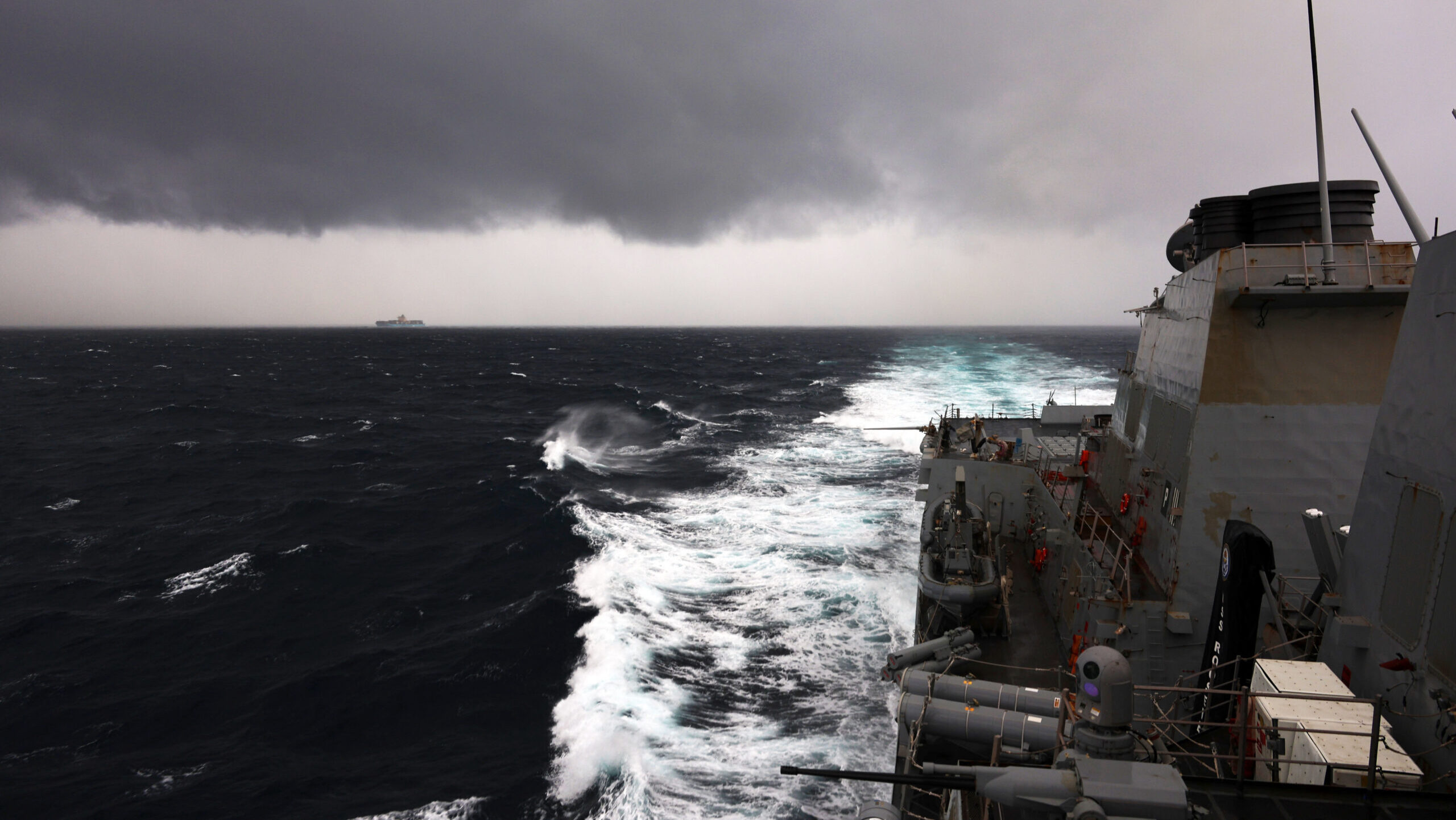
WASHINGTON — The Navy doesn’t have the bandwidth to escort commercial ships through the Strait of Hormuz, according to the Navy’s top officer.
“There are many things we can continue doing to enhance the blockade, and but to actually start doing something where I’m providing escort services through a contested straight will, in my military opinion, exceed the capacity of the Navy to do that effectively,” Chief of Naval Operations Adm. Daryl Caudle told lawmakers on the Senate Appropriations Committee today.
The US Navy has enforced a blockade of all maritime traffic entering and exiting Iranian ports since April, although transit through the strait itself is not blocked by the US for vessels traveling to and from non-Iranian ports. Still, the threat of attack from Iran or its proxies has kept a vast majority of ships from braving the waterway.
In early March President Donald Trump announced a plan in which “[i]f necessary, the United States Navy will begin escorting tankers through the Strait or Hormuz, as soon as possible.” But such an escort mission never came to fruition.
Then, earlier this month Trump said only that naval ships would aid commercial ships under Project Freedom, only to reverse course two days later. At the time, he said the pause came per the request of Pakistan and “other Countries,” and cited the US military campaign’s “tremendous” success.
Today, Caudle cautioned an escort mission would prove a heavy lift.
“If we go try to do escort with that, we have looked into that,” Caudle said. “That’s a very challenging mission in that narrow strait when it’s contested, and so when you’re in a contested environment to de-mine the strait of Hormuz or to do escort duty — is not something that’s easy to do. So we’re going to have to get to a place that that strait is open with a generally accepted ceasefire before that can be turned on en masse.”
Even so, Caudle said that the blockade is proving effective and has facilitated advancing negotiations with Iran. According to US Central Command, US forces have redirected 94 commercial vessels and disabled four as part of enforcing the blockade.
“The blockade has probably been the single most important military operation we’ve done to try to get negotiations to the place where they even are, and we’re getting better at it,” Caudle said. “We’re getting more efficient.”
Meanwhile, negotiations are ongoing with Tehran. Trump said Monday he had scrapped an attack on Iran planned for Tuesday, amid “serious” peace talks. Trump told reporters on Wednesday that the US is in the “final stages of Iran,” but also said later that day that he isn’t in a rush to secure a deal.
