

Six trucks packed with heavily armed military personnel moved slowly into Byain Phyu, a predominantly Rakhine Buddhist village on the outskirts of Sittwe, the capital of Myanmar’s Rakhine State.
The timing of their arrival – 8 a.m. – was odd. Soldiers usually patrolled the village and carried out raids in the afternoon, evening, or night.
About 200 military personnel disembarked from the vehicles after halting at the center of the village. They divided equally into two groups and began to march in opposite directions along the main street passing through the village. Their task was to surround the village of about 2,000 residents and ensure that nobody escaped. A third group of about a dozen military personnel led by a young officer announced over loudspeakers that all residents should assemble at the village center without delay.
Military trucks rumbling through the streets were not unusual in Byain Phyu and neighboring villages in Sittwe’s suburbs. Knocks on doors of homes in the dead of the night were not infrequent either. Residents were familiar with the military thrashing people and dragging them to prison on mere suspicion of seditious activities.
But what unfolded between May 29 and 31, 2024, in Byain Phyu was totally unexpected. The torture and execution of at least 70 residents in that period would change the lives of its residents forever.
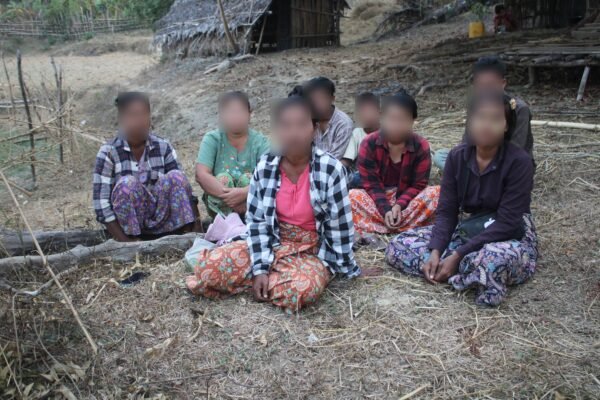
On February 12, 2026, five survivors of the massacre, including three women, narrated their experiences to The Diplomat at Ponnagyun Township in Myanmar, where they are currently lodged.
A map of northern Rakhine state, with the location of Byain Phyu village marked in red. Map via Wikipedia/WikiEditor2004
How the Bloodbath Unfolded
By 9 a.m. on May 29, 2024, the military had surrounded Byain Phyu. Residents were instructed to assemble at the village center, where two streets intersected. About a dozen elderly, physically challenged and sick people were dragged out of their homes by soldiers at gunpoint. Some bikers and daily wagers heading to Sittwe were stopped and forced to return to the village. Among them was an artist Kyaw Kyaw Aung, who was going to Sittwe to sell his paintings. He was compelled to return, and his knapsack with paintings and his motorcycle were confiscated.
Back at the center of Byain Phyu, a burly middle-ranking officer, believed to be an army major, directed all the men to move to the outskirts of the village, near a tea shop. They were blindfolded and their hands were tied behind their back. An estimated 800 men, including teenagers, were herded to the spot. At 6 p.m., they were forced to move to another location on the western fringe of the village.
Another young officer instructed the women and children to sit on both sides of the cobbled roads. He and some soldiers looked closely at the women and children, paused to question those who appeared “suspicious,” and ordered them to remain seated until “further instructions.”
“We never imagined that something very sinister had been planned. We thought the soldiers were tasked to identify some people from our village, who would then be questioned and imprisoned,” said Hla Hla Khin, whose son and husband were among those herded to the periphery of the village.
The situation took a different turn at 7 p.m. when intermittent screams were heard. The men were being tortured. Then, after about an hour, gunshots were heard at regular intervals that lasted till 4 a.m. the following morning.
“At dawn the next day, we saw smoke billowing from the cemetery that was 100 meters from the village periphery. It was then that we realized that many residents might have been killed,” recalled Ma Wong Than, whose father was among the men killed that night. “Their corpses were being burnt at the cemetery.”
Even as the women and children, who were lying flat on the street, wondered what had happened, a middle-aged Burmese trader from Bago in the Burmese heartland, who had been living in Byain Phyu temporarily, was seen walking from the cemetery toward the village center. Soldiers had released him after he revealed his Burmese identity.
Hla Hla Khin said that the trader “looked scared and was hurrying to his residence” when the women stopped and questioned him. “He hurriedly narrated that about 70 men had been killed. Many residents were tortured and shot multiple times. The corpses were either buried or cremated at the cemetery and near the lake,” she recounted.
According to the trader, about a dozen residents who were thirsty asked the soldiers for water. They were forced to drink the soldiers’ urine from plastic bottles; those who protested were beaten with rifle butts, including one middle-aged man who succumbed to injuries two days later.
At least ten residents were unable to walk and speak after being tortured. All the men were likely whisked away to the prison soon after, Hla Hla Khin recalled, quoting the trader.
Saw Tamana Mue, who is Karen by ethnicity and hails from Kayin State bordering Thailand, confirmed the trader’s account. A worker at the docks in Sittwe, he was staying temporarily at the residence of his wife, a Rakhine Buddhist, at Byain Phyu. He was released early morning along with the Burmese trader and about a hundred elderly and sick residents, but not before being tortured.
“All 800 men were divided into three groups and asked to kneel down. Everybody was blindfolded, but I could sense what was happening around me. The torture and killings began after sunset. I believe that more than 70 were killed,” Saw Tamana Mue recalled.
Saw Tamana Mue said that about half a dozen men were apprehended while trying to escape. They were stabbed multiple times and then shot dead. He confirmed the trader’s account that some residents were compelled to drink the urine of some soldiers when they had asked for water.
“They suspected me of being a functionary of the Karen National Liberation Army (KNLA), Saw Tamana Mue recalled. “I had a narrow escape.”

A satellite image of Byain Phyu village, via Google Earth.
Why Was Byain Phyu Targeted?
By mid-2024, the Arakan Army (AA) had wrested control over 70 percent of Myanmar’s Arakan, which spans southern Chin State and Rakhine State, from the military. Only the core region of four townships – Sittwe, Kyaukphyu, Maungdaw, and Manaung – remained under military control. The AA had already infiltrated the suburbs of these townships.
AA’s political wing, the United League of Arakan (ULA), had set up its own administrative mechanism in most of the villages, including Byain Phyu. This was the strategy the AA and ULA adopted toward villages around other townships that the AA had captured in the past.
Early in 2024, the Arakan Army had reportedly demanded the military’s surrender before it launched attacks on Sittwe. Consequently, the military began erecting defensive installations around the city and relocated soldiers’ family members to safer places. Around the same time, AA had intensified its attacks in several townships near Sittwe such as Rathedaung, Pauktaw, Kyaukphyu, and Ramree after liberating the commercial hub of Kyauktaw.
The battle for Kyauktaw was among the fiercest, a senior AA commander recounted, lasting for over a month and culminating in the Myanmar military suffering defeat with heavy casualties. Nearly 300 military personnel had also surrendered to the Arakan Army.
All five survivors of the massacre said that soldiers had repeatedly reminded residents about the casualties the military suffered in the battle for Kyauktaw. “A middle-ranking officer said that the primary objective in targeting Byain Phyu was to avenge the deaths of military personnel and their family members in Kyauktaw. He stressed that the village would be erased,” Khin Khin Hla said.
At the periphery of the village where the men were herded, officers told residents that the military had received information that every household was paying 2,000 kyats ($0.95) to the AA each month and that the village was actively collaborating with the outfit by providing the latter with recruits and information about military formations in Sittwe.
The military had compiled a list of 11 persons from the village whom it suspected of being ULA functionaries. These people were identified, asked to kneel in a row, and quizzed about their links with the rebel outfit. Not surprisingly, the officers were not satisfied with their replies.
“They were beaten with chains and shot dead. Four among them were already unconscious before the trigger was pulled on them,” said 17-year-old Maung Wong, whose father disappeared from Pathein prison where he was imprisoned. Maung Wong was also tortured and imprisoned for eight months before being released from Sittwe prison.
Of all the townships under military control, Sittwe is the most strategic. The city is a commercial hub and the nucleus of a flagship multi-modal connectivity project being built by India to provide an outlet to its landlocked northeastern region.
An AA victory in Sittwe would provide it with a huge military advantage in the campaign to attack and liberate other townships in Rakhine state. The military’s defeat would also boost the morale of the resistance movement in other regions of the country at a time when the military has succeeded in regaining lost territories in some areas.
The loss of Sittwe would compel the military to transport men and materiel from far-off bases outside of Rakhine to defend the other townships. So it is not without reason that the military has gone all out to destroy the AA’s network and influence in the fringe areas of the unliberated townships.
Survivors of the Byain Phyu massacre claimed that at least 30 villages around Sittwe have experienced regular raids, burning of houses and targeted killings. They identified Aung Dine, Kyar Ma Thauk, Myit Nar, and War Bo as some of the villages that have suffered the most and from where residents were also forced out of their villages.
Two Days on the Road, Plunder and Rape
As for the women and children who were at the village center, beginning from the morning of May 29, they were made to squat on the road in the blistering heat for almost two days without a break. Requests by some women to fetch water and food from their homes and to go to washrooms were met with sharp rebukes and threats. A woman in her mid-20s who asked to take her 2-year-old son inside her house when he showed signs of convulsions had a gun pointed at her.
“I saw three elderly women and two children falling unconscious. I don’t know what happened to them,” recalled Ma Wong Than, adding that “many, including children, were forced to drink water from nearby drains.”
The soldiers took turns to surveil and patrol the area. They intimidated anybody who stood up or stirred from their position. Two more trucks arrived in the afternoon on the second day with food and water for the soldiers, which was laid out in a field on the eastern fringe of the village.
In the evening, small groups of soldiers with blazing torches entered and ransacked the houses. Locks were broken and valuable items stolen. One soldier was heard shouting to his colleagues to grab antique objects. A steel trunk filled with valuable items was taken out of a house to a secluded spot, where the loot was then shared among the soldiers.
The same houses were plundered more than once. When new batches of soldiers took over the patrolling from previous batches, they would loot houses again. The houses of all three women survivors I interviewed were looted, and cash, gold ornaments, watches, solar panels, motorbikes and cell phones were taken away.
On the night of May 30, a mentally challenged woman in her early 20s, who had somehow managed to elude soldiers rounding up residents on the first day by hiding in her house, was “gang-raped by four military personnel. Many women heard her screams. It was only on the morning of the next day that her parents were allowed to meet her in the house,” Hla Hla Khin said.
At 10 a.m. on May 31, soldiers told the women and children that they would be relocated to Sittwe in two hours and instructed them to fetch essential belongings from their homes. They were then herded into trucks and dropped at different monasteries in the city.
With the women and children were about 150 men and minors, who were also relocated to Sittwe. The rest, numbering between 600 and 650 men, were taken to the military center in Sittwe, where another session of tribulation awaited them.

Satellite images of the villages of Myit Nar (left) and Taw Kan (right), with destroyed buildings clearly visible. Survivors of the Byain Phyu massacre claimed that at least 30 villages around Sittwe, including these two, have experienced regular raids.
In Prisons and Monasteries
At the military regional command headquarters in Sittwe, the male residents of Byain Phyu were crammed into four medium-sized rooms with single ventilators but without windows or space to move. They were offered rice and a glass of water the next morning, after which they were summoned in groups before senior officers.
Over a hundred men, who included the elderly, the sick, and disabled, and three teachers, were separated and released the next day after the military surmised they were innocent. The rest were subjected to another round of the same questions they were asked before the massacre in their village about donations and assistance to the AA. The same ordeal of battering them with rods and chains was repeated over the next couple of days before they were sent to Sittwe prison.
“Five men in that group were quizzed more than the rest, probably because the military believed they had links with the AA. They were also tortured more. Two of them died within a week in Sittwe prison,” said Twan Hla, who was among those imprisoned in Sittwe.
The prison was manned by the police, who were compassionate to the inmates. Regular meals were served and medicines offered to the sick and wounded residents. A senior officer advised some residents to speak the truth to the military if they were quizzed again. There was no further interrogation of the residents in the prison.
Twan Hla was among 38 minors released after a month in the prison. Around 200 more were freed subsequently, and the rest were dispersed to different prisons, including the one in Pathein. “About 250 men remained in prison. Ten residents had died after their release while I was still in Sittwe,” Twan Hla recalled.
As for the men, women, and children who were relocated to monasteries, they were warned against trying to escape. No mercy would be shown to those who attempted to run away, they were told. The residents of Byain Phyu joined people from other villages in the township who had been evicted earlier. Their settlements too were burned as retaliation against the AA. Hundreds of residents were lodged in makeshift shelters as the monasteries were already overcrowded.
Soldiers monitored the monasteries every day and drove home the message that escape was not an option. Residents were allowed to leave the monasteries to visit the hospital, but they were prevented from going beyond certain streets. Women were permitted to meet their husbands, sons, and relatives in the prison.
Escape From Sittwe
Moe Moe Aye’s husband escaped death narrowly at Byain Phyu but not before sustaining severe injuries in the neck and right leg after being beaten for two days. “I was relieved to hear that my husband was alive but knew there was no possibility of his release very soon.” One of her two sons was also imprisoned in Sittwe. “The idea of escape from Sittwe sprouted in my mind when I heard tales of two women successfully escaping from the monastery where we lived,” Moe Moe Aye said.
Many residents of Byain Phyu and other villages were inspired to hatch escape plans. Since the military did not keep records of each household in Byain Phyu and of those moved to the monasteries, even if a woman escaped, her relatives could not be tracked easily in the prison, they reckoned.
However, there were hurdles galore for the would-be escapees. They were low on money and had little information about safe routes to take. The military had also heavily mined Sittwe’s periphery and escapees needed to walk at least 30 miles to reach the nearest AA-occupied zone located to the north of Sittwe.
Some IDPs from Sittwe had died after stepping on landmines and several others were injured. Moe Moe Aye said that she began to gather information about safe routes from a few elderly persons who were familiar with the city’s layout. “Still, escaping the prison was a huge risk. It would entail evading military check-posts inside the city and walking continuously for several hours to reach the liberated zone,” she said.
Three months after arriving in Sittwe a group of 18 people, including Moe Moe Aye and five other women and their husbands and children, firmed up a plan to escape from the city. On September 2, 2024, they quietly slipped out of the monastery at 8 p.m. on a track that meandered through narrow lanes, which led them out of the city to a marshy area devoid of landmines. They crossed the area at a snail’s pace until they reached a semi-forested region where the military was not present.
After walking continuously for 12 hours, they reached the area of Rakhine held by the AA, where the AA received them. Within a week, they were transferred to an IDP camp in Ponnagyun township located about 80 miles north of Sittwe.
Like Moe Moe Aye, at least 400 other residents of Byain Phyu hit the escape trail to the AA-held zones and were later settled at IDP camps in different townships, most of them in Rathedaung. Two among them sustained injuries after stepping on landmines but were fortunate to have been able to cross the danger zone without being apprehended.
Amid these escape journeys was an extraordinary tale of two middle-aged men from Byain Phyu, who made a clandestine visit to their village sometime in mid-2025 before embarking on the trail to the liberated zone. They couldn’t believe what they saw at Byain Phyu – most of the big houses had been sold by the military and were being occupied by strangers. Many smaller houses had been dismantled; the timber had been sold or used as firewood by the military.
Their account spread like wildfire among the Byain Phyu residents in Sittwe. Many doubted their account as several neighboring villages had remained abandoned after their residents relocated to safer places in the liberated areas. A group of residents then dispatched three men from Sittwe to Byain Phyu to verify the facts on the ground. They confirmed the two men’s account about the village being occupied by outsiders.
“We have lost everything. We can hope to return to our village only after Sittwe is liberated,” said Ma Wong Than, who now sells firewood at an IDP camp in Ponnagyun.
Byain Phyu residents have been lodged in eight IDP camps across Ponnagyun and Rathedaung townships, barring a few who moved further north to Kyauktaw and Paletwa. Most of them earn their livelihood as daily wagers and by selling firewood. Others have opened small shops in the IDP camps. Most of the children are attending schools established by the ULA. And, like Ma Wong Than, they hope to return and resume a new life in Byain Phyu at the earliest.
The names of some interviewees have been changed to protect their identity.
