

Deterrence has been a consistent national priority for Taiwan amid the intensifying pressure from China, which frames reunification with Taiwan as an essential component to the Chinese Communist Party’s goal of national rejuvenation, nominally targeted for 2049. Taiwan’s deterrence strategy relies heavily on U.S. arms sales, security assistance, and military technology cooperation.
Conventional deterrents are necessary: F-16V fighters, Indigenous Defense Fighters, and Patriot missile systems prevent adversarial air superiority; Hsiung Feng anti-ship missiles, sea mines, and Harpoon Coastal Defense Systems repel amphibious invasions; ground forces and HIMARS batteries help blunt, endure, and counter an initial attack. Conventional capabilities are acquired and designed to make military advances prohibitively costly for China.
However, conventional deterrence alone overlooks the vector of conflict most likely to define a cross-strait crisis: civil defense. Chinese tactics in economic coercion are well-documented, Taiwan’s submarine cable network remains vulnerable to sabotage, and Beijing maintains a cognitive warfare apparatus designed to disinform and manipulate Taiwanese public opinion. These challenges cannot be dealt with purely militarily; they require robust civil defense that resists unconventional ruptures to the continuity of life and develops societal preparedness to withstand crises.
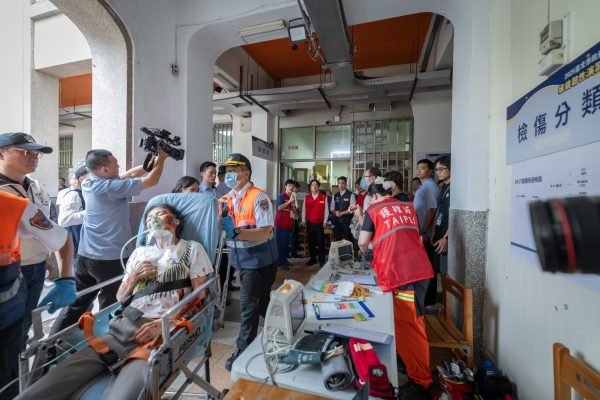
The establishment of the All-Out Defense Mobilization Agency, the introduction of “whole-of-society resilience” in official rhetoric, and civilian resources pointed at a military invasion illustrate how civil defense is prioritized within Taiwan’s defense strategy. Yet, Taiwan’s current civil defense capabilities remain insufficient due to fragmented preparedness initiatives, uneven civil-military coordination, and domestic political stagnation.
Today, protracted conflicts necessitate building resilient civil defense capabilities to withstand technologically superior adversaries. Ukraine’s sustained resistance to Russia’s invasion demonstrates that credible civil defense raises the cost of war for the aggressor and complicates an adversary’s expectation of quick and decisive victory. Learning from the Russia-Ukraine War and South Korea, Taiwan can apply their logic to its unique geography and threat profile to raise the cost of coercion and deny Beijing’s expectations of a swift conflict, kinetic or otherwise.
Status Quo Shortcomings
Civil society organizations currently drive much of the civil defense activity within Taiwan. Groups like Kuma Academy and Forward Alliance train citizens in evacuation planning, open-source intelligence techniques to counter disinformation campaigns, and first aid. The aim is to prepare civilians to respond to kinetic conflict, with courses on causality care and supply reserves, while also increasing public awareness of provocative actions under the threshold of war – gray zone activity – against Taiwan. While still new, these groups have grown quickly: Forward Alliance’s waitlist grew past 1,000 people shortly after Russia’s invasion of Ukraine and both organizations saw sustained demand amid consistent Chinese military exercise near the island, indicating growing support within Taiwan’s own populace to advance such initiatives.
However, these efforts operate largely apart from government funding and integration. A major source of funding for Kuma Academy, for example, has been private philanthropy, with over US$31 million donated by businessman Robert Tsao in 2022. Taipei has pledged a “whole-of-society” defense approach, a framework that seeks to integrate government and civil-society capacity across five areas: civilian training, strategic material stockpiling, critical infrastructure, social welfare and evacuation readiness, and communications network security. Taiwan’s leaders are concerned about China’s ability to disrupt the island’s internal and external communications systems and internet connectivity, emphasizing the importance of a strong, preemptive civil-military coordination.
Taiwan already maintains a comprehensive legal framework for civilian defense in the Civil Defense Act, enacted in 2001 and last amended in 2021; the issue lies in implementation. Under Article 2, the law establishes a nationwide civil defense structure, ranging from municipal to village-level units, with special corps for critical infrastructure and mandating training in evacuation, disaster rescue, and support of military tasks. However, legislative review indicates only between 2 and 13 percent of local civil defense budgets are earmarked for tactical training. Taiwan also has an extensive shelter network; yet a lack of accessibility, maintenance, and emergency provisions bring into question their wartime utility.
Civil defense reform is also stalled by domestic partisan division. The ruling Democratic Progressive Party (DPP) has moved to formalize resilience efforts, but the opposition Kuomintang (KMT) has protested these efforts as “militarization” of daily life, stalling progress.
Lessons From South Korea
South Korea, which resumed its annual large-scale civil defense drills in 2023 after a six-year hiatus, illustrates how civil defense can be institutionalized for civilian populations. The country uses an all-hazards resilience framing based on the Framework Act on the Management of Disasters and Safety; it does not explicitly set preparedness in the context of wartime contingencies. Certain competencies, such as evacuation planning and critical infrastructure protocols, are readily transferable from disaster management to conflict scenarios.
South Korea also maintains a Civil Defense Corps, comprising men aged 20 to 40, who have completed their mandatory military service. Required hours of training scale down based on years of service. The Civil Defense Corps maintains the dual function structure: in wartime, reservists are trained to guide evacuations, conduct rescue operations, and respond to biological and chemical accidents; in peacetime, they assist in disaster response that entail similar protocols. This model provides consistent exposure to citizens that institutionalizes civil defense in a low-stakes environment while normalizing procedures in public consciousness.
Taiwan can also learn from civil defense challenges in South Korea. For one, Seoul only announced plans for its first CBRN-resistant bunkers in 2025, targeting 2028 completion. That means current shelter infrastructure does not match the adversary’s offensive capabilities. Also, the South Korean populace regularly neglects civil defense drills because many lack the perception of an imminent threat, namely from North Korea. That gap both hampers societal preparedness and creates dissonance between civilians and government leadership.
To counter public indifference to civil defense, South Korea has raised the perceived stakes and lowered the friction of engagement. The Ulchi Freedom Shield exercise in 2022, with cooperation from the United States, unfolded alongside the Ulchi government-level disaster preparedness drills. The combination grounded civilian training in a visibly serious military drill, a contrast to the public announcements to take shelter and clear the roads that characterize standard civil defense practices. The Korean Public Alert System, further, provides an easy access point for emergency updates and is pre-installed to commercial smartphones.
Notably, South Korea has fundamental differences from Taiwan that re-emphasize the importance of credible civil defense. Having a physical border with its primary adversary and the Korean War stalemate necessitated and initially embedded robust civil defense infrastructure into society. Unlike Taiwan, South Korea enjoys a mandated military defense commitment from the United States. Without parallel safeguards, Taiwan’s island geography necessitates contingency plans for its vulnerable communications with an exceptional shelter network and strategic reserves for potential blockades.
Options for a Resilient Taiwan
Learning from South Korea, Taiwan has an actionable path toward upgrading its civil defense to match the Civil Defense Act mandate.
Taiwan can curate its annually published handbook with emphasis on dual-use framing between natural disasters and military operations, partially alleviating the risk of partisan accusations. Anticipated typhoons and potential Chinese aggression both necessitate backup power, mobile generators, and redundant communication systems. Further focus on general disaster preparedness and the transferable competencies creates a civilian resource that has high utility given Taiwan’s high vulnerability to natural disasters while being more difficult to scrutinize for politically hedging rhetoric.
Taiwan’s civil preparedness could also benefit from increased transparency on civil defense fund spending. A minimum percent expenditure on civilian training, for instance, could ensure that civil defense budgets are not squandered on social events. Furthermore, while faithful execution depends on local governments, a clearer, apolitical natural disaster framework that subtly prioritizes overlapping skillsets could assuage an expected political dissent.
Most potent is the potential for institutionalized coordination between the All-Out Defense Mobilization Agency and established civil society organizations. Taiwan could extend training capacity, plus giving these groups defined roles within the “whole-of-society resilience” framework could bolster disaster preparedness without leaving them to operate in parallel. Extending the disaster curriculums of organizations like Kuma Academy alongside a rapid communication network like South Korea’s public alert system could further broaden the reach beyond dedicated volunteers.
Public opinion polling revealed that 65.6 percent of respondents believe civil-military interactions during disaster relief improves their impression of the military while 64 percent called natural disaster a serious national threat, a slight increase from the 55 percent who directly cite China. Taken together, these findings indicate that an approach that emphasizes the natural disaster elements to civil defense is unlikely to be read as overtly militaristic while ensuring the island is prepared and resilient for any challenges it may face.
