

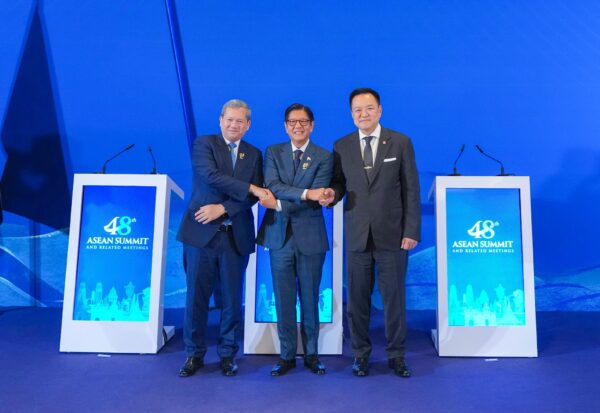
Thailand and Cambodia have agreed to pursue a range of trust-building measures to strengthen a fragile ceasefire along their shared border, following talks in the Philippines yesterday.
The meeting between Thai Prime Minister Anutin Charnvirakul and Cambodian Prime Minister Hun Manet took place on the sidelines of the 48th ASEAN Summit in Cebu. It was also attended by Philippine President Ferdinand Marcos Jr., whose government organized the meeting as chair of the Association of Southeast Asian Nations (ASEAN).
The meeting did not result in any major breakthrough – none was probably expected given the current poor state of relations between Bangkok and Phnom Penh – but the two sides agreed to resume discussions on issues related to the border.
Speaking at a press conference after the meeting, Anutin said that he and Manet had agreed to task their foreign ministers with further discussions to advance “practical confidence-building measures, starting with measures where we have common ground.”
“These measures would be key to restoring trust and gradually rebuilding our bilateral relationship,” he said, as per Nikkei Asia. “Thailand and Cambodia must move forward together, step by step, in the same direction.”
Relations between the two nations remain at a nadir following outbreaks of armed conflict in July and December of last year, which involved Thai air strikes and heavy exchanges of artillery and rockets across their disputed land border. Despite the two sides agreeing to another ceasefire in late December, soldiers remain deployed along long stretches of the frontier, and the situation in any areas remains tense.
At yesterday’s press conference, Marcos said that the two foreign ministers had agreed to exercise restraint and engage constructively. “This was possible because of a very clear, fervent belief by both leaders that it is time for peace and no longer a time for war,” he said. He also confirmed that the ASEAN Observer Team (AOT) would continue to monitor the ceasefire between Cambodia and Thailand at the border, with its mandate extended for another three months until July.
The talks come two days after Thailand cancelled a 2001 MoU with Cambodia over joint offshore energy exploration in the Gulf of Thailand. The MoU set up a framework for discussions on joint oil and gas exploration in areas where the two countries’ maritime claims overlap, as well as for the demarcation of maritime boundaries.
Anutin denied the cancellation had anything to do with the border conflict, although the clamor for its cancellation has grown particularly loud as the dispute has intensified over the past year. Cambodia expressed disappointment at the cancellation, and said that it would seek formal resolution of the overlapping claims under the United Nations Convention on the Law of the Sea (UNCLOS).
Whether or not yesterday’s meeting between Anutin and Hun Manet will lead to a breakthrough remains unclear. The two sides agreed to a ceasefire last July that ended the first outbreak of armed conflict. But neither this nor the high-profile peace accord signed in the presence of U.S. President Donald Trump and Malaysian Prime Minister Anwar Ibrahim on the sidelines of the last ASEAN Summit in October was able to prevent a return to fighting in December.
That said, any decision to resume talks is good news. The two prime ministers have not met since the ceasefire in Malaysia, while the bilateral Joint Border Commission (JBC) that was set up under a separate MoU in 2000 has not met since October. Meanwhile, the border between the two countries remains mostly closed, significantly dampening trade.
The conditions on the Thai side may now be more propitious for peace talks than in December. Anutin was decisively re-elected in February after both encouraging and harnessing the surge of nationalistic sentiment that accompanied the conflict. He is therefore in a stronger political position, should he so wish, to resist the nationalistic political lobbies that have prevented past Thai governments from making compromises on the border issue. The Thai army’s seizure of small, symbolically significant pockets of territory along the border during the fighting in December has also mollified these lobbies to some extent.
Whether the same is true of Cambodia remains unclear. The economic impacts of the conflict are now beginning to bite in Phnom Penh, and it is likely that the Cambodian government does not wish to see another outbreak of conflict. At the same time, Thailand’s occupation of territory along the border, an issue that has been raised repeatedly by the Cambodian government in recent months, could remain a permanent point of contention if not resolved in some way.
At yesterday’s press conference, Manet reiterated Cambodia’s position that” the border cannot be changed, nor determined by force or through fait accompli. He also called for the immediate implementation of the joint statement issued alongside the December ceasefire, particularly the resumption of survey and demarcation work under the JBC.
“Cambodia believes this is a peaceful path towards a fair solution for both parties,” he said.
